

The United Nations Office at Geneva
Multimedia Newsroom
Over the past 11 months, 30 United Nations inter-agency convoys have delivered crucial aid supply to the most vulnerable people in acute need across Ukraine. While several trucks reached areas close to the frontlines, the lack of safe access to Russian-held zones in Ukraine has prevented aid deliveries to the population there.
“A six-truck convoy reached the Donetsk region with water, medicine, emergency shelter material and other supplies to the town of Toretsk which is approximately 10 kilometres from the front line there”, said Jens Laerke, spokesperson for the UN Office for the Coordination of Humanitarian Affairs (OCHA). “The convoy also delivered trauma and emergency surgery supplies”, said Mr. Laerke while referring to the delivery on 31 January.
Approximately 15,0000 people out of the 75,000 residents who lived there before the war are still in that town and nearby communities.
The planning of the convoys, so OCHA, is a constant process, which is conditioned by the security on the ground which may allow or not a humanitarian aid delivery. Via a notification system the parties to the conflict are informed where the convoy intends to go and what material will be transported so that the fighting parties will adhere to their obligation under International Humanitarian Law so that humanitarian assisstance can reach those in need.
So far, the lack of safe access to Russian-held zones in Ukraine has prevented aid deliveries in these areas.
“A number of notifications, as I have mentioned before, has gone out to reach areas under the current control of the military of the Russian Federation”, said Mr. Laerke. “Up until today, none has been provided in the sense that we have not been given the adequate assurances of security to go to these areas”.
On 2 February (yesterday), five inter-agency trucks delivered medications, materials for emergency shelter repairs, tool kits and hygiene items to the Zaporizhzhia region in the south-east of the country. The tools for emergency repairs are urgently needed for the damaged homes to survive the harsh winter.
“Yesterday’s supplies are intended for people in the Huliaipole community, where around 3,000 people remain close to the front line”, OCHA’s spokesperson said. “They are exposed to regular shelling, and their access to basic services is disrupted. Since March last year, the residents here have had no electricity as the facilities were damaged by fighting and they cannot be repaired because the fighting continues”.
Mr. Laerke added that “yesterday, the convoy delivered medicines, including a pneumonia kit and hygiene items and that is particularly to support the most vulnerable people and that, when we speak about vulnerable people here, it is the elderly people with limited mobility and families with children”.
The supplies are provided by the International Organization for Migration (IOM), UNICEF, the UN Refugee Agency (UNHCR) and the World Health Organization (WHO). Representatives from local communities and volunteers help distributing directly to the people in need.
-ends-
- Wide shot, UN Geneva flag alley.
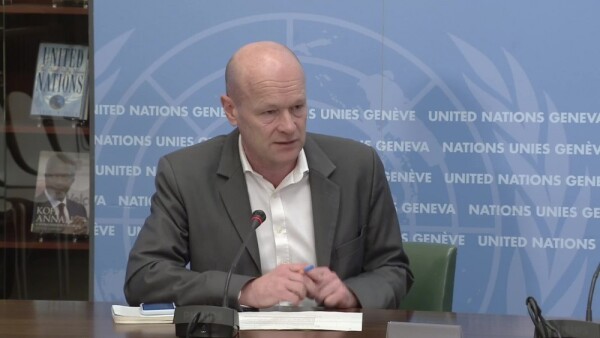
- Wide shot, press room with spokespersons and journalists in the room.
- SOUNDBITE (ENGLISH) – Jens Laerke, Spokesperson for OCHA: “A six-truck convoy reached the Donetsk region with water, medicine, emergency shelter material and other supplies to the town of Toretsk which is approximately 10 kilometres from the front line there. The convoy also delivered trauma and emergency surgery supplies”.
- Medium shot, spokespersons on the podium and screens on the sides
- SOUNDBITE (ENGLISH) - Jens Laerke, Spokesperson for OCHA: “Yesterday’s supplies are intended for people in the Huliaipole community, where around 3,000 people remain close to the front line. They are exposed to regular shelling, and their access to basic services is disrupted. Since March last year, the residents here have had no electricity as the facilities were damaged by fighting and they cannot be repaired because the fighting continues”.
- Close up, Jens Laerke on laptop screen
- SOUNDBITE (ENGLISH) - Jens Laerke, Spokesperson for OCHA: “A number of notifications as I have mentioned before, has gone out to reach areas under the current control of the military of the Russian Federation. Up until today, none has been provided in the sense that we have not been given the adequate assurances of security to go to these areas”.
- Wide shot, press briefing room
- SOUNDBITE (ENGLISH) - Jens Laerke, Spokesperson for OCHA: “Also yesterday the convoy delivered medicines, including a pneumonia kit and hygiene items and that is particularly to support the most vulnerable people and that, when we speak about vulnerable people here, it is the elderly people with limited mobility and families with children”.
- Wide shot, camera tripods with spokespersons in background
- Medium shot, journalists getting filmed by camerawoman
- Close-up, journalist
- Medium shot, camera people behind cameras
Similar Stories

1
1
1
Edited News | UNICEF , WHO , UNHCR
Yemen war continues to force families from homes amid hunger and disease
More than 250,000 people have now fled renewed fighting in Yemen, the UN said on Tuesday, citing particular concern for those sheltering in the southwestern city of Taiz and the wider governorate, where access is “essentially blocked”.

1
1
1
Edited News | UNICEF
A little over one year since a ceasefire agreement was announced between Hamas fighters and Israel, more than 340 children have been reported killed and hundreds more injured, the UN Children’s Fund, UNICEF, said on Friday.

1
1
1
Edited News | UNICEF , IFRC
Six weeks after Nepal’s deadly flooding disaster, communities are still struggling to rebuild their lives, but they will need sustained help as global warming increases the risk of another Himalayan catastrophe, the UN Children’s Fund (UNICEF) said on Friday.

1
1
1
Edited News | WHO
In suspected Russia plague death, testing and monitoring underway – WHO
The death of a lab worker in Russia’s Siberia region has sparked concerns about plague being the cause, the UN World Health Organization (WHO) said on Tuesday, adding that it was following the situation closely.

1
1
Edited News | OHCHR , UNOG
UN Human Rights Chief Volker Türk on Friday provided and oral update to the 63rd session of the Human rights Council on Ukraine.

1
1
1
Edited News | OHCHR , UNOG
UN Human Rights Chief Volker Türk on Friday provided and oral update to the 63rd session of the Human rights Council on the human rights situation in Haiti.

1
1
1
Edited News | WHO
Repeated delays in bringing lifesaving medicines, prosthetics and more from Israel into Gaza risk having devastating consequences on Palestinians who urgently need them in the wartorn enclave, the UN World Health Organization (WHO) said on Friday. “A truck full of non-priority supplies or the right supplies arriving too late, doesn't save lives. That's the question that actually matters," said Dr Reinhilde Van De Weerdt, WHO Representative in the OPT.

1
1
1
Edited News | WHO
DRC: Early access to care and oxygen decisive for Ebola patients’ survival – WHO
In the Democratic Republic of the Congo (DRC), health workers fighting the country’s largest-ever Ebola outbreak are struggling to overcome critical challenges to patient care, the UN World Health Organization (WHO) warned on Tuesday.

1
1
1
Edited News | OCHA , UN
Civilians in Iran are continuing to feel the consequences of months of conflict and military escalation, the UN’s top official in the country has said, as loss of life, damage to civilian infrastructure and mounting economic pressures leave many facing continued uncertainty.
1
1
1
Edited News | WHO , UNICEF
Aid agencies in Yemen highlighted the growing hunger emergency sparked by renewed fighting between Houthi opposition forces and Government troops, after mobile health clinics reported that hundreds of children displaced by the violence are suffering from the most deadly form of malnutrition.
1
1
1
Edited News | UNHCR
Displacement on the rise in Yemen as fighting continues - UNHCR
As hostilities worsen in Yemen, more people have been fleeing their homes, further intensifying the humanitarian crisis within the region, the UN Refugee Agency (UNHCR) warned on Tuesday.
1
1
1
Edited News | IOM , OHCHR , UNFPA , UNOG , UNHCR , WHO
Yemen’s humanitarian crisis growing by the hour amid spike in displacement
Yemenis displaced by renewed fighting have described fleeing for their lives amid shelling and gunfire, aid agencies reported on Friday, while highlighting the dramatic increase in humanitarian needs in the country and in Djibouti, where thousands have sought shelter.