

The United Nations Office at Geneva
Multimedia Newsroom
Aid relief reaches Ukraine towns and cities reclaimed from Russian control
Urgently needed aid relief has reached areas of north-east Ukraine recently reclaimed from Russian control amid ongoing fighting, UN humanitarians said on Friday.
More than 73,000 people in Kharkiv oblast have now received food assistance, which is nearly half of the population in the retaken areas.
Villages and settlements across the oblast that are back under Ukrainian government control are unable to meet even their most basic needs, according to the UN Office for the Coordination of Humanitarian Affairs (OCHA).
“Our access to these areas follows several months of intense fighting,” said OCHA spokesperson Jens Laerke. “Nearly 140,000 people are believed to remain in the towns, villages and settlement in areas where control has changed, but they have extremely limited access to food, water, gas, electricity and medical services.”
Izium latest
In the town of Izium, the eight to 9,000 people still there are “completely dependent” on humanitarian aid to survive, Mr. Laerke continued.
Markets and shops have been destroyed or are closed, and families “gather in the main town square” to exchange possessions and supplies, to meet their basic needs, the OCHA spokesperson explained.
‘Frequent’ fighting in Kupiansk
Further north and at the edge of Luhansk oblast, the town of Kupiansk is today home to 4,000 people, compared with the pre-war population of 28,000.
“Hostilities and fighting are still frequent there,” OCHA reported, adding that aid convoys have delivered food, water, essential household items, medicines and health services to Izium and Kupiansk, where volunteer groups have responded, too.
In addition to food assistance, OCHA has coordinated the distribution of 12,000 hygiene kits and kitchen sets, solar lamps and blankets to 15,000 people.
ends
STORY: North-Eastern Ukraine Humanitarian Update - OCHA
TRT: 1 mins 34s
SOURCE: UNTV CH
RESTRICTIONS: NONE
LANGUAGE: ENGLISH/NATS
ASPECT RATIO: 16:9
DATELINE: 7 October 2022 GENEVA, SWITZERLAND
SHOTLIST
- Medium shot, UN Geneva flag alley.
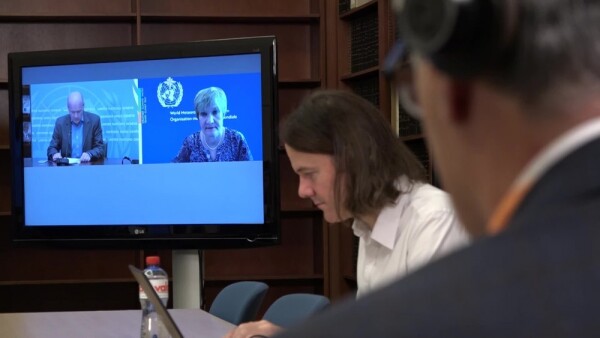
- Wide shot, press room with panel of speakers, cameraman lines up shot in foreground.
- SOUNDBITE (ENGLISH) OCHA, Deputy Spokesperson, Jens Laerke: “More than 73,000 people, and that's nearly half of the population in the retaken areas in Kharkivska oblast have received food assistance. We've also distributed 12,000 hygiene kits and kitchen sets, solar lamps and blankets to 15,000 people.”
- Medium shot, journalist looking at laptop, another participant to rear.
- SOUNDBITE (ENGLISH) OCHA, Deputy Spokesperson, Jens Laerke: “Our access to these areas that we have now follows several months of intense fighting. Nearly 140,000 people are believed to remain in the towns, villages and settlements in areas where control has changed, but they have extremely limited access to food, water, gas, electricity and medical services.”
- Close-up, hands of journalist typing.
- SOUNDBITE (ENGLISH) OCHA, Deputy Spokesperson, Jens Laerke: “In Izium, some 8,000 to 9,000 people remain there in that town, that’s down from its original population of around 46,000 people. And those remaining are completely dependent on humanitarian aid to survive.”
- Medium shot, participants and TV screen showing speakers.
- SOUNDBITE (ENGLISH) OCHA, Deputy Spokesperson, Jens Laerke: “Markets and shops in Izium have been destroyed or are closed. Families gather in the main town square to exchange their possessions and supplies to meet their basic needs.”
- Medium shot, journalists taking notes.
- Close up shot, hands typing on laptop keyboard.
- Medium shot, journalist taking notes in foreground, participant to rear.
Similar Stories

2
17
1
2
Edited News , Press Conferences | OCHA , WMO
Two UN agencies teamed up on Wednesday to issue an appeal for immediate assistance to help communities already being impacted by the strongest El Niño on record.

3
16
2
2
B-roll , Conferences , Edited News | UNITED NATIONS , UNOG
Sixth Consultative Meeting on Enhancing Coordination of Peace Initiatives and Efforts for Sudan

1
1
1
Edited News | UNICEF , WHO , UNHCR
Yemen war continues to force families from homes amid hunger and disease
More than 250,000 people have now fled renewed fighting in Yemen, the UN said on Tuesday, citing particular concern for those sheltering in the southwestern city of Taiz and the wider governorate, where access is “essentially blocked”.

1
1
1
Edited News | UNICEF
A little over one year since a ceasefire agreement was announced between Hamas fighters and Israel, more than 340 children have been reported killed and hundreds more injured, the UN Children’s Fund, UNICEF, said on Friday.

1
1
1
Edited News | UNICEF , IFRC
Six weeks after Nepal’s deadly flooding disaster, communities are still struggling to rebuild their lives, but they will need sustained help as global warming increases the risk of another Himalayan catastrophe, the UN Children’s Fund (UNICEF) said on Friday.

1
1
1
Edited News | WHO
In suspected Russia plague death, testing and monitoring underway – WHO
The death of a lab worker in Russia’s Siberia region has sparked concerns about plague being the cause, the UN World Health Organization (WHO) said on Tuesday, adding that it was following the situation closely.

1
1
Edited News | OHCHR , UNOG
UN Human Rights Chief Volker Türk on Friday provided and oral update to the 63rd session of the Human rights Council on Ukraine.

1
1
1
Edited News | OHCHR , UNOG
UN Human Rights Chief Volker Türk on Friday provided and oral update to the 63rd session of the Human rights Council on the human rights situation in Haiti.

1
1
1
Edited News | WHO
Repeated delays in bringing lifesaving medicines, prosthetics and more from Israel into Gaza risk having devastating consequences on Palestinians who urgently need them in the wartorn enclave, the UN World Health Organization (WHO) said on Friday. “A truck full of non-priority supplies or the right supplies arriving too late, doesn't save lives. That's the question that actually matters," said Dr Reinhilde Van De Weerdt, WHO Representative in the OPT.

1
1
1
Edited News | WHO
DRC: Early access to care and oxygen decisive for Ebola patients’ survival – WHO
In the Democratic Republic of the Congo (DRC), health workers fighting the country’s largest-ever Ebola outbreak are struggling to overcome critical challenges to patient care, the UN World Health Organization (WHO) warned on Tuesday.

1
1
1
Edited News | OCHA , UN
Civilians in Iran are continuing to feel the consequences of months of conflict and military escalation, the UN’s top official in the country has said, as loss of life, damage to civilian infrastructure and mounting economic pressures leave many facing continued uncertainty.
1
1
1
Edited News | WHO , UNICEF
Aid agencies in Yemen highlighted the growing hunger emergency sparked by renewed fighting between Houthi opposition forces and Government troops, after mobile health clinics reported that hundreds of children displaced by the violence are suffering from the most deadly form of malnutrition.