

The United Nations Office at Geneva
Multimedia Newsroom
STORYLINE
UN agency warns of policy-induced global recession worse than 2007 financial crisis
The UN Conference on Trade and Development (UNCTAD) on Monday urged advanced economies to change course in their monetary and fiscal policies to avert a global recession worse than the global financial crisis of 2007 to 2009.
Excessive monetary tightening and inadequate financial support threatens to leave developing countries exposed to cascading crises of debt, health, and climate, UNCTAD warned in its annual report on trade and development.
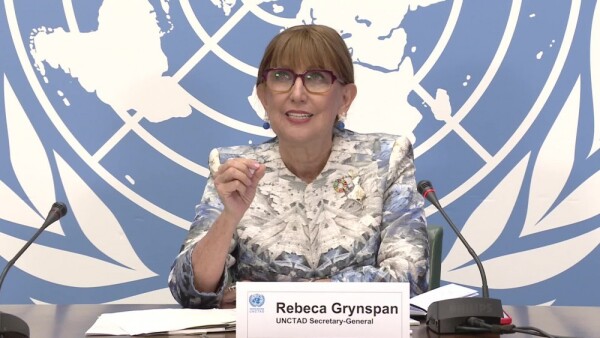
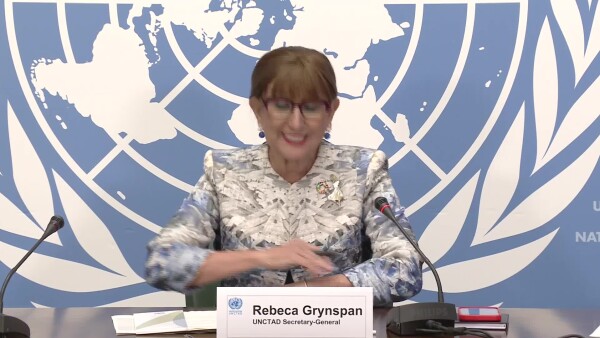
“We are in a world of cascading and interconnected crises: climate change, COVID-19 and the war in Ukraine,” said Rebeca Grynspan, UNCTAD Secretary-General at a press conference in Geneva. “As the Secretary-General of the UN said, we are in a perfect storm. It is a difficult moment, no doubt, for all of us, but also for policymakers, because choices matter.”
Relying on higher interest rates to bring down prices without generating a recession is an imprudent gamble, the UNCTAD report warned. Central banks’ decisions to increase rates impact emerging economies with high levels of private and public debt, it also noted. Fiscal tightening in developed economies, combined with the COVID-19 pandemic and the war in Ukraine have already turned a global slowdown into a downturn.
“The synchronized slowdown is hitting all regions but is ringing alarm bells for developing countries. Our calculations show that the average growth rate in developing countries will drop below three per cent, as it did in the last decade of the 1980s,” she said.
Alarming levels of debt distress and under-investment
In addition, “some 90 developing countries have seen their currencies weaken against the dollar this year. And over a third of them have seen that by more than a ten per cent devaluation.”
UNCTAD expects the world economy to grow 2.5 per cent in 2022, and to decelerate further to 2.2 per cent in 2023. That will leave real GDP still below its pre-pandemic trend and generate a cumulative shortfall of more than $17 trillion, close to 20 per cent of the world’s income. This is insufficient for sustainable development, UNCTAD insisted, further squeezing public and private finances and damaging employment prospects.
Sustainable recommendations
UNCTAD urged a course correction in favour of policy measures that directly target price spikes in energy, food, and other vital sectors.
“We need to prioritize progress on a multilateral legal framework for handling debt restructuring, including all official and private creditors. And we also recommend a program of reforms in developing economies to boost productive investment and constrain capital moving to exploit tax loopholes,” added Ms. Grynspan.
Echoing that message, Richard Kozul-Wright, head of the team in charge of the report insisted that the global economy “is not yet in a recession. It's heading towards one and there are downside risks that could push it into one, depending on how policymakers, particularly in the advanced economies, respond to the current situation. So, I think it’s really (worth) watching what policymakers are going to do over the course of the next four to six months.”
UNCTAD provides economic and trade analysis, facilitates consensus-building and offers technical assistance to help developing countries use trade, investment, finance and technology for inclusive and sustainable development.
ends
TRT: 2’36”
SOURCE: UNTV CH
LANGUAGE: ENGLISH / NATS
ASPECT RATIO: 16:9
DATELINE: 03 Oct. 2022
HYBRID PRESS BRIEFING
GENEVA, SWITZERLAND
SHOTLIST
- Medium shot, UN Geneva flag alley.
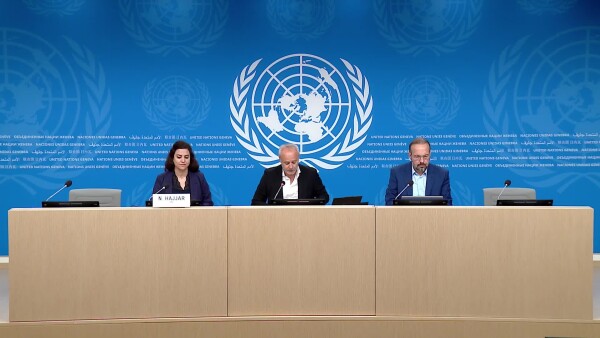
- Wide shot, press room with panel of speakers.
- SOUNDBITE (ENGLISH) UNCTAD Secretary-General, Rebeca Grynspan: “We are in a world of cascading and interconnected crises: climate change, COVID-19 and the war in Ukraine. As the Secretary-General of the UN has said, we are in a perfect storm. It is a difficult moment, no doubt, for all of us, but also for policymakers, because choices matter.”
- Medium shot, cameras, and journalist.
- SOUNDBITE (ENGLISH) UNCTAD Secretary-General, Rebeca Grynspan: “The synchronized slowdown is hitting all regions but is ringing alarm bells for developing countries. Our calculations show that the average growth rate in developing countries will drop below three per cent, as it did in the last decade of the 1980s.”
- Close up shot, camera screen showing speakers.
- SOUNDBITE (ENGLISH) UNCTAD Secretary-General, Rebeca Grynspan: “Some 90 developing countries have seen their currencies weaken against the dollar this year; 90 developing countries. And over a third of them have seen that by more than a ten per cent devaluation.”
- Medium shot, journalists taking notes.
- SOUNDBITE (ENGLISH) UNCTAD Secretary-General, Rebeca Grynspan: “We need to prioritize progress on a multilateral legal framework for handling debt restructuring, including all official and private creditors, and we also recommend a program of reforms in developing economies to boost productive investment and constrain capital moving to exploit tax loopholes.”
- Medium shot, journalists taking notes.
- SOUNDBITE (ENGLISH) Director, Division on Globalization and Development Strategies, UNCTAD, Richard Kozul-Wright: “The global economy is not yet in a recession. It's heading towards one and there are downside risks that could push it into one, depending on how policymakers, particularly in the advanced economies, respond to the current situation. So, I think it’s really (worth) watching what policymakers are going to do over the course of the next four to six months.”
- Medium shot, speaker speaking.
- Medium shot, staff monitoring.
- Close-up shot, hands of journalist typing.
Similar Stories
1
1
1
Edited News | OCHA , UNICEF , WFP
Aid agencies warned on Friday of the fast-developing humanitarian emergency inside Taiz City in Yemen, which has been encircled by de facto Houthi forces fighting government troops along the country’s west coast.
1
1
1
Press Conferences | UN WOMEN , WFP , WHO
UN WOMEN: Sudan Women and girls one year after the fall of El Fasher; increasing drone attacks across the country; WFP: DRC - Ebola spreads to eighth DRC province as WFP delivers food, builds treatment centres and keeps supplies moving; WHO - Update on Ebola (Bundibugyo Virus Disease)
1
12
1
1
Press Conferences , Images | UNOG
Closing Press Conference following the Sixth Consultative Meeting on Enhancing Coordination of Peace Initiatives and Efforts in Sudan

2
17
1
2
Edited News , Press Conferences , Images | OCHA , WMO
Two UN agencies teamed up on Wednesday to issue an appeal for immediate assistance to help communities already being impacted by the strongest El Niño on record.
3
16
2
2
Edited News , B-roll , Conferences , Images | UNITED NATIONS , UNOG
Sixth Consultative Meeting on Enhancing Coordination of Peace Initiatives and Efforts for Sudan
1
1
1
Press Conferences | CITES
Wildlife trade and conservation policy discussions at the 81st meeting of the CITES Standing Committee (SC81)

1
1
1
Edited News | UNICEF , WHO , UNHCR
Yemen war continues to force families from homes amid hunger and disease
More than 250,000 people have now fled renewed fighting in Yemen, the UN said on Tuesday, citing particular concern for those sheltering in the southwestern city of Taiz and the wider governorate, where access is “essentially blocked”.
1
1
1
Press Conferences | UNHCR , UNCTAD , WMO , OCHA , UNICEF , WHO
UNHCR Hungary’s 1956 Refugee Crisis: 70 Years On, UNCTAD World Investment Forum 2026, Doha, WMO Greenhouse Gas Bulletin and Climate Update for COP31, OCHA Afghanistan: Malnutrition, Girls’ Education and Recovery, UNICEF Yemen: Child Malnutrition and Unsafe Water in Taiz, WHO Inequalities in Noncommunicable Diseases and Risk Factors
1
1
1
Press Conferences | UNHCR
End of UNHCR's 77th Annual Executive Committee (ExCom) meeting week

1
1
1
Edited News | UNICEF
A little over one year since a ceasefire agreement was announced between Hamas fighters and Israel, more than 340 children have been reported killed and hundreds more injured, the UN Children’s Fund, UNICEF, said on Friday.
1
1
1
Press Conferences | UNICEF , IOM , UNHCR
UN Special Assistant to the Personal Envoy Office (SUDAN): Peace Initiatives and Efforts in Sudan; UNICEF: Dire situation of children in Gaza; IOM: Damaged Homes and Energy Attacks Risk Displacing Ukrainians for this winter; UNHCR: update on EXCOM week

1
1
1
Press Conferences | IOM , UNDRR
UN stresses importance of household preparedness for disaster risk reduction.