

The United Nations Office at Geneva
Multimedia Newsroom
Press Conferences | UNESCO , UN WOMEN , OHCHR , WFP
UN Geneva Press Briefing - 25 November 2025
UN INFORMATION SERVICE GENEVA PRESS BRIEFING
25 November
Situation of women and girls in Gaza
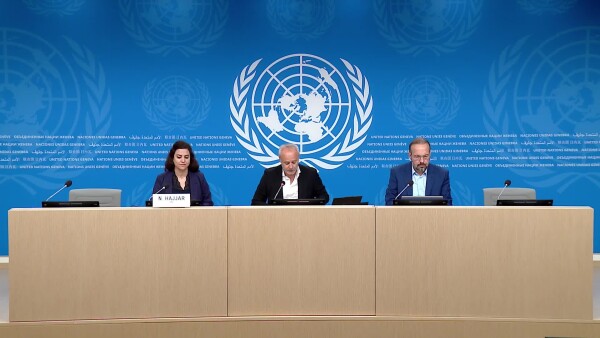
Sofia Calltorp, Head of UN Women in Geneva, who had just returned from Gaza, and had travelled the entire length of the Strip, shared that seeing images of Gaza on the screens did not compare by far to witnessing the scale of the destruction in real life. Ms. Calltorp had met with women across the Gaza Strip, seeing first-hand the immense pain they were experiencing. They were facing hunger and fear, trying to shield their children from hunger and cold. Living in ceasefire did not mean living in peace. The killings, while fewer, continued. Every woman Ms. Calltorp had met had lost at least two family members. Women had been displaced countless times, every time packing the little they had, moving their small children and elderly parents.
Food was still scarce and more expensive than before. The endless bombing had left behind another crisis, of over 12,000 women and girls living with long-term war-related disabilities which they had not had two years before. The women said the same thing all over: they needed the ceasefire to hold, they needed food, medicine, winterization, and psychosocial support. They wanted to see their children return to school. The women also had also spoken of their desire to work. Despite everything, these women’s commitment and will to rebuild their lives was strong. UN Women had been on the ground in Gaza for more than a decade, standing with them through every crisis. No woman or girl should fight this hard just to survive, stressed Ms. Calltorp. Peace was needed now, for every woman and girl, and for everyone. The world should not look away.
Responding to questions from the media, Ms. Calltorp stressed that access to food and water in Gaza was extremely scarce. Food now cost four times more than before the war; a single egg, for example, cost USD 2. During her visit to Gaza, Ms. Calltorp had not met with any officials, she said. Answering a question on pregnant women, Ms. Calltorp spoke of a woman who had lost two babies, one of whom had to be delivered in the middle of a street with the mother fleeing the bombs. Ms. Calltorp explained that her mission had focused on assessing the needs of women and girls on the ground. All those arbitrarily detained had to be freed, answered to a question Thameen Al-Kheetan, for the Office of the High Commissioner for Human Rights (OHCHR), explaining that access to those in detention was limited.
Israeli attacks against Lebanon
Thameen Al-Kheetan, for the Office of the High Commissioner for Human Rights (OHCHR), said that almost a year since the start of the ceasefire between Lebanon and Israel, increasing attacks by the Israeli military continued to result in the killing of civilians and destruction of civilian objects in Lebanon, coupled with alarming threats of a wider, intensified offensive.
The Israeli military’s attacks had resulted in the killing of at least 127 civilians in Lebanon since the ceasefire agreement had come into effect on 27 November 2024, until 24 November this year. In one of the latest, deadliest attacks, at least 13 civilians, including 11 children, had been killed and at least six civilians injured last week in an Israeli strike on the Ein El-Hilweh camp for Palestinian refugees, near Sidon. All the fatalities documented as a result of this strike had been civilians. There had to be prompt and impartial investigations into the Ein El-Hilweh strike, as well as all other incidents involving possible violations of international humanitarian law by all parties, both before and after the ceasefire. Those responsible had to be brought to justice.
Mr. Al-Kheetan said that, in addition to killing and injuring civilians, Israeli attacks in Lebanon had destroyed and damaged civilian infrastructure, including housing units, roads, factories and construction sites. They had also severely hampered reconstruction efforts and attempts by internally displaced people to go back to their homes in southern Lebanon. Over 64,000 people, mostly residents of southern Lebanon, remained displaced in other parts of the country. UN High Commissioner for Human Rights Volker Türk said it was now urgent that the parties show their commitment to comply with the ceasefire in good faith. A genuine path towards a permanent cessation of hostilities was the only way to protect the human rights of civilians on both sides from the devastating effects of new hostilities.
Answering questions, Mr. Al-Kheetan said that the focus of the OHCHR was on the civilians; 127 civilians were verified as having been killed by Israeli strikes since the ceasefire. OHCHR used a strict, established methodology, reminded Mr. Al-Kheetan, and this process took time. The State of Israel was responsible for the actions of its military, which should investigate any violations.
Full statement is available here.
Surge in mass abductions in Nigeria
Thameen Al-Kheetan, for the Office of the High Commissioner for Human Rights (OHCHR), said that OHCHR was shocked at the recent surge in mass abductions in north-central Nigeria, and urged the Nigerian authorities at all levels to take all lawful measures to ensure such vile attacks be halted and those responsible be held to account.
At least 402 people, most of them schoolchildren, had been abducted in the states of Niger, Kebbi, Kwara and Borno since 17 November. Only 88 of them had reportedly been freed or had escaped from their captors. OHCHR called on the Nigerian authorities to ensure the safe return of all those still in captivity to their families, and to prevent further abductions. They had to hold prompt, impartial, and effective investigations into abductions and bring those responsible to justice.
Chi Lael, for the World Food Programme (WFP), speaking from Abuja, said that Nigeria had released the latest Cadre Harmonise – the food security analysis for Nigeria, which showed a rapidly worsening situation across the country, particularly in northern Nigeria. Nearly 35 million people could face severe food insecurity in the next six months. That would be the highest number recorded in the country, and the highest on the continent. Throughout this year, insurgent attacks had intensified. Just the previous month, Nigeria had witnessed reportedly the first attack by JNIM, an al-Qaeda-affiliated group.
Northeast Nigeria, where WFP operated, was now facing its most severe hunger crisis in a decade. Rural farming communities were among the hardest hit. Nearly six million people were food insecure in the conflict zones of Borno, Adamawa and Yobe states. Women and children were once again at the greatest risk of severe malnutrition, but funding cuts had forced us to scale down nutrition programmes in July, affecting more than 300,000 children. Ms. Lael said that almost one million people depended on WFP to survive. Food and nutrition assistance remained one of the very few stabilising forces in northern Nigeria. Without it, there was a real concern that insurgent groups could exploit people’s hunger and desperation to strengthen their own influence, creating a security threat that extended far beyond Nigeria’s borders. Without confirmed funding, Ms. Lael warned, millions would be left without support in 2026. The consequences for stability, for security, and for human life would be severe.
Replying to questions, Ms. Lael, for WFP, explained that WFP required USD 115 million until May 2026, which would be the beginning of the lean season. In 2025, WFP had raised some USD 150 million and was concerned that already by January it would not be able to provide assistance to 900,000 people it was currently helping. Resources were required immediately to secure immediate support to people. Mr. Al-Kheetan, for OHCHR, confirmed reports of groups abducting people for ransom, but their identity could still not be confirmed. Ms. Lael, for WFP, said that the numbers of hungry and food-insecure people in the northeast were growing. If the region that was supposed to be growing food was not doing so, it affected the whole country.
Announcements
Alessandra Vellucci, for the United Nations Information Service, said that today, 25 November, was the International Day of Elimination of Violence against Women and Girls. In 2024, 50,000 women and girls had been killed by an intimate partner or a family member, which translated to 167 women killed every single day. Those were not isolated incidents. The theme of the 16 Days of Activism against Gender-Based Violence in 2025 was digital violence. Ms. Vellucci read the message of the Secretary-General on this Day. Today, at 12:30 pm in Hall XIV at the Palais des Nations, an event would be held to mark the Day and start the 16 Days of Activism, and an exhibition would be organized by UNIDIR in front of the Swiss Salon. UN Women would also participate in an event by civil society organizations at the Bain des Pâquis on Sunday 30 November at 5 pm., when lanterns will be put in the water to remember the victims of femicides.
Today, at 2 pm, ahead of the World AIDS Day, Winnie Byanyima, UNAIDS Executive Director, would hold a press conference on overcoming disruption and transforming the AIDS response.
On 1 December at 9:30 am, the United Nations Institute for Disarmament Research (UNIDIR) would hold a press conference to launch its Landmine Monitor 2025 report.
Ms. Vellucci also informed that on 27 November, from 10 to 12:30, the UNESCO Liaison Office would host the event “UNESCO | From Santiago to Geneva – Advancing Inclusive Sport and Physical Education” at the Restaurant Vieux Bois, which would bring together experts in the field of sport and physical education to explore strategies and best practices for fostering more inclusive and accessible sporting environments. Registration is needed: https://forms.gle/YstzzjkrQ7QqSNUo8.
The Committee against Torture was going to close its 83rd session on 28 November at 10am and issue its concluding observations on the reports of the four countries reviewed: Israel, Argentina, Bahrain, and Albania.
The Committee on the Elimination of Racial Discrimination was concluding this morning its review of the report of Burundi.
On 28 November, the UN Office at Geneva would host an observation of the International Day of Solidarity with the Palestinian People, to start at 3 pm. The meeting would be webcast.
Elizabeth Throssell, for the Office of the High Commissioner for Human Rights (OHCHR), who was retiring this month, thanked the press corps and UN colleagues for 12.5 years of cooperation. She expressed her appreciation for the media coverage of human rights issues over the years. On behalf of the Geneva communications community, Ms. Vellucci thanked her for her dedicated work over the years. Journalists also expressed their appreciation for Ms. Throssell.
***
Similar Stories
1
1
1
Press Conferences | UN WOMEN , WFP , WHO
UN WOMEN: Sudan Women and girls one year after the fall of El Fasher; increasing drone attacks across the country; WFP: DRC - Ebola spreads to eighth DRC province as WFP delivers food, builds treatment centres and keeps supplies moving; WHO - Update on Ebola (Bundibugyo Virus Disease)
1
12
1
1
Press Conferences , Images | UNOG
Closing Press Conference following the Sixth Consultative Meeting on Enhancing Coordination of Peace Initiatives and Efforts in Sudan

2
17
1
2
Edited News , Press Conferences , Images | OCHA , WMO
Two UN agencies teamed up on Wednesday to issue an appeal for immediate assistance to help communities already being impacted by the strongest El Niño on record.
1
1
1
Press Conferences | CITES
Wildlife trade and conservation policy discussions at the 81st meeting of the CITES Standing Committee (SC81)
1
1
1
Press Conferences | UNHCR , UNCTAD , WMO , OCHA , UNICEF , WHO
UNHCR Hungary’s 1956 Refugee Crisis: 70 Years On, UNCTAD World Investment Forum 2026, Doha, WMO Greenhouse Gas Bulletin and Climate Update for COP31, OCHA Afghanistan: Malnutrition, Girls’ Education and Recovery, UNICEF Yemen: Child Malnutrition and Unsafe Water in Taiz, WHO Inequalities in Noncommunicable Diseases and Risk Factors
1
1
1
Press Conferences | UNHCR
End of UNHCR's 77th Annual Executive Committee (ExCom) meeting week
1
1
1
Press Conferences | UNICEF , IOM , UNHCR
UN Special Assistant to the Personal Envoy Office (SUDAN): Peace Initiatives and Efforts in Sudan; UNICEF: Dire situation of children in Gaza; IOM: Damaged Homes and Energy Attacks Risk Displacing Ukrainians for this winter; UNHCR: update on EXCOM week

1
1
1
Press Conferences | IOM , UNDRR
UN stresses importance of household preparedness for disaster risk reduction.

1
1
1
Statements , Press Conferences | OHCHR

1
1
1
Press Conferences | UNHCR , UNICEF , IFRC , OHCHR , UN WOMEN , IOM , OCHA , WHO
UNHCR – ExCom Meeting, UNICEF – Nepal Recovery, IFRC – Flash Floods, WHO – Mental Health, IOM – South Sudan Floods, OCHA – DRC Humanitarian aid, UNHCR – Sahel Displacement, UNICEF – Yemen Update, IOM – Gaza Shelter, UN Women – Gaza Women, OHCHR – Arrests and detentions of Syrians by Israeli force

2
1
2
Press Conferences | UNCTAD
Presentation of the Trade and Developement Report 2026
Embargoed until 9 October 2026 at 11 a.m. (Geneva Time)
UNCTAD: UNCTAD’s flagship report finds that governments increasingly use industrial, trade, financial and technology policies to pursue economic and national security objectives. Market access and the ability to move into higher-value activities now depend more heavily on technology, finance and geopolitics.

1
1
1
Press Conferences | UPU
Release of the State of the Postal Sector Report 2026