

The United Nations Office at Geneva
Multimedia Newsroom
‘Mayhem’ in Idlib’s hospitals amid ongoing violence pushing displaced towards Turkish border
Rapidly escalating conflict in north-west Syria has created health care “mayhem” amid reports of displaced people moving closer to the Turkish border in search of shelter, the World Health Organization (WHO) reported on Friday.
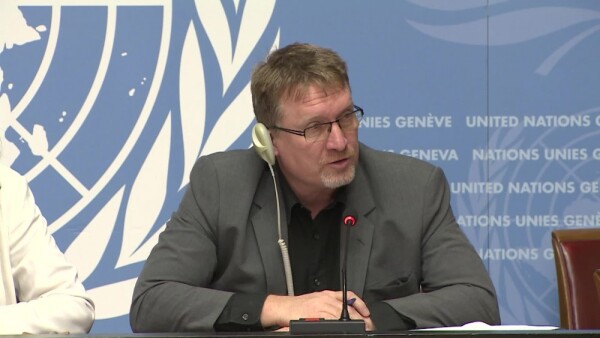
“Health workers the World Health Organization has been speaking to describe mayhem in their health facilities,” WHO spokesperson Christian Lindmeier said.
Speaking to journalists in Geneva, he said that nearly 170,000 “newly displaced people are sleeping out in the open” in Idlib - the last opposition-held area of Syria that is the target of a Government-led military campaign. This “has been exposing children to temperatures close to zero degrees. And that is a drama”.
Since 1 December, 11 healthcare facilities have been attacked, causing 10 deaths and 37 injuries, according to WHO.
The UN agency warned that the displacement crisis has created huge healthcare needs in some medical centres and hospitals but left other facilities deserted, amid a “sharp rise in trauma cases”.
“As of today, 84 health facilities have been forced to suspend operations since 1 December last year, out of those 84, 31 have been able to relocate and provide services where people have sought refuge from bombardments,” Mr Lindmeier said.
As part of a major and ongoing humanitarian cross-border initiative, WHO sent medical and surgical supplies from Turkey to northwest Syria on Tuesday and Wednesday.
“In a two-day operation, WHO has sent seven truckloads, or 55 tons of medicine and medical supplies, from Turkey into Idleb governorate and parts of Aleppo,” Mr Lindmeier explained.
Using the border crossings of Bab al Hawa and Bab al Sama, the UN agency transported equipment including 3,200 trauma and surgical treatments.
These are being distributed to WHO partners in more than 150 facilities - approximately half of functioning health facilities in the northwest.
Since 1 December, the Office for the Coordination for Humanitarian Affairs (OCHA) said on Friday that that nearly a million people have been displaced in the embattled region.
Conditions are “horrifying”, spokesperson Jens Laerke said.
“We now have 950,000 displacements going in absolutely horrifying conditions. People have nothing and they have no place to go. So you know, this is an increase upon an increase upon an increase, and it is really tragic to see what is going on.”
Amid reports that the Turkish authorities had begun allowing Syrian civilians to cross into Turkey after
dozens of Turkish soldiers were reportedly killed in an attack linked to Syrian Government forces, Mr Laerke said that OCHA had yet to receive confirmation of this.
“We have no official confirmation from or communication from the Turkish Government about any change as of now,” he said. “So, the cross-border operation does continue and I could add that in the first two months of this year, we have had more than 2,000 trucks crossing that border and that operation continues.”
- Wide shot: exterior, flag alley, Palais des Nations, United Nations Geneva.
- Medium shot: Press briefing room, journalists, podium with speakers and UN logo.
- SOUNDBITE (EN) — Christian Lindmeier, spokesperson, the World Health Organization (WHO):
- “As of today, 28 February, attacks on health in Syria since the mass displacement started on 1 December, are 11 in total, causing 10 deaths and 37 injuries.”
- Medium shot: journalists, one of who is typing on laptop then looking at podium speaker, profile.
- SOUNDBITE (EN) — Jens Laerke, spokesperson, UN Office for Coordination of Humanitarian Affairs (OCHA): “We now have 950,000 displacements going in absolutely horrifying conditions. People have nothing and they have no place to go. So you know, this is an increase upon an increase upon an increase, and it is really tragic to see what is going on.”
- Close-up: journalists’ faces, profile.
- SOUNDBITE (EN) — Christian Lindmeier, spokesperson, the World Health Organization (WHO):
- “Nearly 170,000 newly displaced people are sleeping out in the open, as you rightly said, which has been exposing children to temperatures close to zero degrees. And that is a drama.”
- Close-up: journalist holding mobile phone, podium speakers in background, UN logo.
- SOUNDBITE (EN) — Christian Lindmeier, spokesperson, the (WHO):
- “In a two-day operation, WHO has sent seven truckloads, or 55 tons of medicine and medical supplies, from Turkey into Idleb governorate and parts of Aleppo.”
- Close-up: hands typing on laptop.
- SOUNDBITE (EN) — Christian Lindmeier, spokesperson, the World Health Organization (WHO): “Health workers the World Health Organization has been speaking to describe mayhem in their health facilities.”
- Medium shot: journalist looking at laptop, onlooker in background.
- SOUNDBITE (EN) — Christian Lindmeier, spokesperson, the World Health Organization (WHO): “As of today, 84 health facilities have been forced to suspend operations since 1 December last year, out of those 84, 31 have been able to relocate and provide services where people have sought refuge from bombardments.”
- Close-up: journalists, head shots, semi-profile.
- Close-up: hands typing on laptops.
- SOUNDBITE (EN) — Jens Laerke, spokesperson, UN Office for Coordination of Humanitarian Affairs (OCHA): “We have no official confirmation from or communication from the Turkish Government about any change as of now. So, the cross-border operation does continue and I could add that in the first two months of this year we have had more than 2,000 trucks crossing that border and that operation continues.”
- Close-up: showing handwriting on press release.
- Medium shot: journalists, podium with speakers and UN logo.
Similar Stories

1
1
1
Edited News | OCHA , UNICEF , WFP
Aid agencies warned on Friday of the fast-developing humanitarian emergency inside Taiz City in Yemen, which has been encircled by de facto Houthi forces fighting government troops along the country’s west coast.

2
17
1
2
Edited News , Press Conferences , Images | OCHA , WMO
Two UN agencies teamed up on Wednesday to issue an appeal for immediate assistance to help communities already being impacted by the strongest El Niño on record.

3
16
2
2
Edited News , B-roll , Conferences , Images | UNITED NATIONS , UNOG
Sixth Consultative Meeting on Enhancing Coordination of Peace Initiatives and Efforts for Sudan

1
1
1
Edited News | UNICEF , WHO , UNHCR
Yemen war continues to force families from homes amid hunger and disease
More than 250,000 people have now fled renewed fighting in Yemen, the UN said on Tuesday, citing particular concern for those sheltering in the southwestern city of Taiz and the wider governorate, where access is “essentially blocked”.

1
1
1
Edited News | UNICEF
A little over one year since a ceasefire agreement was announced between Hamas fighters and Israel, more than 340 children have been reported killed and hundreds more injured, the UN Children’s Fund, UNICEF, said on Friday.

1
1
1
Edited News | UNICEF , IFRC
Six weeks after Nepal’s deadly flooding disaster, communities are still struggling to rebuild their lives, but they will need sustained help as global warming increases the risk of another Himalayan catastrophe, the UN Children’s Fund (UNICEF) said on Friday.

1
1
1
Edited News | WHO
In suspected Russia plague death, testing and monitoring underway – WHO
The death of a lab worker in Russia’s Siberia region has sparked concerns about plague being the cause, the UN World Health Organization (WHO) said on Tuesday, adding that it was following the situation closely.

1
1
Edited News | OHCHR , UNOG
UN Human Rights Chief Volker Türk on Friday provided and oral update to the 63rd session of the Human rights Council on Ukraine.

1
1
1
Edited News | OHCHR , UNOG
UN Human Rights Chief Volker Türk on Friday provided and oral update to the 63rd session of the Human rights Council on the human rights situation in Haiti.

1
1
1
Edited News | WHO
Repeated delays in bringing lifesaving medicines, prosthetics and more from Israel into Gaza risk having devastating consequences on Palestinians who urgently need them in the wartorn enclave, the UN World Health Organization (WHO) said on Friday. “A truck full of non-priority supplies or the right supplies arriving too late, doesn't save lives. That's the question that actually matters," said Dr Reinhilde Van De Weerdt, WHO Representative in the OPT.

1
1
1
Edited News | WHO
DRC: Early access to care and oxygen decisive for Ebola patients’ survival – WHO
In the Democratic Republic of the Congo (DRC), health workers fighting the country’s largest-ever Ebola outbreak are struggling to overcome critical challenges to patient care, the UN World Health Organization (WHO) warned on Tuesday.

1
1
1
Edited News | OCHA , UN
Civilians in Iran are continuing to feel the consequences of months of conflict and military escalation, the UN’s top official in the country has said, as loss of life, damage to civilian infrastructure and mounting economic pressures leave many facing continued uncertainty.