

The United Nations Office at Geneva
Multimedia Newsroom
GAZA : Un afflux d'aide nécessaire pour éviter une famine imminente
Des pertes massives sont imminentes dans certaines parties de Gaza en raison de graves pénuries alimentaires dans la bande qui dépassent les seuils de famine - à moins qu'un cessez-le-feu ne permette d'urgence un afflux substantiel d'aide alimentaire, ont averti mardi les humanitaires de l'ONU.
« Tous les mécanismes d'adaptation ont été épuisés. Et, je vous le dis, les mécanismes d'adaptation que nous avons vus ces dernières semaines, voire ces derniers mois, sont des gens mangeant des graines d'oiseaux, des fourrages pour animaux, des herbes sauvages et du blé. Donc, ils ont déjà consommé cela, nous sommes au-delà de cela, il ne reste littéralement plus rien », a déclaré Jens Laerke, porte-parole du Bureau de la coordination des affaires humanitaires de l'ONU (OCHA) lors d'un point de presse de l'ONU mardi à Genève.
La dernière analyse du rapport de la Classification Intégrée de la Sécurité Alimentaire (IPC) avertit que la situation à Gaza est catastrophique, avec une famine très probable à tout moment entre maintenant et mai 2024.
« Ce ne sont pas non plus des projections où ils disent que cela va probablement se produire d'ici la fin mai. Ils disent que cela se produit très probablement dans une période qui a commencé il y a deux jours, à la mi-mars, » a précisé M. Laerke. « Donc, la famine... ce qu'ils disent clairement, c'est que le seuil de famine pourrait déjà être atteint dans le nord de Gaza. »
« En regardant les projections de famine avec 1,1 million de personnes à risque, et en regardant le taux brut de mortalité, vous envisagez plus de 200 personnes mourant de faim par jour, » a ajouté le porte-parole de l'OCHA.
Les bombardements israéliens intenses et les opérations terrestres - ainsi que les combats acharnés entre les forces israéliennes et les groupes armés palestiniens - continuent d'être signalés dans une grande partie de la bande de Gaza, en particulier à Deir Al Balah et près de l'hôpital Al-Shifa dans la ville de Gaza au nord.
« Mes collègues et moi avons rarement vu une situation évoluer aussi rapidement et aussi brutalement que celle dont nous parlons aujourd'hui, » a déclaré M. Laerke, en réfléchissant sur 20 ans de travail humanitaire de l'ONU et de ses partenaires dans le monde entier. « On se pose la question : où est passée l'humanité ? »
Selon l'Organisation mondiale de la santé (OMS), moins de 1 pour cent (0,8 %) des enfants de moins de 5 ans étaient atteints de malnutrition aiguë à Gaza avant les 5 derniers mois de conflit. Cependant, le rapport de la Classification Intégrée de la Sécurité Alimentaire (IPC), publié plus tôt cette semaine, montre qu'en février, cette malnutrition aiguë affecte désormais entre 12,4 et 16,5 pour cent de la population dans les zones nord.
« Ce que les médecins et le personnel médical nous disent, c'est qu'ils voient de plus en plus les effets de la famine, » a déclaré la porte-parole de l'OMS, Dr. Margaret Harrison.
« Ils voient des nouveau-nés simplement mourir parce qu'ils sont trop petits à la naissance, ils voient les femmes enceintes qui viennent également sous-alimentées et souffrantes, les complications qui surviennent si vous essayez de mener une grossesse et que vous manquez de nutrition, » a-t-elle dit.
L'OMS et ses partenaires soutiennent actuellement les enfants souffrant de malnutrition aiguë sévère et de complications médicales, qui sont les plus à risque de décès imminent, par le biais d'un centre de stabilisation nutritionnelle à Rafah, dans le sud de Gaza.
« Rien de ce que nous voyons n'existait avant le début de ces hostilités et il faudra un afflux massif d'aide pour inverser la situation, mais cela peut être inversé, pour l'instant, si les hostilités cessent, » a déclaré Dr. Harrison. « Et je demanderais à ceux qui disent qu'il y a un objectif militaire qu'ils pensent devoir atteindre, je leur demanderais de regarder dans les yeux d'un enfant à Gaza et de lui expliquer pourquoi leur objectif militaire est plus important que sa vie, » a-t-elle ajouté.
Le Bureau du Haut-Commissariat des Nations Unies aux droits de l'homme (HCDH) a déclaré que l'étendue des restrictions continues d'Israël sur l'entrée de l'aide à Gaza, ainsi que la manière dont il continue de mener les hostilités, pourraient équivaloir à l'utilisation de la famine comme méthode de guerre, ce qui constitue un crime de guerre.
REPORTAGE : Menace imminente de famine à Gaza - OCHA, OMS, HCDH
DURÉE : 3:43”
SOURCE : UNTV CH
RESTRICTIONS : AUCUNE
LANGUE : ANGLAIS / SONORES
FORMAT D'IMAGE : 16:9
DATE LIMITE : 19 mars 2024 GENEVE, SUISSE
1. Plan moyen : Allée du drapeau de l'ONU
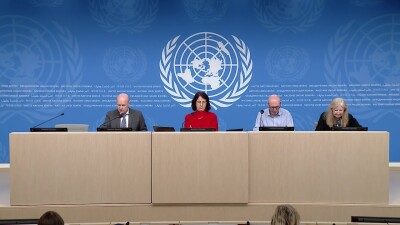
2. Plan moyen : orateurs au pupitre de la conférence de presse
Similar Stories

2
17
1
2
Edited News , Press Conferences | OCHA , WMO
Two UN agencies teamed up on Wednesday to issue an appeal for immediate assistance to help communities already being impacted by the strongest El Niño on record.

3
16
2
2
B-roll , Conferences , Edited News | UNITED NATIONS , UNOG
Sixth Consultative Meeting on Enhancing Coordination of Peace Initiatives and Efforts for Sudan

1
1
1
Edited News | UNICEF , WHO , UNHCR
Yemen war continues to force families from homes amid hunger and disease
More than 250,000 people have now fled renewed fighting in Yemen, the UN said on Tuesday, citing particular concern for those sheltering in the southwestern city of Taiz and the wider governorate, where access is “essentially blocked”.

1
1
1
Edited News | UNICEF
A little over one year since a ceasefire agreement was announced between Hamas fighters and Israel, more than 340 children have been reported killed and hundreds more injured, the UN Children’s Fund, UNICEF, said on Friday.

1
1
1
Edited News | UNICEF , IFRC
Six weeks after Nepal’s deadly flooding disaster, communities are still struggling to rebuild their lives, but they will need sustained help as global warming increases the risk of another Himalayan catastrophe, the UN Children’s Fund (UNICEF) said on Friday.

1
1
1
Edited News | WHO
In suspected Russia plague death, testing and monitoring underway – WHO
The death of a lab worker in Russia’s Siberia region has sparked concerns about plague being the cause, the UN World Health Organization (WHO) said on Tuesday, adding that it was following the situation closely.

1
1
Edited News | OHCHR , UNOG
UN Human Rights Chief Volker Türk on Friday provided and oral update to the 63rd session of the Human rights Council on Ukraine.

1
1
1
Edited News | OHCHR , UNOG
UN Human Rights Chief Volker Türk on Friday provided and oral update to the 63rd session of the Human rights Council on the human rights situation in Haiti.

1
1
1
Edited News | WHO
Repeated delays in bringing lifesaving medicines, prosthetics and more from Israel into Gaza risk having devastating consequences on Palestinians who urgently need them in the wartorn enclave, the UN World Health Organization (WHO) said on Friday. “A truck full of non-priority supplies or the right supplies arriving too late, doesn't save lives. That's the question that actually matters," said Dr Reinhilde Van De Weerdt, WHO Representative in the OPT.

1
1
1
Edited News | WHO
DRC: Early access to care and oxygen decisive for Ebola patients’ survival – WHO
In the Democratic Republic of the Congo (DRC), health workers fighting the country’s largest-ever Ebola outbreak are struggling to overcome critical challenges to patient care, the UN World Health Organization (WHO) warned on Tuesday.

1
1
1
Edited News | OCHA , UN
Civilians in Iran are continuing to feel the consequences of months of conflict and military escalation, the UN’s top official in the country has said, as loss of life, damage to civilian infrastructure and mounting economic pressures leave many facing continued uncertainty.
1
1
1
Edited News | WHO , UNICEF
Aid agencies in Yemen highlighted the growing hunger emergency sparked by renewed fighting between Houthi opposition forces and Government troops, after mobile health clinics reported that hundreds of children displaced by the violence are suffering from the most deadly form of malnutrition.