

The United Nations Office at Geneva
Multimedia Newsroom
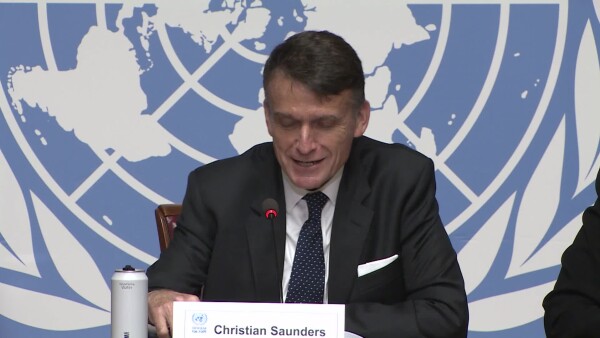
After the release of the US Middle East peace plan earlier this week, a lot of Palestinians are “in a state of shock at this point”, said Christian Saunders, acting Commissioner-General of the United Nations Relief and Work Agency for Palestine Refugees in the Near East (UNRWA) today at the United Nations in Geneva.
Speaking to the press Saunders said that “the plan that was released this week is extremely unsettling for the Palestine refugees living under occupation, under blockade, and through conflict after conflict and crisis after crisis, hoping for justice and human rights, and with the constant fear that the international community will one day abandon them”.
He added that “today, more than ever, there is a need for stability and today the international community must send a clear message to Palestine refugees and to the world at large that the international community stands firmly behind them”.
UNRWA is the UN agency mandated by the UN General Assembly to provide protection and assistance to some 5.6 million Palestine refugees in Gaza, Jordan, Lebanon, Syria, the West Bank including East Jerusalem.
US President Trumps Middle East Peace Plan, presented last Tuesday (28.01.), proposed an independent Palestinian state, the recognition of Israeli sovereinty over West Bank settlements and to keep Jerusalem as Israel’s undivided capital. The plan was seen as heavily biased towards Israel and provoked protests of thousands of Palestinians rejecting it.
“A lot of people, a lot of Palestininas, are in a state of shock at this point in time, in a state of disbelief over the Trump Peace plan, the US Peace plan. The coming days, the coming weeks and months will see how they respond to that”, Saunders said.
UNRWA’s interim Commissioner Saunders came to Geneva to launch an appeal to donors to fund UNRWA’s 2020 budget with a minimum of US$ 1.4 billion for the 5,6 million registered refugees across the Middle East for this year.
“We are stretched to our limits under our shrinking budgets and the growing needs of Palestine refugees who are impacted by the same volatility and unpredictability that people face in the Middle East every day”, Saunders said. “In 2020, Palestine refugees in the West Bank, including East Jerusalem, Gaza, Jordan, Lebanon and Syria will continue to face a range of daunting human development and protection challenges. Central to these pressures is the ongoing occupation of the West Bank, including East Jerusalem, the blockade of Gaza, the continuing conflict in Syria, the political crisis in Lebanon and the growing economic needs in Jordan, all of which continue to dramatically impact the lives of Palestine refugees”.
Of the required US$ 1.4 billion, the Agency will use US$ 806 million for essential core services. UNRWA will be able to provide education to over half a million girls and boys in some 700 schools across the region, and enable 8.5 million patient visits in its health facilities, like it did in 2019.
UNRWA has faced severe funding difficulties after President Trump’s decision in 2018 to suspend entirely the US contribution to the agency’s budget, cutting nearly one third of the entire budget.
“In 2018, UNRWA’s largest donor at that time, the United States, stopped funding us, cutting nearly one third of our budget. The repercussions on our finances and plans were huge, but the support we received from our member states and partners was phenomenal, and a true testament to the continued international commitment to Palestine refugee. This incredible support allowed us to continue to provide vital services and protection to Palestine refugees, despite the potential implications of this loss of funding”.
Since 1949 UNRWA has been mandated by the UN General Assembly to provide protection and essential services to Palestinian refugees until there is a just and lasting solution based on international law and relevant UN resolutions.
UNRWA’s humanitarian services encompass primary and vocational training, primary health care, infrastructure and camp improvement to Palestinian refugees.
- Exterior, Palais des Nations
- Wide shot, press briefing room
- SOUNDBITE (English) – Christian Saunders, UNRWA Acting Commissioner-General: “The plan that was released this week is extremely unsettling for the Palestine refugees living under occupation, under blockade, and through conflict after conflict and crisis after crisis, hoping for justice and human rights, and with the constant fear that the international community will one day abandon them. Today, more than ever there is a need for stability and today the international community must send a clear message to Palestine refugees and to the world at large that the international community stands firmly behind them”.
- Wide shot, journalists
- SOUNDBITE (English) – Christian Saunders, UNRWA Acting Commissioner-General: “A lot of people, a lot of Palestininas, are in a state of shock at this point in time, in a state of disbelief over the Trump Peace plan, the US Peace plan. The coming days, the coming weeks and months will see how they respond to that”.
- Medium shot, podium
- SOUNDBITE (English) – Christian Saunders, UNRWA Acting Commissioner-General: “We are stretched to our limits under our shrinking budgets and the growing needs of Palestine refugees who are impacted by the same volatility and unpredictability that people face in the Middle East every day. In 2020, Palestine refugees in the West Bank, including East Jerusalem, Gaza, Jordan, Lebanon and Syria will continue to face a range of daunting human development and protection challenges. Central to these pressures is the ongoing occupation of the West Bank, including East Jerusalem, the blockade of Gaza, the continuing conflict in Syria, the political crisis in Lebanon and the growing economic needs in Jordan, all of which continue to dramatically impact the lives of Palestine refugees”.
- Medium shot, journalists
- SOUNDBITE (English) – Christian Saunders, UNRWA Acting Commissioner-General: “In 2018, UNRWA’s largest donor at that time, the United States, stopped funding us, cutting nearly one third of our budget. The repercussions on our finances and plans were huge, but the support we received from our member states and partners was phenomenal, and a true testament to the continued international commitment to Palestine refugee. This incredible support allowed us to continue to provide vital services and protection to Palestine refugees, despite the potential implications of this loss of funding”.
- Wide shot, podium
- Medium shot, photographers
- Medium shot, press room
- Medium shot, photographers
- Two shot, journalists
- Close up, journalist
Similar Stories

1
1
1
Edited News | OCHA , UNICEF , WFP
Aid agencies warned on Friday of the fast-developing humanitarian emergency inside Taiz City in Yemen, which has been encircled by de facto Houthi forces fighting government troops along the country’s west coast.

2
17
1
2
Edited News , Press Conferences , Images | OCHA , WMO
Two UN agencies teamed up on Wednesday to issue an appeal for immediate assistance to help communities already being impacted by the strongest El Niño on record.

3
16
2
2
Edited News , B-roll , Conferences , Images | UNITED NATIONS , UNOG
Sixth Consultative Meeting on Enhancing Coordination of Peace Initiatives and Efforts for Sudan

1
1
1
Edited News | UNICEF , WHO , UNHCR
Yemen war continues to force families from homes amid hunger and disease
More than 250,000 people have now fled renewed fighting in Yemen, the UN said on Tuesday, citing particular concern for those sheltering in the southwestern city of Taiz and the wider governorate, where access is “essentially blocked”.

1
1
1
Edited News | UNICEF
A little over one year since a ceasefire agreement was announced between Hamas fighters and Israel, more than 340 children have been reported killed and hundreds more injured, the UN Children’s Fund, UNICEF, said on Friday.

1
1
1
Edited News | UNICEF , IFRC
Six weeks after Nepal’s deadly flooding disaster, communities are still struggling to rebuild their lives, but they will need sustained help as global warming increases the risk of another Himalayan catastrophe, the UN Children’s Fund (UNICEF) said on Friday.

1
1
1
Edited News | WHO
In suspected Russia plague death, testing and monitoring underway – WHO
The death of a lab worker in Russia’s Siberia region has sparked concerns about plague being the cause, the UN World Health Organization (WHO) said on Tuesday, adding that it was following the situation closely.

1
1
Edited News | OHCHR , UNOG
UN Human Rights Chief Volker Türk on Friday provided and oral update to the 63rd session of the Human rights Council on Ukraine.

1
1
1
Edited News | OHCHR , UNOG
UN Human Rights Chief Volker Türk on Friday provided and oral update to the 63rd session of the Human rights Council on the human rights situation in Haiti.

1
1
1
Edited News | WHO
Repeated delays in bringing lifesaving medicines, prosthetics and more from Israel into Gaza risk having devastating consequences on Palestinians who urgently need them in the wartorn enclave, the UN World Health Organization (WHO) said on Friday. “A truck full of non-priority supplies or the right supplies arriving too late, doesn't save lives. That's the question that actually matters," said Dr Reinhilde Van De Weerdt, WHO Representative in the OPT.

1
1
1
Edited News | WHO
DRC: Early access to care and oxygen decisive for Ebola patients’ survival – WHO
In the Democratic Republic of the Congo (DRC), health workers fighting the country’s largest-ever Ebola outbreak are struggling to overcome critical challenges to patient care, the UN World Health Organization (WHO) warned on Tuesday.

1
1
1
Edited News | OCHA , UN
Civilians in Iran are continuing to feel the consequences of months of conflict and military escalation, the UN’s top official in the country has said, as loss of life, damage to civilian infrastructure and mounting economic pressures leave many facing continued uncertainty.