

The United Nations Office at Geneva
Multimedia Newsroom
Ahead of World Food Day (16 October), the United Nations World Food Programme (WFP) warns that it may soon be forced to cut food rations to more than half a million women, men and children in north-eastern Nigeria while calling urgently for funding of at least US$ 55 million in the coming weeks.
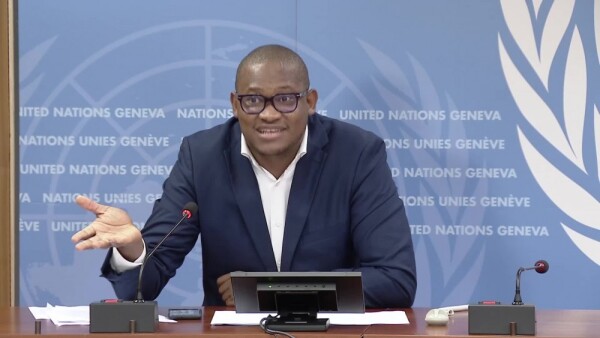
Speaking at a press briefing at the United Nations in Geneva, Tomson Phiri, World Food Programme’s (WFP) spokesperson said that “the World Food Programme will be forced to cut food rations in a matter of weeks. We are not talking of months, we are not talking of a six-month period, we are talking literally of weeks - unless we receive aid and funding.”
Without additional resources, the food assistance agency will run out of funds for emergency food distribution and nutrition support by the end of October 2021.
The cuts would then come as hunger reaches a five-year high in the country which has been suffering years of conflict and insecurity. According to Tomson Phiri, “we are facing very severe levels of hunger that we have witnessed since, this is probably the highest that we are witnessing since the crisis exploded in 2016. Approximately 4.4 million people are facing acute food insecurity in the conflict-affected states of Borno, Adamawa and Yobe.”
The situation in the country has been worsened by the socio-economic fallout due to Covid-19, high food prices and limited food supply. Furthermore, the number of internally displaced people reached more than 2 million in September 2021. WFP estimates that over 1 million children are malnourished. Food assistance is already prioritized for the most vulnerable ones.
“What makes this situation of concern, is that we are already providing prioritized assistance”, Mr. Phiri stated. He added that “there have already been austere measures that we had implemented, and the situation now will mean we have no other choice but to implement deeper cuts. We urgently require 197 million United States Dollars over the next six months to be able to sustain our operations in Nigeria”.
For five years, WFP has provided life-saving food and nutrition assistance to severely food insecure people, displaced families in camps, and to vulnerable people living in host communities.
“The situation is largely been driven by insecurity. Of course, we have a confluence of climate crises as well in the north, but it is largely insecurity with reports of non-state armed groups targeting civilians, community leaders in the north-east,” said WFP’s spokesperson.
WFP ramped up its response to address rising food insecurity and the impact of Covid-19 with life-saving food assistance. However, the situation in north-eastern Nigeria remains dramatic.
Tomson Phiri said that “the peak lean season was between June and August and just after that people are really on the brink and by that I mean you are talking about, we are assisting 1.7 million people and of these 800,000 people face emergency levels. Emergency levels is just one step away from phase 5, that is catastrophic, that is a step away from famine”.
-ends-
- Exterior wide shot, United Nations flag flying.
- Medium-wide shot, inside the press conference room, showing speakers and participants.
- SOUNDBITE (English): Tomson Phiri, World Food Programme’s (WFP) spokesperson: “The World Food Programme will be forced to cut food rations in a matter of weeks. We are not talking of months, we are not talking of a six-month period, we are talking literally of weeks unless we receive aid and funding.”
- Close shot, a journalist, masked, listening to the press conference, Mr. Phiri on screen and to rear.
- SOUNDBITE (English): Tomson Phiri, World Food Programme’s (WFP) spokesperson: “We are facing very severe levels of hunger that we have witnessed since, this is probably the highest that we are witnessing since the crisis exploded in 2016. Approximately 4.4 million people are facing acute food insecurity in the conflict-affected states of Borno, Adamawa and Yobe.”
- Close shot on one of the journalists’ hand, writing down notes from the press briefing.
- SOUNDBITE (English): Tomson Phiri, World Food Programme’s (WFP) spokesperson: “What makes this situation of concern, is that we are already providing prioritized assistance. There have already been austere measures that we had implemented, and the situation now will mean we have no other choice but to implement deeper cuts. We urgently require 197 million United States Dollars over the next six months to be able to sustain our operations in Nigeria.”
- Close shot on one of the journalist’s laptop showing the press briefing broadcast on Zoom, speakers in the background.
- SOUNDBITE (English): Tomson Phiri, World Food Programme’s (WFP) spokesperson: “The situation is largely been driven by insecurity. Of course, we have a confluence of climate crises as well in the north, but it is largely insecurity with reports of non-state armed groups targeting civilians, community leaders in the north-east.”
- Close shot, a journalist, masked, attending the conference.
- SOUNDBITE (English): Tomson Phiri, World Food Programme’s (WFP) spokesperson: “The peak lean season was between June and August and just after that people are really on the brink and by that I mean you are talking about, we are assisting 1.7 million people and of these 800,000 people face emergency levels. Emergency levels is just one step away from phase 5, that is catastrophic, that is a step away from famine.”
- Medium shot, inside the press conference room, showing speakers and the broadcast on Zoom.
- Close shot on a journalist, masked, taking notes.
- Medium shot, journalists attending the meeting.
Similar Stories

1
1
1
Edited News | UNICEF
A little over one year since a ceasefire agreement was announced between Hamas fighters and Israel, more than 340 children have been reported killed and hundreds more injured, the UN Children’s Fund, UNICEF, said on Friday.

1
1
1
Edited News | UNICEF , IFRC
Six weeks after Nepal’s deadly flooding disaster, communities are still struggling to rebuild their lives, but they will need sustained help as global warming increases the risk of another Himalayan catastrophe, the UN Children’s Fund (UNICEF) said on Friday.

1
1
1
Edited News | WHO
In suspected Russia plague death, testing and monitoring underway – WHO
The death of a lab worker in Russia’s Siberia region has sparked concerns about plague being the cause, the UN World Health Organization (WHO) said on Tuesday, adding that it was following the situation closely.

1
1
Edited News | OHCHR , UNOG
UN Human Rights Chief Volker Türk on Friday provided and oral update to the 63rd session of the Human rights Council on Ukraine.

1
1
1
Edited News | OHCHR , UNOG
UN Human Rights Chief Volker Türk on Friday provided and oral update to the 63rd session of the Human rights Council on the human rights situation in Haiti.

1
1
1
Edited News | WHO
Repeated delays in bringing lifesaving medicines, prosthetics and more from Israel into Gaza risk having devastating consequences on Palestinians who urgently need them in the wartorn enclave, the UN World Health Organization (WHO) said on Friday. “A truck full of non-priority supplies or the right supplies arriving too late, doesn't save lives. That's the question that actually matters," said Dr Reinhilde Van De Weerdt, WHO Representative in the OPT.

1
1
1
Edited News | WHO
DRC: Early access to care and oxygen decisive for Ebola patients’ survival – WHO
In the Democratic Republic of the Congo (DRC), health workers fighting the country’s largest-ever Ebola outbreak are struggling to overcome critical challenges to patient care, the UN World Health Organization (WHO) warned on Tuesday.

1
1
1
Edited News | OCHA , UN
Civilians in Iran are continuing to feel the consequences of months of conflict and military escalation, the UN’s top official in the country has said, as loss of life, damage to civilian infrastructure and mounting economic pressures leave many facing continued uncertainty.
1
1
1
Edited News | WHO , UNICEF
Aid agencies in Yemen highlighted the growing hunger emergency sparked by renewed fighting between Houthi opposition forces and Government troops, after mobile health clinics reported that hundreds of children displaced by the violence are suffering from the most deadly form of malnutrition.
1
1
1
Edited News | UNHCR
Displacement on the rise in Yemen as fighting continues - UNHCR
As hostilities worsen in Yemen, more people have been fleeing their homes, further intensifying the humanitarian crisis within the region, the UN Refugee Agency (UNHCR) warned on Tuesday.
1
1
1
Edited News | IOM , OHCHR , UNFPA , UNOG , UNHCR , WHO
Yemen’s humanitarian crisis growing by the hour amid spike in displacement
Yemenis displaced by renewed fighting have described fleeing for their lives amid shelling and gunfire, aid agencies reported on Friday, while highlighting the dramatic increase in humanitarian needs in the country and in Djibouti, where thousands have sought shelter.
1
1
1
Edited News | OHCHR , UNOG
The UN Human Rights Office issued on Friday a report documenting a shocking pattern of sexual violence amid Russia’s full-scale armed attack on Ukraine.