

The United Nations Office at Geneva
Multimedia Newsroom
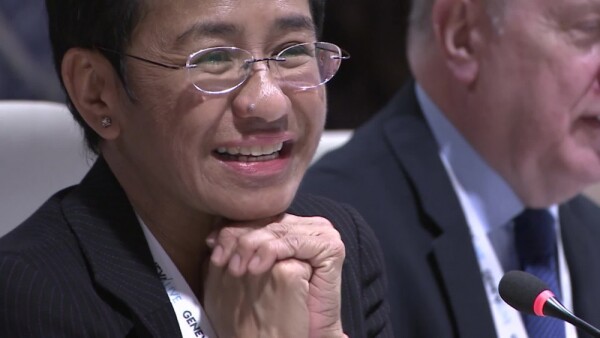
Journalists Maria Ressa and Dmitry Muratov jointly won the 2021 Nobel Peace Prize for their fights to defend freedom of expression in the Philippines and Russia, the Norwegian Noble Committee in Oslo announced today.
A UN spokesperson mentioning the Nobel Peace Prize award to the investigative journalists said at a briefing at the United Nations in Geneva that “the Norwegian Nobel Prize Committee has just announced that it has decided to award the 2021 Nobel Peace Prize to Maria Ressa and Dimitri Muratov for their efforts to safeguard freedom of expression which is a precondition for democracy and lasting peace says the Committee. I would like to congratulate the two laureates”.
The two journalists were chosen out of 329 candidates for this year’s Nobel Peace Prize.
Ms Ressa, who co-founded the news site Rappler in 2012, was commended by the Norwegian Noble Committee for using freedom of expression to “expose abuse of power, use of violence and growing authoritarianism in her native country, the Philippines”.
The site now has 4,5 million followers on Facebook and has become known for its intelligent analysis and hard-hitting investigations. It is one of the few Philippine media organizations to be openly critical of President Rodrigo Duterte and his policies.
Rappler has extensively published on the populist president’s deadly war on drugs and has taken a critical look at issues such as misogyny, human rights violations and corruption.
Earlier this year in April, the investigative journalist and media executive Maria Ressa has received the 2021 press freedom award by the United Nations Educational, Scientific and Cultural Organization (UNESCO). According to UNESCO, Ms. Ressa has been arrested for “alleged crimes related to the exercise of her profession”, and has been subject to a sustained campaign of gendered online abuse, threats and harassment, which at one point, resulted in her receiving an average of over 90 hateful messages an hour on Facebook.
The former lead investigative journalist for Asia at CNN and head of ABS-CBN News and Current Affairs, Ms. Ressa was also among a group of journalists named as Time Magazine’s person of the year in 2018.
Nobel Peace Prize winner Maria Ressa said upon her nomination that “nothing is possible without facts….a world without facts means a world without truth and trust”.
-ends-
- Exterior wide shot, United Nations flag flying.
- Medium-wide shot, inside the press conference room, showing speakers and participants.
- SOUNDBITE (English): Alessandra Vellucci, Director of United Nations Information Service in Geneva: “The Norwegian Nobel Prize Committee has just announced that it has decided to award the 2021 Nobel Peace Prize to Maria Ressa and Dimitri Muratov for their efforts to safeguard freedom of expression which is a precondition for democracy and lasting peace says the Committee. I would like to congratulate the two laureates.”
- Wide shot, inside one of the rooms at the Palais, participants attending the conference “Maria Ressa Rappler Free Media Pioneer”.
- Medium shot of speakers at the conference.
- Close shot, a participant taking pictures of the event.
- Medium shot, Maria Ressa speaking in front of the audience.
- Wide shot, inside the conference room, showing speakers and participants.
- Medium shot, M. Ressa delivering her speech.
- Medium shot, from the back, speakers seated in front of their audience.
- Close shot, M. Ressa adjusting her microphone.
- Close shot, from the back, one of the speakers delivering his speech.
- Medium shot, speakers seated listening to the conference.
- Medium-wide shot, high camera angle, the table of speakers with a large-screen TV showing the conference room.
- Medium shot, inside the conference room, people seated.
- Close shot, a participant listening to the conference using headphones.
- Close shot of a smartphone filming the conference.
Following images are ARCHIVE FOOTAGE:
UN Geneva, International Press Institute (IPI) World Congress (4-6 June 2019)
Similar Stories

2
17
1
2
Edited News , Press Conferences | OCHA , WMO
Two UN agencies teamed up on Wednesday to issue an appeal for immediate assistance to help communities already being impacted by the strongest El Niño on record.
3
16
2
2
B-roll , Conferences , Edited News | UNITED NATIONS , UNOG
Sixth Consultative Meeting on Enhancing Coordination of Peace Initiatives and Efforts for Sudan
1
1
1
Edited News | UNICEF , WHO , UNHCR
Yemen war continues to force families from homes amid hunger and disease
More than 250,000 people have now fled renewed fighting in Yemen, the UN said on Tuesday, citing particular concern for those sheltering in the southwestern city of Taiz and the wider governorate, where access is “essentially blocked”.

1
1
1
Edited News | UNICEF
A little over one year since a ceasefire agreement was announced between Hamas fighters and Israel, more than 340 children have been reported killed and hundreds more injured, the UN Children’s Fund, UNICEF, said on Friday.

1
1
1
Edited News | UNICEF , IFRC
Six weeks after Nepal’s deadly flooding disaster, communities are still struggling to rebuild their lives, but they will need sustained help as global warming increases the risk of another Himalayan catastrophe, the UN Children’s Fund (UNICEF) said on Friday.

1
1
1
Edited News | WHO
In suspected Russia plague death, testing and monitoring underway – WHO
The death of a lab worker in Russia’s Siberia region has sparked concerns about plague being the cause, the UN World Health Organization (WHO) said on Tuesday, adding that it was following the situation closely.

1
1
Edited News | OHCHR , UNOG
UN Human Rights Chief Volker Türk on Friday provided and oral update to the 63rd session of the Human rights Council on Ukraine.

1
1
1
Edited News | OHCHR , UNOG
UN Human Rights Chief Volker Türk on Friday provided and oral update to the 63rd session of the Human rights Council on the human rights situation in Haiti.

1
1
1
Edited News | WHO
Repeated delays in bringing lifesaving medicines, prosthetics and more from Israel into Gaza risk having devastating consequences on Palestinians who urgently need them in the wartorn enclave, the UN World Health Organization (WHO) said on Friday. “A truck full of non-priority supplies or the right supplies arriving too late, doesn't save lives. That's the question that actually matters," said Dr Reinhilde Van De Weerdt, WHO Representative in the OPT.

1
1
1
Edited News | WHO
DRC: Early access to care and oxygen decisive for Ebola patients’ survival – WHO
In the Democratic Republic of the Congo (DRC), health workers fighting the country’s largest-ever Ebola outbreak are struggling to overcome critical challenges to patient care, the UN World Health Organization (WHO) warned on Tuesday.

1
1
1
Edited News | OCHA , UN
Civilians in Iran are continuing to feel the consequences of months of conflict and military escalation, the UN’s top official in the country has said, as loss of life, damage to civilian infrastructure and mounting economic pressures leave many facing continued uncertainty.
1
1
1
Edited News | WHO , UNICEF
Aid agencies in Yemen highlighted the growing hunger emergency sparked by renewed fighting between Houthi opposition forces and Government troops, after mobile health clinics reported that hundreds of children displaced by the violence are suffering from the most deadly form of malnutrition.