

The United Nations Office at Geneva
Multimedia Newsroom
Edited News | UNICEF , OCHA , WFP
UNOG Bi-weekly press briefing: Tigray Malnutrition - UNICEF-WFP-OCHA + B-roll
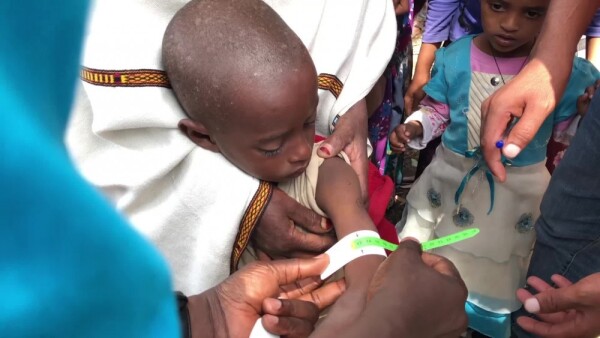
More than 100,000 children in Tigray, Ethiopia, could suffer from life-threatening severe acute malnutrition in the next 12 months, a 10-fold jump over average annual levels, UN Children's Fund (UNICEF) said on Friday.
The development comes as UNICEF announced that it had recently reached areas of Tigray that were previously inaccessible owing to insecurity linked to nearly nine months of conflict between Government forces and those loyal to the Tigray People’s Liberation Front.
UNICEF spokesperson Marixie Mercado told a UN briefing in Geneva that humanitarians’ worst fears about the health and wellbeing of children have been confirmed.
Assessments also indicate that 47 per cent of pregnant and breastfeeding women are acutely malnourished, suggesting that they could face more pregnancy-related complications, an increased risk of maternal death during childbirth and the delivery of low-birthweight babies, who are much more prone to sickness and death.
"We need unfettered access into Tigray and across the region, in order to provide support children and women urgently need," she said.
Meanwhile, World Food Programme (WFP) spokesperson Tomson Phiri, said that a convoy of more than 200 trucks was on its way to Tigray, but “this is a drop in the ocean.” At least 100 trucks are needed every day “if we are to stand a chance to reverse the catastrophic situation,” he said.
The United Nations needs “critical communications equipment and longer-term visas for NGO staff” for its aid operation in Tigray, UN humanitarian coordination office (OCHA) spokesperson Jens Laerke said, in an appeal to the Ethiopian Government.
Speaking of her own recent experience in the region, Ms. Mercado noted that one young female survivor of sexual assault told her that “she watched her grandmother get killed, she was raped by several men and she watched her nine month old baby being tossed around by other men”.
A doctor at a UNICEF supported referral centre in Mekelle told her that he had been struck by the fact that in many cases it was not the assault itself, but rather the psychological damage it inflicts on children, women and health staff, that was most difficult to bear.
ENDS
STORY: TIGRAY MALNUTRITION
TRT: 4:24”
SOURCE: UNTV CH
RESTRICTIONS: NONE
LANGUAGE: ENGLISH
ASPECT RATIO: 16:9
DATELINE: 31 JULY 2021, GENEVA, SWITZERLAND
SHOTLIST
- 1.Exterior wide shot, United Nations flag flying.
- Wide shot, press room briefing
- SOUNDBITE: (ENGLISH) MARIXIE MERCADO, UNICEF SPOKESPERSON:
- “UNICEF estimates that over 100,000 children in Tigray could suffer from life-threatening severe acute malnutrition in the next 12 months. A tenfold increase compared to the average annual caseload. Screening data also indicated that almost half, that’s 47 per cent of all pregnant and breastfeeding women, who are acutely malnourished.”
- 4.Close of journalists in press briefing room.
- SOUNDBITE: (ENGLISH) MARIXIE MERCADO, UNICEF SPOKESPERSON: “We need unfettered actress into Tigray and across the region in order to provide the support children and women urgently need. Right now, we have just 6,900 cartons of lifesaving, ready to eat, therapeutic foods in our warehouses in Tigray. That is enough to treat severe malnutrition in just 6,900 children.”
- 6.Close up of TV camera filming in press briefing room
- SOUNDBITE: (ENGLISH) MARIXIE MERCADO, UNICEF SPOKESPERSON: “She watched her grandmother get killed, she was raped by several men and she watched her nine-month old baby being tossed around by other men and what the doctor at this UNICEF supported referral centre in Mekelle said which also struck me was that in many cases, it’s not the assault itself, but it's the psychological damage.”
- 8.Journalists in press briefing room
- SOUNDBITE: (ENGLISH) TOMSON PHIRI,WORLD FOOD PROGRAMME SPOKESPERSON: “A convoy of over 200 trucks is on its way now from Semera to Mekelle. This is a drop in the ocean. We need at least 100 trucks to be making their way every day into Tigray if we are to stand a chance to reverse the catastrophic situation which we have today.”
- 10.Mid of journalists in press briefing room
- SOUNDBITE: (ENGLISH) TOMSON PHIRI,WORLD FOOD PROGRAMME SPOKESPERSON: “Yes we are getting access but we need much, much faster passage. This is a catastrophic situation, one that we can already see will further deteriorate and we need all hands on deck, trucks getting in, supplies moving in, aid workers accessing in and out of Tigray at a much faster rate.”
- 12.Mid of journalists in press briefing room.
- SOUNDBITE: (ENGLISH) JENS LAERKE, SPOKESPERSON, UN HUMANITARIAN OFFICE: “There’s one thing that is a very concrete ask from us to the government of Ethiopia and that is that the Government must permit humanitarians to bring in additional communications equipment and provide longer-term visas for NGO staff. This is critical. We need these things in order to operate.”
- Images of UNICEF aid work in Tigray, 19 July 2021.
Similar Stories

1
1
1
Edited News | OCHA , UNICEF , WFP
Aid agencies warned on Friday of the fast-developing humanitarian emergency inside Taiz City in Yemen, which has been encircled by de facto Houthi forces fighting government troops along the country’s west coast.

2
17
1
2
Edited News , Press Conferences , Images | OCHA , WMO
Two UN agencies teamed up on Wednesday to issue an appeal for immediate assistance to help communities already being impacted by the strongest El Niño on record.

3
16
2
2
Edited News , B-roll , Conferences , Images | UNITED NATIONS , UNOG
Sixth Consultative Meeting on Enhancing Coordination of Peace Initiatives and Efforts for Sudan

1
1
1
Edited News | UNICEF , WHO , UNHCR
Yemen war continues to force families from homes amid hunger and disease
More than 250,000 people have now fled renewed fighting in Yemen, the UN said on Tuesday, citing particular concern for those sheltering in the southwestern city of Taiz and the wider governorate, where access is “essentially blocked”.

1
1
1
Edited News | UNICEF
A little over one year since a ceasefire agreement was announced between Hamas fighters and Israel, more than 340 children have been reported killed and hundreds more injured, the UN Children’s Fund, UNICEF, said on Friday.

1
1
1
Edited News | UNICEF , IFRC
Six weeks after Nepal’s deadly flooding disaster, communities are still struggling to rebuild their lives, but they will need sustained help as global warming increases the risk of another Himalayan catastrophe, the UN Children’s Fund (UNICEF) said on Friday.

1
1
1
Edited News | WHO
In suspected Russia plague death, testing and monitoring underway – WHO
The death of a lab worker in Russia’s Siberia region has sparked concerns about plague being the cause, the UN World Health Organization (WHO) said on Tuesday, adding that it was following the situation closely.

1
1
Edited News | OHCHR , UNOG
UN Human Rights Chief Volker Türk on Friday provided and oral update to the 63rd session of the Human rights Council on Ukraine.

1
1
1
Edited News | OHCHR , UNOG
UN Human Rights Chief Volker Türk on Friday provided and oral update to the 63rd session of the Human rights Council on the human rights situation in Haiti.

1
1
1
Edited News | WHO
Repeated delays in bringing lifesaving medicines, prosthetics and more from Israel into Gaza risk having devastating consequences on Palestinians who urgently need them in the wartorn enclave, the UN World Health Organization (WHO) said on Friday. “A truck full of non-priority supplies or the right supplies arriving too late, doesn't save lives. That's the question that actually matters," said Dr Reinhilde Van De Weerdt, WHO Representative in the OPT.

1
1
1
Edited News | WHO
DRC: Early access to care and oxygen decisive for Ebola patients’ survival – WHO
In the Democratic Republic of the Congo (DRC), health workers fighting the country’s largest-ever Ebola outbreak are struggling to overcome critical challenges to patient care, the UN World Health Organization (WHO) warned on Tuesday.

1
1
1
Edited News | OCHA , UN
Civilians in Iran are continuing to feel the consequences of months of conflict and military escalation, the UN’s top official in the country has said, as loss of life, damage to civilian infrastructure and mounting economic pressures leave many facing continued uncertainty.