

The United Nations Office at Geneva
Multimedia Newsroom
Edited News | OCHA , WFP , UNICEF , OHCHR
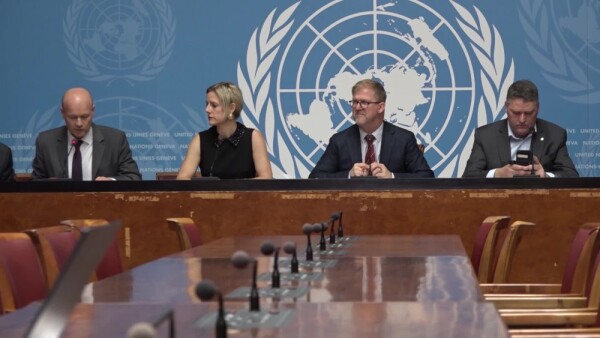
Bi-weekly press briefing: Syria Update - OCHA/WFP/UNICEF/OHCHR,/UNHCR/ICRC
Speaking to journalists in Geneva, Jens Laerke from the Office for the Coordination of Humanitarian Affairs (OCHA) said that Thursday had seen “intense shelling all along the north-eastern Syrian border with Turkey, from Jarablus, to the west of the Euphrates, to the Iraqi border”.
Highlighting the potential for further suffering for Syrians caught up in more than eight years of war, Christian Cardon de Lichtbuer, from the International Committee of the Red Cross (ICRC) said: “What is happening and what has been happening in the last 48 hours is extremely worrying, and I believe that we have there all the ingredients for unfortunately yet another humanitarian crisis in Syria.”
According to the UN human rights office, OHCHR, “as of last night, we had reports of seven civilians, including two women and a boy who had been killed with another boy injured …during the first two days of the Turkish operation”, spokesperson Rupert Colville said. “In addition, a civilian man was reported killed in Jarablus on 9 October and a woman and a boy injured yesterday during counter-attacks and ground strikes by Kurdish non-State armed groups.”
In response to the mass displacement of people from the northern border area, mainly to Al-Hasakeh district, the World Food Programme (WFP) has provided ready-to-eat meals to around 11,000 people there, with the help of the Syrian Arab Red Crescent (SARC).
WFP supports close to 650,000 people in north-eastern Syria via a field hub in Qamishli; around 580,000 are currently in areas under Kurdish control, it said in a statement.
“Mass population displacement has been reported since the escalation of violence,” said WFP spokesperson Hervé Verhoosel. “Over 70,000 people from Ras al-Ain and Tal Abiad have been displaced so far.”
Several thousand more have move to Raqqa governorate since the beginning of Operation Peace Spring by the Turkish military on Wednesday, Verhoosel noted, while many other were on their way to shelters in Raqqa city “where WFP will be covering their food needs”.
Mr. Laerke added that UN humanitarians remain in Qamishli, but “their ability to operate and provide relief is severely restricted and hindered by the ongoing hostilities and as I mentioned also, local authorities are reportedly imposing some quite strict security measures at checkpoints”.
Linked to the military campaign, Marixie Mercado from the UN Children’s Fund (UNICEF) said that “the Alouk water pumping station reportedly came …under attack early yesterday morning. This is a station that provides safe water to at least 400,000 people in Hassakeh governorate including displacement camps.”
In Tal Abiad, two schools had been reportedly taken over for military use, Mercado added, while child protection programmes had been suspended in Ras al-Ain, Mabrouka camp, Tal Halaf, Sulok and Tal Abiad.
Health and Nutrition response in Ras al-Ain and Mabourka camp had also been suspended, while schools in these areas had closed and the water supply had been affected. Asked whether any Syrian refugees had been seen returning to a so-called safe zone either side of the border, Andrej Mahecic, spokesperson for the UN High Commissioner for Refugees (UNCHR), said: “I have no information of any Syrian refugees returning to what is being called the safe zone.”
The UNHCR spokesperson added that any such buffer zone would have to set up “with full international humanitarian law safeguards in place, including the consent of the Government and warring parties and the zone being of civilian character, the safety of civilians would be hard to guarantee”.
After more than eight years of war in Syria, needs are “significant and widespread”, Najat Rochdi, Senior Humanitarian Adviser to the UN Special Envoy for Syria, said on Thursday in Geneva. Over 11 million people require some form of humanitarian assistance, she said, including 4.7 million living in areas of high severity of need.
Highlighting the critical vulnerability of those displaced by the conflict and the uncertainty surrounding the so-called buffer zone cleared of Kurdish fighters on the border reportedly proposed by Turkey, OCHA’s Jens Laerke said that “it’s not something that’s been set up by humanitarians, it is a zone that has been set up by military planners in Turkey. So, we do not control it and we have not been involved in the planning of it.”
Amid uncertainty about how the military campaign will develop, the ICRC reiterated concern about the lack of basic services available to those displaced in the coming days and weeks, in towns and cities levelled by bombardment and shelling in a bid to drive out ISIL forces.
“People are moving inside Syria, so we can assume, yes, they will go towards (the) south,” said ICRC’s de Lichtbuer. “With the complexity and so areas like Deir-Ez-Zor, and Raqqa, which are not necessarily places that can welcome thousands of people, we will see how it evolves in the coming hours, because it is moving very fast.”
Similar Stories

1
1
1
Edited News | OCHA , UNICEF , WFP
Aid agencies warned on Friday of the fast-developing humanitarian emergency inside Taiz City in Yemen, which has been encircled by de facto Houthi forces fighting government troops along the country’s west coast.

2
17
1
2
Edited News , Press Conferences , Images | OCHA , WMO
Two UN agencies teamed up on Wednesday to issue an appeal for immediate assistance to help communities already being impacted by the strongest El Niño on record.

3
16
2
2
Edited News , B-roll , Conferences , Images | UNITED NATIONS , UNOG
Sixth Consultative Meeting on Enhancing Coordination of Peace Initiatives and Efforts for Sudan

1
1
1
Edited News | UNICEF , WHO , UNHCR
Yemen war continues to force families from homes amid hunger and disease
More than 250,000 people have now fled renewed fighting in Yemen, the UN said on Tuesday, citing particular concern for those sheltering in the southwestern city of Taiz and the wider governorate, where access is “essentially blocked”.

1
1
1
Edited News | UNICEF
A little over one year since a ceasefire agreement was announced between Hamas fighters and Israel, more than 340 children have been reported killed and hundreds more injured, the UN Children’s Fund, UNICEF, said on Friday.

1
1
1
Edited News | UNICEF , IFRC
Six weeks after Nepal’s deadly flooding disaster, communities are still struggling to rebuild their lives, but they will need sustained help as global warming increases the risk of another Himalayan catastrophe, the UN Children’s Fund (UNICEF) said on Friday.

1
1
1
Edited News | WHO
In suspected Russia plague death, testing and monitoring underway – WHO
The death of a lab worker in Russia’s Siberia region has sparked concerns about plague being the cause, the UN World Health Organization (WHO) said on Tuesday, adding that it was following the situation closely.

1
1
Edited News | OHCHR , UNOG
UN Human Rights Chief Volker Türk on Friday provided and oral update to the 63rd session of the Human rights Council on Ukraine.

1
1
1
Edited News | OHCHR , UNOG
UN Human Rights Chief Volker Türk on Friday provided and oral update to the 63rd session of the Human rights Council on the human rights situation in Haiti.

1
1
1
Edited News | WHO
Repeated delays in bringing lifesaving medicines, prosthetics and more from Israel into Gaza risk having devastating consequences on Palestinians who urgently need them in the wartorn enclave, the UN World Health Organization (WHO) said on Friday. “A truck full of non-priority supplies or the right supplies arriving too late, doesn't save lives. That's the question that actually matters," said Dr Reinhilde Van De Weerdt, WHO Representative in the OPT.

1
1
1
Edited News | WHO
DRC: Early access to care and oxygen decisive for Ebola patients’ survival – WHO
In the Democratic Republic of the Congo (DRC), health workers fighting the country’s largest-ever Ebola outbreak are struggling to overcome critical challenges to patient care, the UN World Health Organization (WHO) warned on Tuesday.

1
1
1
Edited News | OCHA , UN
Civilians in Iran are continuing to feel the consequences of months of conflict and military escalation, the UN’s top official in the country has said, as loss of life, damage to civilian infrastructure and mounting economic pressures leave many facing continued uncertainty.