

The United Nations Office at Geneva
Multimedia Newsroom
Edited News | UNHCR , UNOG
UNHCR - Global Refugee Forum - Antonio Guterres, UN Secretary-General
At a three-day global forum aimed at transforming the way the world responds to refugee situations, UN Secretary General António Guterres took the stage in Geneva, Switzerland, today to underscore the importance of protecting refugees, respecting their rights, and addressing the causes of human displacement.
“Now more than ever, we need international cooperation and practical,
effective responses. We need better answers for those who flee, and better help for communities and countries that receive and host them.” the UN Secretary-General said.
The world has experience what experts are calling “a decade of displacement”, during which refugee numbers have surged. More than 70 million people are forcibly displaced – double the level of 20 years ago, and 2.3 million more than just one year ago. More than 25 million of them are refugees, having fled across international borders and unable to return to their homes.
In reference to the main international agreements that have for decades underpinned assistance to refugees the Secretary-General said that there is a need today to “re-establish the integrity of the international refugee protection regime,” based on the 1951 Refugee Convention and 1967 Protocol.
“Indeed, at a time when the right to asylum is under assault, when so many
Borders and doors are being closed to refugees, when even child refugees can be divided from their families, we need to reaffirm the human rights of refugees,” Mr. Guterres said.
The first-ever Global Refugee Forum is bringing together refugees, heads of state and government, UN leaders, international institutions, development organizations, business leaders and civil society representatives, among others, at the United Nations in Geneva.
UNHCR is co-hosting the Forum together with Switzerland, and it is being co-convened by Costa Rica, Ethiopia, Germany, Pakistan, and Turkey. The aim of the Forum is to generate new approaches and long-term commitments from a variety of actors to help refugees and the communities in which they live. Worldwide, over 70 million people are displaced by war, conflict, and persecution.
In outlining possible solutions, Mr. Guterres said that the Global Compact on Refugees, a plan affirmed by the UN General Assembly in 2018, offers a path forward. The Global Compact on Refugees is a blueprint for governments, international organizations, and others to ensure that host communities get the support they need and that refugees can lead productive lives. It was adopted by the UN General Assembly in 2018.
“The Global Compact on Refugees gives us the blueprint,” the Secretary-General said, asking participants “to be bold and concrete in the pledges” they will make.
“This is a moment for ambition. It is a moment to jettison a model of support that too often left refugees for decades with their lives on hold: confined to camps, just scraping by, unable to flourish or contribute. It is a moment to build a more equitable response to refugee crises through a sharing of responsibility,’ Mr. Guterres said.
In his appeal for joint action, Mr. Guterres said that “the Global Compact on Refugees is our collective achievement and our collective responsibility. It speaks to the plight of millions of people. And it speaks to the heart of the mission of the United Nations.”
António Guterres served as UN High Commissioner for Refugees for a ten-year period (2005-2015) prior to his election as Secretary-General of the United Nations. He referred to the protections of refugees as one of the great issues of this era, or any era, and said that “as refugees go, so goes our world.”
"Throughout human history, people everywhere have provided shelter to
strangers seeking refuge – bound to them by a sense of duty and
humanity. Solidarity runs deep in the human character," the Secretary-General said.
"Today we must do all we can to enable that humanitarian spirit to prevail
over those who today seem so determined to extinguish it. We cannot afford to abandon refugees to hopelessness, nor their hosts to bear the responsibility alone,” he added.
Pledges are in support of refugees were expected today by the World Bank and the Inter-American Development Bank, as well as by the private sector.
The Global Refugee Forum will continue through tomorrow, 18 December.
- Wide shot: exterior, flag alley, Palais des Nations, United Nations Geneva.
- Various arrivals (Swiss Foreign Minister Ignazio Cassis, President of Costa Rica Carlos Alvarado Quesasda, German Foreign Minister Heiko Maas, Pakistan Prime Minister Imran Khan)
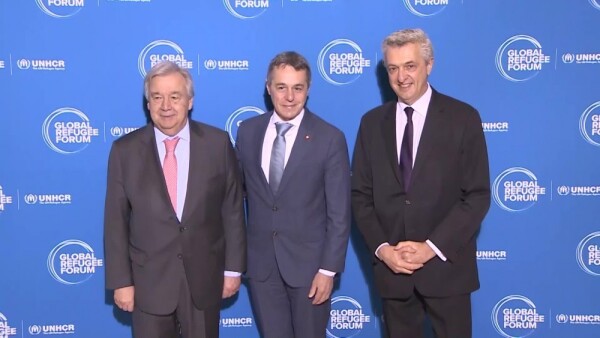
- Medium shot, photo op: UN SG Antonio Guterres, Swiss Foreign Minister Ignazio Cassis and UNHCR High Commissioner Filippo Grandi
- Wide shot, Assembly Hall
- SOUNDBITE (EN) Antonio Guterres, UN Secretary-General: “Now more than ever, we need international cooperation and practical, effective responses and this is the reason, why we are here. We need better answers for those who flee, and better help for communities and countries that receive and host them.”
- Medium shot: SG at the podium
- SOUNDBITE (EN) Antonio Guterres, UN Secretary-General: “More fundamentally, we need to re-establish the integrity of the international refugee protection regime with the 1951 Refugee Convention and 1967 Protocol at its core”.
- Medium shot, SG at podium
- SOUNDBITE (EN) Antonio Guterres, UN Secretary-General: “Borders and doors are being closed to refugees, when even child refugees can be divided from their families, we need to reaffirm the human rights of refugees”.
- Wide shot: Audience at Assembly Hall
- SOUNDBITE (EN) Antonio Guterres, UN Secretary-General: “The Global Compact on Refugees gives us the blueprint”.
- Medium shot, SG at podium
- SOUNDBITE (EN) Antonio Guterres, UN Secretary-General: “I urge you to be bold and concrete in the pledges you make. This is a moment for ambition. It is a moment to jettison a model of support that too often left refugees for decades with their lives on hold: confined to camps, just scraping by, unable to flourish or contribute. It is a moment to build a more equitable response to refugee crises through a sharing of responsibility”.
- Wide shot: Audience in Assembly Hall
- SOUNDBITE (EN) Antonio Guterres, UN Secretary-General: “The Global Compact on Refugees is our collective achievement and our collective responsibility. It speaks to the plight of millions of people. And it speaks to the heart of the mission of the United Nations.”
- Wide shot, podium
- SOUNDBITE (EN) Antonio Guterres, UN Secretary-General: “Throughout human history, people everywhere have provided shelter to strangers seeking refuge – bound to them by a sense of duty and humanity. Solidarity runs deep in the human character. Today we must do all we can to enable that humanitarian spirit to prevail over those who today seem so determined to extinguish it. We cannot afford to abandon refugees to hopelessness, nor their hosts to bear the responsibility alone.”
- Wide shot, applause
Similar Stories

1
1
1
Edited News | OCHA , UNICEF , WFP
Aid agencies warned on Friday of the fast-developing humanitarian emergency inside Taiz City in Yemen, which has been encircled by de facto Houthi forces fighting government troops along the country’s west coast.

2
17
1
2
Edited News , Press Conferences , Images | OCHA , WMO
Two UN agencies teamed up on Wednesday to issue an appeal for immediate assistance to help communities already being impacted by the strongest El Niño on record.

3
16
2
2
Edited News , B-roll , Conferences , Images | UNITED NATIONS , UNOG
Sixth Consultative Meeting on Enhancing Coordination of Peace Initiatives and Efforts for Sudan

1
1
1
Edited News | UNICEF , WHO , UNHCR
Yemen war continues to force families from homes amid hunger and disease
More than 250,000 people have now fled renewed fighting in Yemen, the UN said on Tuesday, citing particular concern for those sheltering in the southwestern city of Taiz and the wider governorate, where access is “essentially blocked”.

1
1
1
Edited News | UNICEF
A little over one year since a ceasefire agreement was announced between Hamas fighters and Israel, more than 340 children have been reported killed and hundreds more injured, the UN Children’s Fund, UNICEF, said on Friday.

1
1
1
Edited News | UNICEF , IFRC
Six weeks after Nepal’s deadly flooding disaster, communities are still struggling to rebuild their lives, but they will need sustained help as global warming increases the risk of another Himalayan catastrophe, the UN Children’s Fund (UNICEF) said on Friday.

1
1
1
Edited News | WHO
In suspected Russia plague death, testing and monitoring underway – WHO
The death of a lab worker in Russia’s Siberia region has sparked concerns about plague being the cause, the UN World Health Organization (WHO) said on Tuesday, adding that it was following the situation closely.

1
1
Edited News | OHCHR , UNOG
UN Human Rights Chief Volker Türk on Friday provided and oral update to the 63rd session of the Human rights Council on Ukraine.

1
1
1
Edited News | OHCHR , UNOG
UN Human Rights Chief Volker Türk on Friday provided and oral update to the 63rd session of the Human rights Council on the human rights situation in Haiti.

1
1
1
Edited News | WHO
Repeated delays in bringing lifesaving medicines, prosthetics and more from Israel into Gaza risk having devastating consequences on Palestinians who urgently need them in the wartorn enclave, the UN World Health Organization (WHO) said on Friday. “A truck full of non-priority supplies or the right supplies arriving too late, doesn't save lives. That's the question that actually matters," said Dr Reinhilde Van De Weerdt, WHO Representative in the OPT.

1
1
1
Edited News | WHO
DRC: Early access to care and oxygen decisive for Ebola patients’ survival – WHO
In the Democratic Republic of the Congo (DRC), health workers fighting the country’s largest-ever Ebola outbreak are struggling to overcome critical challenges to patient care, the UN World Health Organization (WHO) warned on Tuesday.

1
1
1
Edited News | OCHA , UN
Civilians in Iran are continuing to feel the consequences of months of conflict and military escalation, the UN’s top official in the country has said, as loss of life, damage to civilian infrastructure and mounting economic pressures leave many facing continued uncertainty.