

The United Nations Office at Geneva
Multimedia Newsroom
UNICEF warns of a “very, very serious protection crisis in Mozambique” where growing attacks by jihadists are adding to an already desperate situation
The situation of families and individuals who have abandoned their belongings and livelihoods in northern Mozambique after the heinous attacks end of March in the town of Palma in Cabo Delgado province remains desperate.
“We are facing both a large and likely long-lasting humanitarian situation”, said Manuel Fontaine, UNICEF’s Director of Emergencies speaking remotely from Mozambique to journalists at the United Nations. “One third of the population is displaced right now, really striking to see in some towns, population has doubled, in some cases tripled. And so, you imagine, how heavy it is for populations and towns and villages that are already poor.”
Mozambique's north has been ravaged by an escalating Islamist insurgency since 2017, including the heinous attacks in Palma last month that killed dozens and displaced tens of thousands.
“These are constant stories: stories of people being kidnapped, stories of gender-based violence, horrific stories of all of these people working for days and days, kids arriving with their feet swollen and injured and having to be taken care of”, Manuel Fontaine said. “So, it is a very, very serious protection crisis.”
UNICEF has so far identified 220,000 children but assumes that the number is much higher. The Child Agency’s 2021 funding appeal for all Mozambique is USD 52,8 million dollars out of which USD 30 million are for Capo Delgado. Currently only 37 % funded are funded.
“We need to get a million dollars immediately in order to make sure that we don’t have a stockout of the ready-to-use therapeutic food that save children for example and then the cholera response really needs more money now”, said UNICEF’s spokesperson Marixie Mercado. “The numbers are much down in Cabo Delgado because of a huge effort by the government and UN agencies, including UNICEF and WHO, but there is a very high risk of another outbreak in these conditions, and it is already spreading to neighboring provinces. So that is critical.”
With difficult access to the population, and a severe malnutrition prevalence, the World Food Programme (WFP) said today, it needed USD 82 million to provide life-saving assistance to hundreds of thousands of people facing severe hunger in violence-ravaged northern Mozambique.
“As the security situation continues to deteriorate, more than 950,000 people in the north of Mozambique are now facing severe hunger”, said WFP’s spokesperson Tomson Phiri. “WFP plans to assist approximately 750,000 internally displaced people and vulnerable members of the hosting communities in Cabo Delgado as well as in the neighboring provinces of Nampula, Niassa and Zambezia.”
Phiri said that WFP aims to assist 50,000 people displaced from the town. “WFP is organizing emergency food distribution for families who have fled the violence in Palma and is providing high-energy biscuits, as well as ready-to-eat immediate response rations that are comprised of rice, vegetable oil, canned food such as sardines and beans, biscuits and water enough to last them two weeks.”
-ends-
Exterior wide shot, UN building to rear and UN flag in foreground, a sunny day.
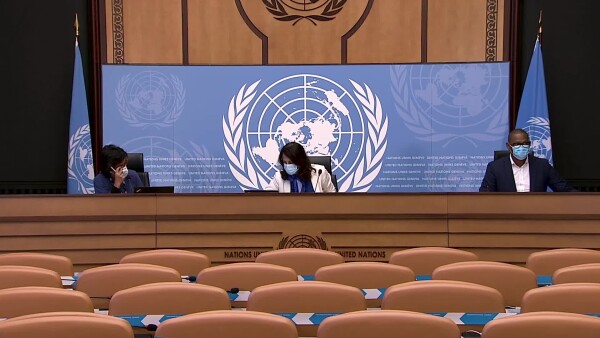
- Medium shot, podium with speakers in a near-empty Room XIV in line with COVID-19 distancing measures, Palais des Nations.
- Medium shot, journalist listening in foreground, screen with speakers to rear, Room XIV, Palais des Nations
- SOUNDBITE (English) — Manuel Fontaine, Director of Emergencies, UNICEF (United Nations International Children's Emergency Fund): “We are facing both a large and likely long-lasting humanitarian situation. One third of the population is displaced right now, really striking to see in some towns, population has doubled, in some cases tripled. And so, you imagine how heavy it is for populations and towns and villages that are already poor.”
- Wide shot, journalist typing on laptop in foreground and podium with speakers to rear, Room XIV, Palais des Nations.
- SOUNDBITE (English) — Manuel Fontaine, Director of Emergencies, UNICEF (United Nations International Children's Emergency Fund): “These are constant stories: stories of people being kidnapped, stories of gender-based violence, horrific stories of all of these people working for days and days, kids arriving with their feet swollen and injured and having to be taken care of. So, it is a very, very serious protection crisis.”
- Medium shot, podium with speakers, side shot, Room XIV, Palais des Nations.
- SOUNDBITE (English) — Marixie Mercado, spokesperson, UNICEF (United Nations International Children's Emergency Fund): “We need to get a million dollars immediately in order to make sure that we don’t have a stock out of the ready-to-use therapeutic food that save children for example and then the cholera response really needs more money now. The numbers are much down in Cabo Delgado because of a huge effort by the government and UN agencies, including UNICEF and WHO, but there is a very high risk of another outbreak in these conditions, and it is already spreading to neighboring provinces. So that is critical.”
- Medium shot, TV broadcasting in foreground and podium with speakers to rear, Room XIV, Palais des Nations.
- SOUNDBITE (English) — Tomson Phiri, spokesperson, WFP (World Food Programme): “As the security situation continues to deteriorate, more than 950,000 people in the north of Mozambique are now facing severe hunger. WFP plans to assist approximately 750,000 internally displaced people and vulnerable members of the hosting communities in Cabo Delgado as well as in the neighboring provinces of Nampula, Niassa and Zambezia.”
- Medium shot, journalist reading notes, side shot, Room XIV, Palais des Nations
- SOUNDBITE (English) — Tomson Phiri, spokesperson, WFP (World Food Programme): “In response, WFP is organizing emergency food distribution for families who have fled the violence in Palma and is providing high-energy biscuits, as well as ready-to-eat immediate response rations that are comprised of rice, vegetable oil, canned food such as sardines and beans, biscuits and water enough to last them two weeks.”
- Medium shot, podium with speakers, side shot, Room XIV, Palais des Nations.
Similar Stories

1
1
1
Edited News | OCHA , UNICEF , WFP
Aid agencies warned on Friday of the fast-developing humanitarian emergency inside Taiz City in Yemen, which has been encircled by de facto Houthi forces fighting government troops along the country’s west coast.

2
17
1
2
Edited News , Press Conferences , Images | OCHA , WMO
Two UN agencies teamed up on Wednesday to issue an appeal for immediate assistance to help communities already being impacted by the strongest El Niño on record.

3
16
2
2
Edited News , B-roll , Conferences , Images | UNITED NATIONS , UNOG
Sixth Consultative Meeting on Enhancing Coordination of Peace Initiatives and Efforts for Sudan

1
1
1
Edited News | UNICEF , WHO , UNHCR
Yemen war continues to force families from homes amid hunger and disease
More than 250,000 people have now fled renewed fighting in Yemen, the UN said on Tuesday, citing particular concern for those sheltering in the southwestern city of Taiz and the wider governorate, where access is “essentially blocked”.

1
1
1
Edited News | UNICEF
A little over one year since a ceasefire agreement was announced between Hamas fighters and Israel, more than 340 children have been reported killed and hundreds more injured, the UN Children’s Fund, UNICEF, said on Friday.

1
1
1
Edited News | UNICEF , IFRC
Six weeks after Nepal’s deadly flooding disaster, communities are still struggling to rebuild their lives, but they will need sustained help as global warming increases the risk of another Himalayan catastrophe, the UN Children’s Fund (UNICEF) said on Friday.

1
1
1
Edited News | WHO
In suspected Russia plague death, testing and monitoring underway – WHO
The death of a lab worker in Russia’s Siberia region has sparked concerns about plague being the cause, the UN World Health Organization (WHO) said on Tuesday, adding that it was following the situation closely.

1
1
Edited News | OHCHR , UNOG
UN Human Rights Chief Volker Türk on Friday provided and oral update to the 63rd session of the Human rights Council on Ukraine.

1
1
1
Edited News | OHCHR , UNOG
UN Human Rights Chief Volker Türk on Friday provided and oral update to the 63rd session of the Human rights Council on the human rights situation in Haiti.

1
1
1
Edited News | WHO
Repeated delays in bringing lifesaving medicines, prosthetics and more from Israel into Gaza risk having devastating consequences on Palestinians who urgently need them in the wartorn enclave, the UN World Health Organization (WHO) said on Friday. “A truck full of non-priority supplies or the right supplies arriving too late, doesn't save lives. That's the question that actually matters," said Dr Reinhilde Van De Weerdt, WHO Representative in the OPT.

1
1
1
Edited News | WHO
DRC: Early access to care and oxygen decisive for Ebola patients’ survival – WHO
In the Democratic Republic of the Congo (DRC), health workers fighting the country’s largest-ever Ebola outbreak are struggling to overcome critical challenges to patient care, the UN World Health Organization (WHO) warned on Tuesday.

1
1
1
Edited News | OCHA , UN
Civilians in Iran are continuing to feel the consequences of months of conflict and military escalation, the UN’s top official in the country has said, as loss of life, damage to civilian infrastructure and mounting economic pressures leave many facing continued uncertainty.