

The United Nations Office at Geneva
Multimedia Newsroom
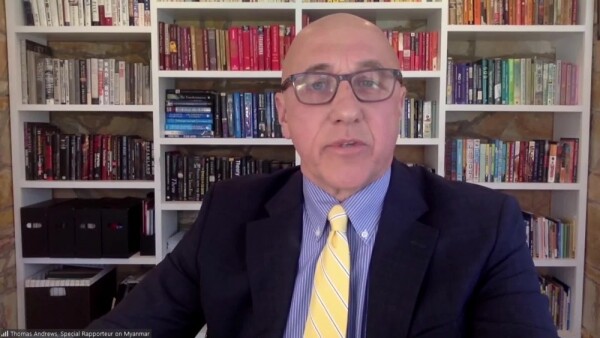
The Myanmar junta’s brutal response to peaceful protests likely meets the legal threshold for crimes against humanity, an UN-appointed independent rights expert told the Human rights Council on Thursday.
Calling for a united global response, Special Rapporteur Thomas H. Andrews said that “the people of Myanmar need not only words of support but supportive action. They need the help of the international community, now”.
According to Andrews, an independent expert appointed by the Council for a three-year mandate, a UN security council statement expressing their deep concern about developments in Myanmar are welcome words, but “they are wholly insufficient.”
Andrews stressed that a growing body of reporting indicates that the junta’s security forces are committing acts of murder, imprisonment, persecution and other crimes as part of a coordinated campaign, directed against a civilian population, in a widespread and systematic manner, with the knowledge of the junta’s leadership - thereby likely meeting the legal threshold for crimes against humanity.
“Credible reports indicate that, as of today, Myanmar security forces have murdered at least 70 people”, he said.
“The junta is detaining dozens, sometimes hundreds, every day. As of last night, the total number of arbitrary arrests and detentions since 1 February had risen beyond 2,000, and the violence against protesters, including violence against people sitting peacefully in their homes, is steadily increasing,” Andrews added.
According to Andrews, “the people of Myanmar are desperate. They are upholding and defending the highest principles of this body and the United Nations, including their commitment to non-violence. But these principles, and their very lives, are under vicious attack”.
In a report to the Human Rights Council, Andrews details how the Myanmar military illegally overthrew the civilian government last month and proceeded to attack the people of Myanmar by committing the crimes of murder, assault and arbitrary detention. He also details human rights violations preceding the coup in an annex to the report.
With the UN Security Council seemingly unwilling to invoke its Chapter VII authority, Andrews said Member States must rally together to take action.
Andrews outlined five options that such a coalition could take immediately among which are: to stop the flow of funds to the junta, including by imposing targeted sanctions on the junta’s business enterprises and on Myanmar Oil and Gas Enterprise, the single largest source of revenue to the State of Myanmar; impose an international arms embargo; ensure accountability for the crimes, through national courts using universal jurisdiction if the Security Council is unwilling to refer the matter to the International Criminal Court; work directly with local civil society and aid organizations to provide humanitarian assistance whenever possible; and deny recognition of the military junta as the legitimate government representing the people of Myanmar.
In response to the report, Mr. Chan Aye, Permanent Secretary of the Ministry of Foreign Affairs of the Republic of the Union of Myanmar, said that the State Administration Council (SAC) “did not abolish the State Constitution and it has made its commitment to consolidate the genuine, disciplined multi-party democratic system that suits the prevailing situation of the country as aspired to by the people of Myanmar.
He added that “in the recent days, the authorities concerned have been paying attention to maintaining law and order in the country. The authorities have been exercising utmost restraint to deal with violent protests. The authorities have tried to handle the violent protests in line with riot control manual in accordance with domestic laws, rules and applicable international standards.”
- ENDS-
1.Exterior wide shot, United Nations flag flying.
2.Wide of Assembly Hall briefing
3.SOUNDBITE (English) Thomas H. Andrews, Special Rapporteur on the situation of human rights in Myanmar: “Credible reports indicate that, as of today, Myanmar’s security forces have murdered at least 70 people. Madame President, those murdered were fathers, sons, mothers, daughters, husbands, and wives. They were educators, they were engineers; they were students, they were many ages, but more than half of those murdered were members of Generation Z, or young people under the age of 25”.
4. Wide shot of Assembly Hall briefing with projection of speaker
5. SOUNDBITE (English) Thomas H. Andrews, Special Rapporteur on the situation of human rights in Myanmar: ”The junta is detaining dozens, sometimes hundreds, every day. As of last night, the total number of arbitrary arrests and detentions since 1 February had risen beyond 2,000, and the violence against protesters, including violence against people sitting peacefully in their homes, is steadily increasing”.
6.Close of panel
7. SOUNDBITE (English) Thomas H. Andrews, Special Rapporteur on the situation of human rights in Myanmar: “As I
documented in my report, the junta has systemically destroyed legal protections, from freedom of expression, assembly and
association, to the right to privacy. It has given itself the authority to invade people’s homes without warning; removed habeas
corpus, or the right to appear before a judge to determine whether an arrest is lawful”.
8. Wide of Assembly Hall briefing.
9. SOUNDBITE (English) Thomas H. Andrews, Special Rapporteur on the situation of human rights in Myanmar: ”There is growing evidence that this same Myanmar military, led by the same senior leadership, is now likely engaging in crimes against humanity, including the acts of murder, enforced disappearance, persecution, torture, and imprisonment in violation of fundamental rules of international law”.
10. Close of video camera
11. SOUNDBITE (English) Thomas H. Andrews, Special Rapporteur on the situation of human rights in Myanmar: ”Yesterday, the UN Security Council released a statement expressing their deep concern about developments in Myanmar. They condemned the violence against peaceful protesters and expressed continued support for a democratic transition. These words are welcome. But, they are wholly insufficient”.
12. Mid shot of journalists
13. SOUNDBITE (English) Thomas H. Andrews, Special Rapporteur on the situation of human rights in Myanmar: “The people of Myanmar are desperate. They are upholding and defending the highest principles of this body and the United Nations, including their commitment to non-violence. But these principles, and their very lives, are under vicious attack. The people of Myanmar need not only words of support but supportive ACTION. They need the help of the international community, now”.
14. Wide of Mr. Chan Aye, Permanent Secretary of the Ministry of Foreign Affairs of the Republic of the Union of Myanmar speaking to the panel
15. SOUNDBITE (English) Mr. Chan Aye, Permanent Secretary of the Ministry of Foreign Affairs of the Republic of the Union of Myanmar: “After assumption of the responsibilities of State, the SAC did not abolish the State Constitution (2008) and it has made its commitment to consolidate the genuine, discplined multi-party democratic system that suits the prevailing situation of the country as aspired to by the people of Myanmar”.
16.Mid of Mr. Chan Aye, Permanent Secretary of the Ministry of Foreign Affairs of the Republic of the Union of Myanmar speaking to the panel
17. SOUNDBITE (English) Mr. Chan Aye, Permanent Secretary of the Ministry of Foreign Affairs of the Republic of the Union of Myanmar: “In the recent days, the authorities concerned have been paying attention to maintaining law and order in the country. The authorities have been exercising utmost restraint to deal with violent protests”.
18. Wide of Assembly Hall briefing
19. Close of Mr. Chan Aye, Permanent Secretary of the Ministry of Foreign Affairs of the Republic of the Union of Myanmar, speaking on screen.
20. UN logo
Similar Stories
1
1
1
Edited News | OCHA , UNICEF , WFP
Aid agencies warned on Friday of the fast-developing humanitarian emergency inside Taiz City in Yemen, which has been encircled by de facto Houthi forces fighting government troops along the country’s west coast.

2
17
1
2
Edited News , Press Conferences , Images | OCHA , WMO
Two UN agencies teamed up on Wednesday to issue an appeal for immediate assistance to help communities already being impacted by the strongest El Niño on record.
3
16
2
2
Edited News , B-roll , Conferences , Images | UNITED NATIONS , UNOG
Sixth Consultative Meeting on Enhancing Coordination of Peace Initiatives and Efforts for Sudan

1
1
1
Edited News | UNICEF , WHO , UNHCR
Yemen war continues to force families from homes amid hunger and disease
More than 250,000 people have now fled renewed fighting in Yemen, the UN said on Tuesday, citing particular concern for those sheltering in the southwestern city of Taiz and the wider governorate, where access is “essentially blocked”.

1
1
1
Edited News | UNICEF
A little over one year since a ceasefire agreement was announced between Hamas fighters and Israel, more than 340 children have been reported killed and hundreds more injured, the UN Children’s Fund, UNICEF, said on Friday.

1
1
1
Edited News | UNICEF , IFRC
Six weeks after Nepal’s deadly flooding disaster, communities are still struggling to rebuild their lives, but they will need sustained help as global warming increases the risk of another Himalayan catastrophe, the UN Children’s Fund (UNICEF) said on Friday.

1
1
1
Edited News | WHO
In suspected Russia plague death, testing and monitoring underway – WHO
The death of a lab worker in Russia’s Siberia region has sparked concerns about plague being the cause, the UN World Health Organization (WHO) said on Tuesday, adding that it was following the situation closely.

1
1
Edited News | OHCHR , UNOG
UN Human Rights Chief Volker Türk on Friday provided and oral update to the 63rd session of the Human rights Council on Ukraine.

1
1
1
Edited News | OHCHR , UNOG
UN Human Rights Chief Volker Türk on Friday provided and oral update to the 63rd session of the Human rights Council on the human rights situation in Haiti.

1
1
1
Edited News | WHO
Repeated delays in bringing lifesaving medicines, prosthetics and more from Israel into Gaza risk having devastating consequences on Palestinians who urgently need them in the wartorn enclave, the UN World Health Organization (WHO) said on Friday. “A truck full of non-priority supplies or the right supplies arriving too late, doesn't save lives. That's the question that actually matters," said Dr Reinhilde Van De Weerdt, WHO Representative in the OPT.

1
1
1
Edited News | WHO
DRC: Early access to care and oxygen decisive for Ebola patients’ survival – WHO
In the Democratic Republic of the Congo (DRC), health workers fighting the country’s largest-ever Ebola outbreak are struggling to overcome critical challenges to patient care, the UN World Health Organization (WHO) warned on Tuesday.

1
1
1
Edited News | OCHA , UN
Civilians in Iran are continuing to feel the consequences of months of conflict and military escalation, the UN’s top official in the country has said, as loss of life, damage to civilian infrastructure and mounting economic pressures leave many facing continued uncertainty.