

The United Nations Office at Geneva
Multimedia Newsroom
Violence in DRC Ebola hotspot leaves people ‘caught in crossfire’, disrupts aid relief
Attacks on communities in an Ebola outbreak hotspot in eastern Democratic Republic of the Congo (DRC) have created a humanitarian crisis and threatened aid distribution, the UN said on Friday, amid reports of serious civil unrest.
Tensions in eastern Beni territory in DRC’s North Kivu province have been rising since the launch of a Government-led security operation against the Allied Democratic Forces (ADF) on 30 October, UN Refugee Agency (UNHCR) spokesperson Charlie Yaxley told journalists in Geneva.
Armed groups have been targeting civilians and displaced populations in the region, killing scores of people and leaving others “caught in the crossfire”, he added.
In a statement on Friday, Hervé Verhoosel, spokesperson for the World Food Programme (WFP) said that the agency had temporarily suspended aid distribution “because both our staff - and more importantly the staff of the partners who are working with us on the ground - the security was not guaranteed any more and the access was very difficult”.
As a result, “thousands of people will not receive food assistance in the coming days,” he added.
According to UNHCR, Beni town is home to around 500,000 people. “We understand there’s at least 275,000 people in the surrounding areas who’ve already been displaced and conditions are quite dire and deteriorating,” Mr. Yaxley said.
Children are in need of immediate support, he continued, as many “have lost their parents or have arrived unaccompanied. Forced recruitment by armed groups is a real threat to the safety of children and women also face widespread sexual violence, abuse and risk of exploitation.”
The development comes as people in eastern DRC continue to be targeted by a multitude of armed groups, with at least 100 people reportedly killed in violent attacks in the Beni region and thousands displaced since 2 November, UNHCR said.
Highlighting the impact of the insecurity in Beni and Oicha on frontline healthworkers tasked with tracing anyone who has come into contact with people infected with Ebola, Christian Lindmeier, spokesperson for the World Health Organization (WHO), said that surveillance levels had dropped from 86 to 59 per cent at the start of the week.
According to WHO, around one-third of WHO’s Ebola response personnel in Beni have been temporarily relocated to Goma.
“These are essential functions of the response that are well known to reduce the risk of spread of the virus and the fluctuations in performance following insecurity may enable – well, we’re actually pretty sure it will enable - new chains of transmission,” he explained.
As of 26 November, a total of 3,304 cases of Ebola have been reported, of which 2,199 people have died since the outbreak was declared on 1 August 2018, WHO reported.
In an appeal for an end to the violence in and around Beni, UNCHR’s Mr. Yaxley warned that humanitarian agencies needed “immediate access to support the affected population. Hundreds of households are currently sleeping in churches and schools.”
Some groups of people were “trapped”, he said, noting that they were surrounded by armed forces and facing “ongoing attacks against schools (and) health centres. Even where people are known to be sheltering, they’re being displaced again because of these attacks by armed groups. At times, people are getting caught in the crossfire.”
In its latest update on the outbreak, the country’s Ministry of Health noted the “disruption of activities in the sectors of Beni and Butembo, following popular demonstrations at the killing of civilians”.
“Widespread violence” had erupted in the town of Beni nine days ago, the WFP official told journalists, precipitating the decision to temporarily move “non-essential staff” to Goma in the south of the country.
The development also follows attacks by armed groups on Wednesday at a camp in Biakato Mines and an Ebola response coordination office that claimed the lives of three responders and a police officer, injuring six others.
Condemning the violence, the WHO appealed for the “constant” attacks to stop, the development risks reversing significant progress made against the epidemic, with infections falling to just a handful in recent weeks.
Earlier this month in the town of Lwemba, Ituri province, attackers killed an Ebola response community health worker and left his wife critically injured before burning down their home. The victim was also a reporter for a community radio station, helping to raise Ebola awareness.
Wide shot: exterior, flag alley, Palais des Nations, United Nations Geneva.
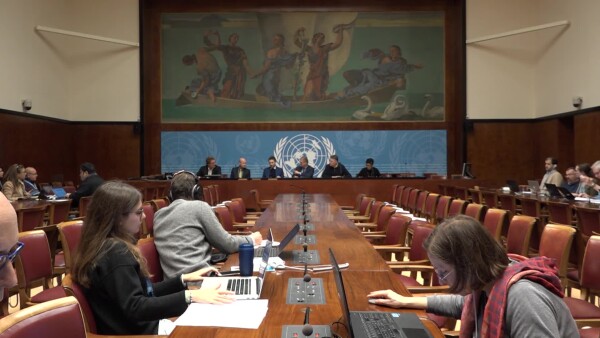
- Wide shot: Press room, journalists, podium.
- Medium shot: journalists.
- SOUNDBITE (EN) Hervé Verhoosel, spokesperson for the World Food Programme (WFP): “For us we have suspended - we have suspended temporarily – because both our staff and more importantly the staff of the partners who are working with us on the ground, the security was not guaranteed any more and the access was very difficult.”
- Wide shot: journalists, seated, semi-profile.
- SOUNDBITE (EN) Hervé Verhoosel, spokesperson for the World Food Programme (WFP): “That means that thousands of people will not receive food assistance in the coming days.”
- Medium shot: journalists, semi-profile.
- SOUNDBITE (EN) Christian Lindmeier, spokesperson for the World Health Organization (WHO):“The overall average percentage of contacts under surveillance in the last seven days is 86 per cent, but it dropped as low as 59 per cent on 25 November. These are essential functions of the response that are well known to reduce the risk of spread of the virus and the fluctuations in performance following insecurity may enable – well, we’re actually pretty sure it will enable - new chains of transmission.”
- Medium shot: journalists, profile.
- SOUNDBITE (EN) Charlie Yaxley, spokesperson for the UN Refugee Agency (UNCHR): “UNHCR and its partners are calling for an urgent restoration of security to allow humanitarian agencies immediate access to support the affected population. Hundreds of households are currently sleeping in churches and schools.”
- Medium shot: journalists, typing on laptops, podium with UN logo in part to left of shot.
- SOUNDBITE (EN) Charlie Yaxley, spokesperson for the UN Refugee Agency (UNCHR): “There are certain civilian groups who are trapped, they’re surrounded by armed forces and are currently not able to leave the areas they are in.”
- Medium shot: journalist typing on laptop, other journalists and spokespersons behind.
- SOUNDBITE (EN) Charlie Yaxley, spokesperson for the UN Refugee Agency (UNCHR): “There are ongoing attacks against schools, health centres, even where people are known to be sheltering, they’re being displaced again because of these attacks by armed groups; at times, people are getting caught in the crossfire.”
- Medium shot: journalists, TV camera crews.
- SOUNDBITE (EN) Charlie Yaxley, spokesperson for the UN Refugee Agency (UNCHR): “We estimate that there’s half a million people in the town itself, in Beni. We understand there’s at least 275,000 people in the surrounding areas who’ve already been displaced and conditions are quite dire and deteriorating. ”
- Medium shot: journalist wearing mobile phone headphones, looking down at laptop.
- SOUNDBITE (EN) Charlie Yaxley, spokesperson for the UN Refugee Agency (UNCHR): “Children are in need of immediate support, many of whom have lost their parents or have arrived unaccompanied. Forced recruitment by armed groups is a real threat to the safety of children and women also face widespread sexual violence, abuse and risk of exploitation.”
- Medium shot: journalists, podium backdrop partly visible.
- Medium shot: journalists, podium with speakers to rear.
Similar Stories

1
1
1
Edited News | OCHA , UNICEF , WFP
Aid agencies warned on Friday of the fast-developing humanitarian emergency inside Taiz City in Yemen, which has been encircled by de facto Houthi forces fighting government troops along the country’s west coast.

2
17
1
2
Edited News , Press Conferences , Images | OCHA , WMO
Two UN agencies teamed up on Wednesday to issue an appeal for immediate assistance to help communities already being impacted by the strongest El Niño on record.

3
16
2
2
Edited News , B-roll , Conferences , Images | UNITED NATIONS , UNOG
Sixth Consultative Meeting on Enhancing Coordination of Peace Initiatives and Efforts for Sudan

1
1
1
Edited News | UNICEF , WHO , UNHCR
Yemen war continues to force families from homes amid hunger and disease
More than 250,000 people have now fled renewed fighting in Yemen, the UN said on Tuesday, citing particular concern for those sheltering in the southwestern city of Taiz and the wider governorate, where access is “essentially blocked”.

1
1
1
Edited News | UNICEF
A little over one year since a ceasefire agreement was announced between Hamas fighters and Israel, more than 340 children have been reported killed and hundreds more injured, the UN Children’s Fund, UNICEF, said on Friday.

1
1
1
Edited News | UNICEF , IFRC
Six weeks after Nepal’s deadly flooding disaster, communities are still struggling to rebuild their lives, but they will need sustained help as global warming increases the risk of another Himalayan catastrophe, the UN Children’s Fund (UNICEF) said on Friday.

1
1
1
Edited News | WHO
In suspected Russia plague death, testing and monitoring underway – WHO
The death of a lab worker in Russia’s Siberia region has sparked concerns about plague being the cause, the UN World Health Organization (WHO) said on Tuesday, adding that it was following the situation closely.

1
1
Edited News | OHCHR , UNOG
UN Human Rights Chief Volker Türk on Friday provided and oral update to the 63rd session of the Human rights Council on Ukraine.

1
1
1
Edited News | OHCHR , UNOG
UN Human Rights Chief Volker Türk on Friday provided and oral update to the 63rd session of the Human rights Council on the human rights situation in Haiti.

1
1
1
Edited News | WHO
Repeated delays in bringing lifesaving medicines, prosthetics and more from Israel into Gaza risk having devastating consequences on Palestinians who urgently need them in the wartorn enclave, the UN World Health Organization (WHO) said on Friday. “A truck full of non-priority supplies or the right supplies arriving too late, doesn't save lives. That's the question that actually matters," said Dr Reinhilde Van De Weerdt, WHO Representative in the OPT.

1
1
1
Edited News | WHO
DRC: Early access to care and oxygen decisive for Ebola patients’ survival – WHO
In the Democratic Republic of the Congo (DRC), health workers fighting the country’s largest-ever Ebola outbreak are struggling to overcome critical challenges to patient care, the UN World Health Organization (WHO) warned on Tuesday.

1
1
1
Edited News | OCHA , UN
Civilians in Iran are continuing to feel the consequences of months of conflict and military escalation, the UN’s top official in the country has said, as loss of life, damage to civilian infrastructure and mounting economic pressures leave many facing continued uncertainty.