

The United Nations Office at Geneva
Multimedia Newsroom
Belarus human rights situation under review at UN forum
Belarus’s rights record received support from some Member States and urgent calls for reform from others at a regular review at the United Nations in Geneva on Monday.
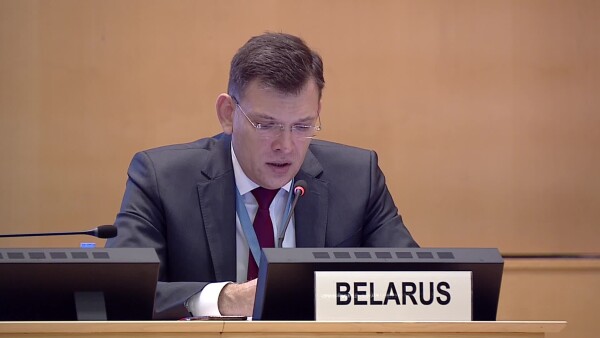
Permanent Representative of Belarus to the UN in Geneva, Ambassador Yury Ambrazevich, opened the Universal Periodic Review (UPR) meeting by appealing to other Member States to respect its current situation while commenting on its recent human rights record.
“The third cycle of the UPR is being undertaken by Belarus in a situation not only of a pandemic but also a complex situation with politics and society in our country following the elections to the presidency,” he said. “We have publicly several times spoken out on this subject. In that connection I would like to appeal to all participants today not to turn the UPR on Belarus only into a discussion of post-election events.”
Belarus faced written questions from the United States, Germany, Britain and others demanding greater safeguards on torture and freedom of expression, amid questions and comments from more than 90 delegations during the discussion.
“Belarus recognises that there are issues on which work needs to be done, and work will continue on these in the future,” Ambassador Ambrazevich said. “At the same time, we are convinced that only through respectful dialogue without external pressure, blackmail or conditions is it possible to make true progress, including on the basis of leading international experience.”
In September, UN Secretary General António Guterres expressed deep concern about the use of force against peaceful protestors in Belarus, where the re-election of President Alexander Lukashenko in August prompted huge demonstrations, and the UN Human Rights Council adopted a resolution on the deteriorating rights situation.
In Monday’s UPR session, Russian Ambassador and Permanent Representative to the UN in Geneva Gennady Gatilov welcomed the implementation by Minsk of previous UPR recommendations. “In conditions of increasing external pressure that would not be easy,” he added. “We take the view that non-interference in internal affairs of a sovereign state, including in electoral processes, is a basic principle of international law.”
US Permanent Representative to the UN in Geneva, Ambassador Andrew Bremberg, said that Belarus should immediately stop its “brutal crackdown” on peaceful protestors and hold those responsible to account. It should also immediately release all those detained in election-related protests and engage in a genuine dialogue with civil society, he added.
“Belarus’s 9 August presidential elections were fraudulent and we are deeply concerned by the ongoing use of violence, intimidation and repression against the Belarusian people,” Ambassador Bremberg said.
The UPR session also heard from Government bodies and ministries in Minsk, who commented by videolink. A Belarusian Interior Ministry official rejected earlier criticism, saying that the protests were deliberate provocations by trained fighters. Under interrogation, detained young people had said they had made a mistake by going to the protests, he said, adding that the demonstrators had been lured by fake news and used as “cannon fodder”.
The Interior Ministry official added that Belarus was allowed to limit the rights and freedoms of citizens in the interests of national security, public order, protection of morality and public health, and that there had been no identified cases of unlawful acts by the police.
- Wide shot, Assembly Hall, UN Geneva, venue for the Universal Periodic Review by Member States.
- SOUNDBITE (RU/EN): Permanent Representative of Belarus to the UN in Geneva, Ambassador Yury Ambrazevich: “The third cycle of the UPR is being undertaken by Belarus in a situation not only of a pandemic but also a complex situation with politics and society in our country following the elections to the presidency. We have publicly several times spoken out on this subject. In that connection, I would like to appeal to all participants today not to turn the UPR on Belarus only into a discussion of post-election events.”
- Wide shot, podium and delegates in the Assembly Hall, UN Geneva.
- SOUNDBITE (RU/EN): Permanent Representative of Belarus to the UN in Geneva, Ambassador Yury Ambrazevich: “…that is natural and normal. Belarus recognises that there are issues on which work needs to be done, and work will continue on these in future. At the same time, we are convinced that only through respectful dialogue without external pressure, blackmail or conditions, is it possible to make true progress, including on the basis of leading international experience.”
- Medium shot, podium speakers in the Assembly Hall, UN Geneva.
- SOUNDBITE (RU/EN): Permanent Representative of Russia to the UN in Geneva, Ambassador Gennady Gatilov: “We welcome the implementation by Minsk of the recommendations made under the second cycle of the UPR. In conditions of increasing external pressure that would not be easy. We take the view that non-interference in internal affairs of a sovereign State, including in electoral processes, is a basic principle of international law.”
- Medium shot, showing Permanent Representative of Belarus to the UN in Geneva, Ambassador Yury Ambrazevich, sitting close to another delegate, in line with COVID-19 distancing measures, Assembly Hall, UN Geneva.
- SOUNDBITE (English) — US Permanent Representative to the UN in Geneva, Ambassador Andrew Bremberg: “Belarus’s August 9 Presidential elections were fraudulent and we are deeply concerned by the ongoing use of violence, intimidation and repression against the Belarussian people. We call upon the Belarussian authorities to demonstrate restraint and engage in a genuine dialogue with Belarussian civil society.”
- Medium shot, delegates, profile, Assembly Hall, UN Geneva.
- Close-up, delegates, Assembly Hall, UN Geneva.
- Medium shot: presiding, President of the UN Human Rights Council for 2020, Austrian Ambassador and Permanent Representative to the UN in Geneva Elisabeth Tichy-Fisslberger.
- Medium shot: delegates, TV camera operator, Assembly Hall, UN Geneva.
- Close up, UN logo on open door showing UPR delegate (blurred) to rear.
Similar Stories

2
17
1
2
Edited News , Press Conferences | OCHA , WMO
Two UN agencies teamed up on Wednesday to issue an appeal for immediate assistance to help communities already being impacted by the strongest El Niño on record.

3
16
2
2
B-roll , Conferences , Edited News | UNITED NATIONS , UNOG
Sixth Consultative Meeting on Enhancing Coordination of Peace Initiatives and Efforts for Sudan

1
1
1
Edited News | UNICEF , WHO , UNHCR
Yemen war continues to force families from homes amid hunger and disease
More than 250,000 people have now fled renewed fighting in Yemen, the UN said on Tuesday, citing particular concern for those sheltering in the southwestern city of Taiz and the wider governorate, where access is “essentially blocked”.

1
1
1
Edited News | UNICEF
A little over one year since a ceasefire agreement was announced between Hamas fighters and Israel, more than 340 children have been reported killed and hundreds more injured, the UN Children’s Fund, UNICEF, said on Friday.

1
1
1
Edited News | UNICEF , IFRC
Six weeks after Nepal’s deadly flooding disaster, communities are still struggling to rebuild their lives, but they will need sustained help as global warming increases the risk of another Himalayan catastrophe, the UN Children’s Fund (UNICEF) said on Friday.

1
1
1
Edited News | WHO
In suspected Russia plague death, testing and monitoring underway – WHO
The death of a lab worker in Russia’s Siberia region has sparked concerns about plague being the cause, the UN World Health Organization (WHO) said on Tuesday, adding that it was following the situation closely.

1
1
Edited News | OHCHR , UNOG
UN Human Rights Chief Volker Türk on Friday provided and oral update to the 63rd session of the Human rights Council on Ukraine.

1
1
1
Edited News | OHCHR , UNOG
UN Human Rights Chief Volker Türk on Friday provided and oral update to the 63rd session of the Human rights Council on the human rights situation in Haiti.

1
1
1
Edited News | WHO
Repeated delays in bringing lifesaving medicines, prosthetics and more from Israel into Gaza risk having devastating consequences on Palestinians who urgently need them in the wartorn enclave, the UN World Health Organization (WHO) said on Friday. “A truck full of non-priority supplies or the right supplies arriving too late, doesn't save lives. That's the question that actually matters," said Dr Reinhilde Van De Weerdt, WHO Representative in the OPT.

1
1
1
Edited News | WHO
DRC: Early access to care and oxygen decisive for Ebola patients’ survival – WHO
In the Democratic Republic of the Congo (DRC), health workers fighting the country’s largest-ever Ebola outbreak are struggling to overcome critical challenges to patient care, the UN World Health Organization (WHO) warned on Tuesday.

1
1
1
Edited News | OCHA , UN
Civilians in Iran are continuing to feel the consequences of months of conflict and military escalation, the UN’s top official in the country has said, as loss of life, damage to civilian infrastructure and mounting economic pressures leave many facing continued uncertainty.
1
1
1
Edited News | WHO , UNICEF
Aid agencies in Yemen highlighted the growing hunger emergency sparked by renewed fighting between Houthi opposition forces and Government troops, after mobile health clinics reported that hundreds of children displaced by the violence are suffering from the most deadly form of malnutrition.