

The United Nations Office at Geneva
Multimedia Newsroom
Belarus concerns lead opening session of Human Rights Council
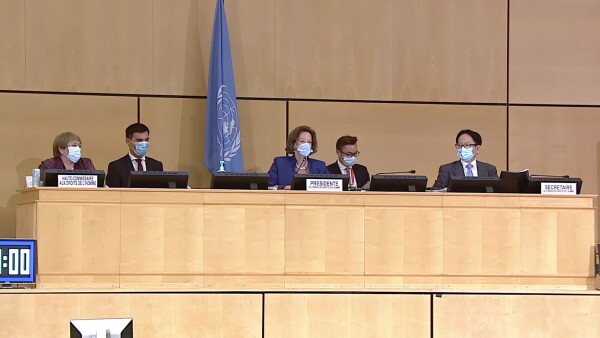
UN Member States gathered in person in Geneva on Monday for a new session of the Human Rights Council; proceedings began with a decision to hold a rare Urgent Debate on the situation in Belarus.
Leading the request, the European Union delegation - represented by Germany - highlighted what it called a “steep deterioration of the human rights situation” in the country, before and after the disputed presidential election in August.
The delegation for Belarus rejected the proposed debate, citing outside interference.
“The enforced disappearances, the forced abductions, expulsions and arbitrary detentions continue to take place every day in Belarus,” said Ambassador Michael von Ungern-Sternberg, for the European Union. “In past days we have witnessed a further escalation of violence and intimidation against members of the Coordination Council and other representatives of civil society. The opposition leader, Maria Kolesnikova, was abducted and journalists lost their accreditations. Therefore, the situation on the ground clearly warrants an Urgent Debate. The Human Rights Council should not stay silent on this matter.”
Ambassador von Ungern-Sternberg maintained that “the reasons for this request are clear. There has been a steep deterioration of the human rights situation in Belarus in the run-up to and aftermath of the Presidential election of 9 August 2020. Which was held in the absence of meaningful international observation and was neither free nor fair.”
The development at the Council’s 45th session follows condemnation of violence against demonstrators in Belarus by UN rights chief, Michelle Bachelet, since the presidential election on 9 August.
Over the weekend, UN Secretary-General António Guterres also expressed deep concern about the continued use of force against peaceful protestors and the detention of people exercising their democratic rights.
Dismissing the EU proposal, Belarus’s Ambassador Yury Ambrazevic noted that the Presidential elections of 2020 had returned Alexander Lukashenko to power.
He had been “victorious”, the Ambassador noted, “and he received the corresponding congratulations from the heads of China, Russia, Kazakhstan and many other States”.
Nonetheless, “part of our society was not in agreement with these events”, the Ambassador continued, leading to “highly politicised” events and “a high level of political activity by the citizens. In the capital and in certain other states, street protests have been taking place.”
It was unfortunate and “very sad – that some people have suffered, both protesters and employees of law enforcement agencies have been injured”, he continued, noting that “in all cases”, wherever there had been “clashes between protesters and law enforcement, we have conducted checks and verifications”.
Ambassador Ambrazevic also insisted that the Government was “working on a proposal to update the Belarus constitution and considering how to organise a national dialogue in order to overcome the political standoff that has formed within our society. Work is being done also to restore national harmony within the country.”
Urgent Debates can be requested during regular sessions of the Council to tackle urgent situations requiring a rapid response from the body. In June, the Council gave the green light to an Urgent Debate on systemic racism, alleged police brutality and violence against protesters, following the killing of American George Floyd in police custody.
After a roll-call vote on the proposal on Belarus by the Council’s 47 Members, Council President Ambassador Tichy-Fisslberger announced that the outcome was “25 votes in favour, two against and 20 abstentions. Which means that the proposal to hold an Urgent Debate on Belarus is adopted.”
The Urgent Debate would be held this Friday, she added.
- Medium-wide shot: exterior, flag alley, passer-by, Palais des Nations, United Nations Geneva.
- Wide shot: Assembly Hall, UN Geneva, temporary home of the UN Human Rights Council, podium speakers including Ambassador Elisabeth Tichy-Fisslberger (Austria), President of the Human Rights Council, following a call for an urgent debate on the deteriorating situation in Belarus, made by EU Member States on 11 September 2020.
- SOUNDBITE (EN) – Germany’s Ambassador Michael von Ungern-Sternberg for the European Union: “The enforced disappearances, forced abductions and expulsions and arbitrary detentions continue to take place every day in Belarus. In past days we have witnessed a further escalation of violence and intimidation against members of the Coordination Council and other representatives of civil society. The opposition leader, Maria Kolesnikova, was abducted and journalists lost their accreditations. Therefore, the situation on the ground clearly warrants an Urgent Debate. The Human Rights Council should not stay silent on this matter.”
- Medium shot: showing delegates spaced apart, one is typing on a laptop.
- SOUNDBITE (EN) – Germany’s Ambassador Michael von Ungern-Sternberg for the European Union: “The reasons for this request are clear. There has been a steep deterioration of the human rights situation in Belarus in the run-up to and aftermath of the Presidential election of 9 August 2020. It was held in the absence of meaningful international observation and was neither free nor fair.”
- Medium shot: delegates wearing facemasks in foreground, TV cameraman to rear, swivelling camera.
- SOUNDBITE (EN) – Belarus’s Ambassador Yury Ambrazevic: “The Presidential elections of 2020, the current head of state, Alexander Lukashenko was victorious, and he received the corresponding congratulations from the heads of China, Russia, Kazakhstan and many other states. Part of our society was not in agreement with these events; as a result, following the Presidential elections there were events in our country in August of 2020 which were highly politicised and saw a high level of political activity by the citizens. In the capital and in certain other states, street protests have been taking place.”
- Medium shot: photographer wearing facemask, standing amid delegates.
- SOUNDBITE (EN) – Belarus’s Ambassador Yury Ambrazevic: “Unfortunately – and it is very sad – that some people have suffered, both protesters and employees of law enforcement agencies have been injured. In all cases, where there were clashes between protesters and law enforcement, we have conducted checks and verifications. The political leadership of the Government and the Government are working on a proposal to update the Belarus constitution and considering how to organise a national dialogue in order to overcome the political standoff that has formed within our society. Work is being done also to restore national harmony within the country.”
- Close-up: delegate for Spain, wearing facemask.
- SOUNDBITE (EN) – Ambassador Elisabeth Tichy-Fisslberger (Austria), President of the Human Rights Council: “The Council will now proceed to a roll-call vote on the proposal to hold an Urgent Debate on the situation of human rights in Belarus.”
- Medium shot, panning: delegates either responding or listening to the roll-call, features Ukraine (votes yes), Uruguay (yes), Venezuela (no), Afghanistan (yes), Angola (absention).
- Wide shot: Assembly Hall, delegates and podium, dimly-lit.
- SOUNDBITE (EN) – SOUNDBITE (EN) – Ambassador Elisabeth Tichy-Fisslberger (Austria), President of the Human Rights Council: “And the result is 25 votes in favour, two against and 20 abstentions. Which means that the proposal to hold an Urgent Debate on the human rights situation Belarus is adopted.”
- Wide shot: Assembly Hall from above.
- Medium shot: delegate typing on laptop, podium to rear.
Similar Stories

1
1
1
Edited News | OCHA , UNICEF , WFP
Aid agencies warned on Friday of the fast-developing humanitarian emergency inside Taiz City in Yemen, which has been encircled by de facto Houthi forces fighting government troops along the country’s west coast.

2
17
1
2
Edited News , Press Conferences , Images | OCHA , WMO
Two UN agencies teamed up on Wednesday to issue an appeal for immediate assistance to help communities already being impacted by the strongest El Niño on record.

3
16
2
2
Edited News , B-roll , Conferences , Images | UNITED NATIONS , UNOG
Sixth Consultative Meeting on Enhancing Coordination of Peace Initiatives and Efforts for Sudan

1
1
1
Edited News | UNICEF , WHO , UNHCR
Yemen war continues to force families from homes amid hunger and disease
More than 250,000 people have now fled renewed fighting in Yemen, the UN said on Tuesday, citing particular concern for those sheltering in the southwestern city of Taiz and the wider governorate, where access is “essentially blocked”.

1
1
1
Edited News | UNICEF
A little over one year since a ceasefire agreement was announced between Hamas fighters and Israel, more than 340 children have been reported killed and hundreds more injured, the UN Children’s Fund, UNICEF, said on Friday.

1
1
1
Edited News | UNICEF , IFRC
Six weeks after Nepal’s deadly flooding disaster, communities are still struggling to rebuild their lives, but they will need sustained help as global warming increases the risk of another Himalayan catastrophe, the UN Children’s Fund (UNICEF) said on Friday.

1
1
1
Edited News | WHO
In suspected Russia plague death, testing and monitoring underway – WHO
The death of a lab worker in Russia’s Siberia region has sparked concerns about plague being the cause, the UN World Health Organization (WHO) said on Tuesday, adding that it was following the situation closely.

1
1
Edited News | OHCHR , UNOG
UN Human Rights Chief Volker Türk on Friday provided and oral update to the 63rd session of the Human rights Council on Ukraine.

1
1
1
Edited News | OHCHR , UNOG
UN Human Rights Chief Volker Türk on Friday provided and oral update to the 63rd session of the Human rights Council on the human rights situation in Haiti.

1
1
1
Edited News | WHO
Repeated delays in bringing lifesaving medicines, prosthetics and more from Israel into Gaza risk having devastating consequences on Palestinians who urgently need them in the wartorn enclave, the UN World Health Organization (WHO) said on Friday. “A truck full of non-priority supplies or the right supplies arriving too late, doesn't save lives. That's the question that actually matters," said Dr Reinhilde Van De Weerdt, WHO Representative in the OPT.

1
1
1
Edited News | WHO
DRC: Early access to care and oxygen decisive for Ebola patients’ survival – WHO
In the Democratic Republic of the Congo (DRC), health workers fighting the country’s largest-ever Ebola outbreak are struggling to overcome critical challenges to patient care, the UN World Health Organization (WHO) warned on Tuesday.

1
1
1
Edited News | OCHA , UN
Civilians in Iran are continuing to feel the consequences of months of conflict and military escalation, the UN’s top official in the country has said, as loss of life, damage to civilian infrastructure and mounting economic pressures leave many facing continued uncertainty.