

The United Nations Office at Geneva
Multimedia Newsroom
20260529 Ebola update – WHO_Storyline
‘A disease you get when you care for someone’: on the frontlines of the Ebola crisis with WHO
Two weeks into the latest Ebola outbreak, the World Health Organization (WHO) is estimating that there are 906 suspected cases of Ebola in the Democratic Republic of Congo (DRC), including 223 suspected deaths.
Early detection and community mobilization remain critical to saving lives, as potential treatments and vaccines are being still being assessed, WHO said on Friday.
Since 15 May, UN agencies have been supporting both the DRC and neighbouring Uganda to contain the outbreak caused by the rare Bundibugyo strain of the Ebola virus, which spreads through close contact.
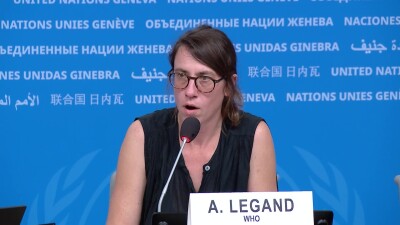
“It's a disease that you get when you care for someone, for your husband or your partner or your child or your mother,” Anaïs Legand, a WHO Technical Officer told reporters in Geneva.
“You get it when you want to help someone with symptoms, and this is terrible,” she said, explaining that families and friends have to be instructed not to touch loved ones who are falling sick.
Ms. Legand highlighted the critical importance of prevention and early access to care, in the face of this particularly deadly disease. Based on previous outbreaks the lethality “ranges between 30 and 50 per cent,” she said - “it’s huge.”
While “five out of 10 people are likely to die,” more can be done to promote recovery, according to the WHO expert. “We can scale up optimized intensive care,” she said. "We can support the communities to recognize the symptoms early to get early diagnostics, so that they can receive the level of care they need.”
Experience shows that Ebola flare-ups can only be controlled when communities are “fully involved” in the response, Ms. Legrand insisted -- highlighting a recent case in the DRC where a patient fully recovered and was discharged from the hospital.
WHO has gathered experts to review potential treatments and vaccines against the virus, with several products now identified for further assessment.
For confirmed cases, three candidate therapeutics for treatment have been prioritized for clinical trials, Ms. Legand revealed: the monoclonal antibodies MBP 134 and maftivimab, and the antiviral remdesivir.
For prevention, the oral antiviral obeldesivir is being prioritized within a clinical study as a post-exposure measure for those who have been in contact with confirmed cases.
The WHO expert added that two candidate vaccines have been identified for evaluation once doses become available.
The agency is working closely with the governments of DRC and Uganda to support the assessment of these potential medical countermeasures, while at the same time “urgently scaling up care capacities to ensure all patients in affected communities can access optimized supportive care that can help save lives,” Ms. Legand said.
“This outbreak is happening in a very complex context,” she stressed, recalling that in the affected Ituri province alone, 1.2 million people require humanitarian assistance, while ongoing conflict and food insecurity are hampering the response.
“The issue that we have in the field is not necessarily an issue of resources,” Ms. Legand insisted. “It's an issue of access.”
The airport in Ituri province’s capital Bunia has been closed, and while the DRC Government has allowed humanitarian flights to proceed, operational constraints remain. “One day I got a call from my team telling me there is no fuel,” the WHO expert said.
Ahead of his arrival in DRC on Thursday, WHO chief Tedros Adhanom Ghebreyesus appealed to armed groups to declare a ceasefire so that health workers can reach people in need and halt spread of the disease.
The DRC notified WHO of an outbreak of Bundibugyo virus disease on 15 May and as of Thursday, 125 confirmed cases have been reported, including 17 deaths across Ituri, North Kivu and South Kivu provinces. In addition, 906 suspected cases including over 223 deaths are under investigation and are being reviewed as testing capacity improves.
In Uganda, as of Thursday there were seven confirmed cases, including one death; three of them were imported from the DRC and others are linked contacts. WHO said that there is no evidence of community transmission in the country at this stage.
While indicating that people from the affected areas who may have been exposed to Ebola should not travel, the UN health agency does not recommend any restriction on travel or trade with the DRC or Uganda based on the current information.
-ends-
STORY Ebola update - WHO
TRT: 4:52’’
SOURCE: UNTV CH
RESTRICTIONS: CREDIT UNICEF BROLL
LANGUAGE: ENGLISH/FRENCH/NATS
ASPECT RATIO: 16:9
DATELINE: 29 MAY 2026 GENEVA, SWITZERLAND and 28 MAY 2026, ITURI, DEMOCRATIC REPUBLIC OF THE CONGO
1. Exterior wide shot: Palais des Nations, Flag Alley.
2. Wide reverse shot: Speakers at the podium of the press conference; speaker on screens; journalists in the Press room.
3. SOUNDBITE (English) – Anaïs Legand, Technical Officer, Viral Haemorrhagic Fevers, World Health Organization (WHO): “It's a disease that you get when you care for someone. When you care for your husband or your partner or your child or your mother. You get it when you want to help someone with symptoms. And this is terrible, because this disease, to avoid getting it, you have to ask communities not to touch someone they love when they are feeling sick. But this is critical.”
4. Medium reverse shot: Speakers at the podium of the press conference; speaker on screens.
5. SOUNDBITE (English) – Anaïs Legand, Technical Officer, Viral Haemorrhagic Fevers, World Health Organization (WHO): “From previous outbreaks of Bundibugyo virus disease, the lethality, that is the number of people who died among people who were confirmed for the infection, ranges between 30 to 50 per cent. It's huge. It means like up to five out of 10 people are likely to die. So, having people who recover tells us two things: Five people are likely also to recover, and we can do more.”
6. Wide shot: Journalists in the Press room; speaker on screens.
7. SOUNDBITE (French) – Anaïs Legand, Technical Officer, Viral Haemorrhagic Fevers, World Health Organization (WHO): “La mobilisation communautaire reste essentielle. L'expérience montre que des flambées de ce type ne peuvent être maîtrisées que lorsque les communautés sont pleinement impliquées dans la riposte. Un développement positif pour conclure sur la RDC. Est également à signaler que le 27 mai, un patient a guéri et a quitté l'hôpital et a été déchargé dans la communauté.”
8. Medium shot: Speakers at the podium of the press conference.
9. SOUNDBITE (French) – Anaïs Legand, Technical Officer, Viral Haemorrhagic Fevers, World Health Organization (WHO): “Plusieurs produits candidats ont été identifiés pour des essais cliniques pour le traitement. Trois candidats thérapeutiques sont priorisés pour les essais cliniques, les anticorps monoclonaux MBP 134, le maftivimab ainsi que l'antiviral remdesivir. Pour la prévention, l'antiviral oral obeldesivir est priorisé pour une utilisation post-exposition chez les contacts de cas confirmés dans le cadre d'essais cliniques. En outre, deux vaccins candidats ont été identifiés pour évaluation dès que des doses deviendront disponibles.”
10. Medium shot: Journalist in the Press room.
11. SOUNDBITE (English) – Anaïs Legand, Technical Officer, Viral Haemorrhagic Fevers, World Health Organization (WHO): “Now we have this candidate therapeutics and vaccine, WHO is working closely with the Governments of both countries to support the assessment of these candidate medical countermeasures, while at the same time and urgently, scaling up care capacities to ensure all patients in those affected communities can access optimized supportive care that can help save lives.”
12. Wide reverse shot: Speakers at the podium of the press conference; speaker on screens; journalists in the Press room.
13. SOUNDBITE (English) – Anaïs Legand, Technical Officer, Viral Haemorrhagic Fevers, World Health Organization (WHO): “This outbreak is happening in a very complex context. In Ituri alone, 1.2 million people require humanitarian assistance. Ongoing conflict and food insecurity are making the response more difficult.”
14. Medium shot: Journalists in the Press room.
15. SOUNDBITE (English) – Anaïs Legand, Technical Officer, Viral Haemorrhagic Fevers, World Health Organization (WHO): “The issue that we have in the field is not necessarily an issue of resources. It's an issue of access. You may have heard in the news that Bunia Airport has been closed. And we thank the Republic Democratic of the Congo to allow humanitarian flights to still continue to go in Bunia. But access is not fully functional. One day I got a call from my team telling me there is no fuel.”
16. UNICEF B-ROLL: CREDIT UNICEF. 28 MAY 2026, ITURI, DEMOCRATIC REPUBLIC OF THE CONGO: Various shots, UNICEF’s first international shipment of Ebola response supplies arriving at Ituri, northeastern DRC.
Similar Stories

1
1
1
Edited News | UNICEF
A little over one year since a ceasefire agreement was announced between Hamas fighters and Israel, more than 340 children have been reported killed and hundreds more injured, the UN Children’s Fund, UNICEF, said on Friday.

1
1
1
Edited News | UNICEF , IFRC
Six weeks after Nepal’s deadly flooding disaster, communities are still struggling to rebuild their lives, but they will need sustained help as global warming increases the risk of another Himalayan catastrophe, the UN Children’s Fund (UNICEF) said on Friday.

1
1
1
Edited News | WHO
In suspected Russia plague death, testing and monitoring underway – WHO
The death of a lab worker in Russia’s Siberia region has sparked concerns about plague being the cause, the UN World Health Organization (WHO) said on Tuesday, adding that it was following the situation closely.

1
1
Edited News | OHCHR , UNOG
UN Human Rights Chief Volker Türk on Friday provided and oral update to the 63rd session of the Human rights Council on Ukraine.

1
1
1
Edited News | OHCHR , UNOG
UN Human Rights Chief Volker Türk on Friday provided and oral update to the 63rd session of the Human rights Council on the human rights situation in Haiti.

1
1
1
Edited News | WHO
Repeated delays in bringing lifesaving medicines, prosthetics and more from Israel into Gaza risk having devastating consequences on Palestinians who urgently need them in the wartorn enclave, the UN World Health Organization (WHO) said on Friday. “A truck full of non-priority supplies or the right supplies arriving too late, doesn't save lives. That's the question that actually matters," said Dr Reinhilde Van De Weerdt, WHO Representative in the OPT.

1
1
1
Edited News | WHO
DRC: Early access to care and oxygen decisive for Ebola patients’ survival – WHO
In the Democratic Republic of the Congo (DRC), health workers fighting the country’s largest-ever Ebola outbreak are struggling to overcome critical challenges to patient care, the UN World Health Organization (WHO) warned on Tuesday.

1
1
1
Edited News | OCHA , UN
Civilians in Iran are continuing to feel the consequences of months of conflict and military escalation, the UN’s top official in the country has said, as loss of life, damage to civilian infrastructure and mounting economic pressures leave many facing continued uncertainty.
1
1
1
Edited News | WHO , UNICEF
Aid agencies in Yemen highlighted the growing hunger emergency sparked by renewed fighting between Houthi opposition forces and Government troops, after mobile health clinics reported that hundreds of children displaced by the violence are suffering from the most deadly form of malnutrition.
1
1
1
Edited News | UNHCR
Displacement on the rise in Yemen as fighting continues - UNHCR
As hostilities worsen in Yemen, more people have been fleeing their homes, further intensifying the humanitarian crisis within the region, the UN Refugee Agency (UNHCR) warned on Tuesday.
1
1
1
Edited News | IOM , OHCHR , UNFPA , UNOG , UNHCR , WHO
Yemen’s humanitarian crisis growing by the hour amid spike in displacement
Yemenis displaced by renewed fighting have described fleeing for their lives amid shelling and gunfire, aid agencies reported on Friday, while highlighting the dramatic increase in humanitarian needs in the country and in Djibouti, where thousands have sought shelter.
1
1
1
Edited News | OHCHR , UNOG
The UN Human Rights Office issued on Friday a report documenting a shocking pattern of sexual violence amid Russia’s full-scale armed attack on Ukraine.