

The United Nations Office at Geneva
Multimedia Newsroom
The UN Migration Agency appealed on Friday for the immediate liberation of a volunteer and child who remain missing since a gun battle in South Sudan at the weekend that claimed the lives of three agency workers.
According to IOM, they were caught in the crossfire between two armed groups in Isebi, Morobo County, in South Sudan’s Central Equatoria region.
The volunteers had been manning an Ebola screening point in border areas between South Sudan and the Democratic Republic of Congo, tracking the spread of the deadly disease that has killed more than 2,180 people in DRC since last August.
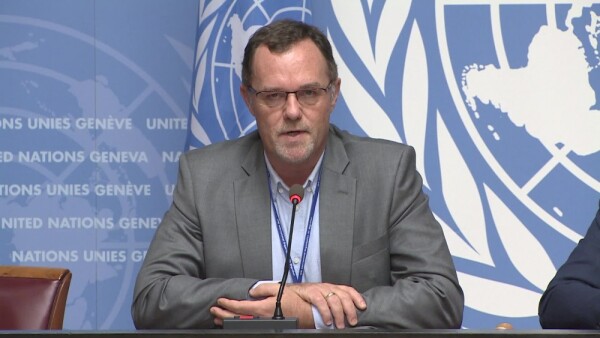
Speaking in Geneva, spokesperson Paul Dillon repeated the call “for the unconditional release of a female volunteer and a four-year-old child abducted in South Sudan during gun battle on Sunday morning that claimed the lives of three IOM humanitarian workers”.
The three IOM workers were two men and a woman, and it is understood that it was her son that was abducted, Mr. Dillon said.
He added that “all possible action” was being taken “to get our colleague released from her abductors immediately without pre-conditions”.
For the time being the agency has halted operations in several border areas.
“Obviously, we are there for a reason, to monitor possible flows of Ebola into South Sudan,” Mr. Dillon explained.
“These individuals in South Sudan as in many other countries are very much on the front line in this response.”
He added: “We have suspended our operations in five of those border areas until we can get clarity on the security situation and the commitment from all actors in that area that the security of our staff in that area will be safeguarded.”
IOM began operations in southern Sudan in early 2005 and established the IOM South Sudan mission after the country’s independence in July 2011.
Last month, Deputy Special Representative and Humanitarian/Resident Coordinator Alain Noudehou noted concerns that if Ebola spread to South Sudan, it risked overwhelming the healthcare system.
Since the outbreak of civil war in December 2013, IOM has provided support to thousands of host communities, returnees and internally displaced people.
This includes those seeking protection at the United Nations Mission in South Sudan Protection of Civilians sites, IOM said in a statement.
- Wide shot, exterior, Palais des Nations, Geneva.
- Wide shot, journalists and podium in Press Room III, United Nations Geneva.
- Medium shot, journalists, profile.
- SOUNDBITE (English) — Paul Dillon, International Organization for Migration (IOM): “The International Organization for Migration continues to call for the unconditional release of a female volunteer and a four-year-old child abducted in South Sudan during gun battle on Sunday morning that claimed the lives of three IOM humanitarian workers.”
- Medium shot, journalists, profile, Press Room III, United Nations Geneva.
- SOUNDBITE (English) — Paul Dillon, International Organization for Migration (IOM): “All possible action is being taken with the goal of trying to get our colleague released from her abductors immediately without pre-conditions.”
- Medium shot, TV camera crews, Press Room III, United Nations Geneva.
- SOUNDBITE (English) — Paul Dillon, International Organization for Migration (IOM): “We have suspended our operations in five of those border areas until we can get clarity on the security situation and the commitment from all actors in that area that the security of our staff in that area will be safeguarded.”
- Close up, journalists, profile, Press Room III, United Nations Geneva.
- SOUNDBITE (English) — Paul Dillon, International Organization for Migration (IOM): “Obviously, we are there for a reason, to monitor possible flows of Ebola into South Sudan. These individuals in South Sudan as in many other countries are very much on the front line in this response.”
- Close up, journalist’s fingers holding pen and writing on notepad, Press Room III, United Nations Geneva.
- Medium shot, podium partly obscured by press release being held up by journalist, Press Room III, United Nations Geneva.
- Medium shot, journalists, Press Room III, United Nations Geneva.
Similar Stories

1
1
1
Edited News | UNICEF
A little over one year since a ceasefire agreement was announced between Hamas fighters and Israel, more than 340 children have been reported killed and hundreds more injured, the UN Children’s Fund, UNICEF, said on Friday.

1
1
1
Edited News | UNICEF , IFRC
Six weeks after Nepal’s deadly flooding disaster, communities are still struggling to rebuild their lives, but they will need sustained help as global warming increases the risk of another Himalayan catastrophe, the UN Children’s Fund (UNICEF) said on Friday.

1
1
1
Edited News | WHO
In suspected Russia plague death, testing and monitoring underway – WHO
The death of a lab worker in Russia’s Siberia region has sparked concerns about plague being the cause, the UN World Health Organization (WHO) said on Tuesday, adding that it was following the situation closely.

1
1
Edited News | OHCHR , UNOG
UN Human Rights Chief Volker Türk on Friday provided and oral update to the 63rd session of the Human rights Council on Ukraine.

1
1
1
Edited News | OHCHR , UNOG
UN Human Rights Chief Volker Türk on Friday provided and oral update to the 63rd session of the Human rights Council on the human rights situation in Haiti.

1
1
1
Edited News | WHO
Repeated delays in bringing lifesaving medicines, prosthetics and more from Israel into Gaza risk having devastating consequences on Palestinians who urgently need them in the wartorn enclave, the UN World Health Organization (WHO) said on Friday. “A truck full of non-priority supplies or the right supplies arriving too late, doesn't save lives. That's the question that actually matters," said Dr Reinhilde Van De Weerdt, WHO Representative in the OPT.

1
1
1
Edited News | WHO
DRC: Early access to care and oxygen decisive for Ebola patients’ survival – WHO
In the Democratic Republic of the Congo (DRC), health workers fighting the country’s largest-ever Ebola outbreak are struggling to overcome critical challenges to patient care, the UN World Health Organization (WHO) warned on Tuesday.

1
1
1
Edited News | OCHA , UN
Civilians in Iran are continuing to feel the consequences of months of conflict and military escalation, the UN’s top official in the country has said, as loss of life, damage to civilian infrastructure and mounting economic pressures leave many facing continued uncertainty.
1
1
1
Edited News | WHO , UNICEF
Aid agencies in Yemen highlighted the growing hunger emergency sparked by renewed fighting between Houthi opposition forces and Government troops, after mobile health clinics reported that hundreds of children displaced by the violence are suffering from the most deadly form of malnutrition.
1
1
1
Edited News | UNHCR
Displacement on the rise in Yemen as fighting continues - UNHCR
As hostilities worsen in Yemen, more people have been fleeing their homes, further intensifying the humanitarian crisis within the region, the UN Refugee Agency (UNHCR) warned on Tuesday.
1
1
1
Edited News | IOM , OHCHR , UNFPA , UNOG , UNHCR , WHO
Yemen’s humanitarian crisis growing by the hour amid spike in displacement
Yemenis displaced by renewed fighting have described fleeing for their lives amid shelling and gunfire, aid agencies reported on Friday, while highlighting the dramatic increase in humanitarian needs in the country and in Djibouti, where thousands have sought shelter.
1
1
1
Edited News | OHCHR , UNOG
The UN Human Rights Office issued on Friday a report documenting a shocking pattern of sexual violence amid Russia’s full-scale armed attack on Ukraine.