

The United Nations Office at Geneva
Multimedia Newsroom
Brutal Gaza war erased years of progress on education, in an “assault on the future itself” – UNICEF
Restoring Gaza’s shattered education system is “lifesaving” and getting children back into schools must be an immediate priority, the UN Children’s Fund (UNICEF) said on Tuesday.
“Almost two and a half years of attacks on Gaza’s schooling have left an entire generation at risk,” warned UNICEF spokesperson James Elder.
Mr. Elder stressed that in the devastated enclave, 60 per cent of school-aged children have no access to in-person learning and more than 90 per cent of schools have been damaged or destroyed.
“Before this war on children, Palestinians in Gaza had some of the highest literacy rates in the world,” the UNICEF spokesperson insisted, adding that education was “a source of pride, resilience and progress for generations.”
“Today, that legacy is very much under attack,” he said. “Schools, universities and libraries have been destroyed, and years of progress have been erased. This isn't just physical destruction. It is an assault on the future itself.”
Almost half of the Strip’s population is under 18.
Mr. Elder said that working with the Palestinian Ministry of Education, the UN relief agency for Palestinians (UNRWA) and other partners, UNICEF is scaling up its “Back to Learning” programme in the Strip to reach 336,000 children this year.
Restoring education services “must sit at the very top of Gaza's recovery agenda,” he said, explaining that UNICEF’s learning centres provide safe spaces in an “often inaccessible and dangerous” territory, connecting children to health, nutrition and basic services including sanitation.
Mr. Elder called the demand for spots “overwhelming,” adding that each learning centre has “long waiting lists.”
“When I was in Gaza two weeks ago, I had dozens of parents outside learning centres pleading for places for their children,” he said.
The UNICEF spokesperson underscored the relatively low cost of getting one child into a UNICEF learning centre – “just around $280 for a year, including mental health support,” he said.
“To reach 336,000 children for the rest of this year, UNICEF urgently needs $86 million. $86 million, to put in some sort of global perspective, is roughly what the world spends on coffee in an hour or two,” he insisted.
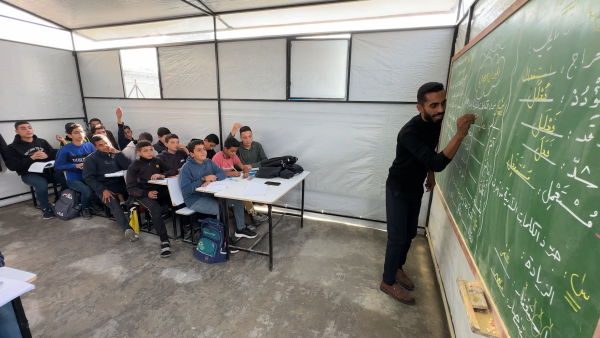
Tents make up many the new temporary classrooms, “which means in winter they're cold… in summer they'll be scorchingly hot,” Mr. Elder explained.
Getting children back to learning immediately is often “under canvases in community centres… They can't wait for that brick and mortar,” he added.
Mr. Elder also stressed the urgent need to open the Rafah border crossing between Egypt and southern Gaza. Rafah has been mostly closed since May 2024 and was meant to reopen during the ceasefire between Israel and Hamas, which took hold in October last year. The UNICEF spokesperson called Rafah a “lifeline” for medical evacuations, family reunification and essential services.
On Monday in New York, the UN spokesperson said that Secretary-General António Guterres urgedall parties to move forward “in good faith, and without delay” with subsequent phases of the US-led ceasefire plan, including facilitating sustained and unhindered humanitarian access, notably through the Rafah crossing.
Israel has reportedly agreed to reopen the crossing once the remains of the last remaining Israeli hostage is Gaza have been retrieved. According to reports on Monday, the body of Ran Gvili, who was among more than 250 Israeli and foreign nationals abducted by Hamas and other Palestinian armed groups during their attack on southern Israel on 7 October 2023, was recovered.
UNICEF’s Mr. Elder said that he has daily contact with Palestinians who are “desperate” for the Rafah crossing to open.
“How many families have been separated?” he asked. “There is a great desperation in a personal sense for families,” he concluded.
-Ends-
STORY Gaza education update - UNICEF
TRT: 2:59”
SOURCE: UNTV CH AND UNICEF
RESTRICTIONS: NONE
LANGUAGE: ENGLISH/NATS
ASPECT RATIO: 16:9
DATELINE: 27 JANUARY 2026 GENEVA, SWITZERLAND; 26 JANUARY 2026, GAZA CITY – credit UNICEF
1. Exterior wide shot: Palais des Nations, Flag Alley.
2. Wide shot: Speakers at the podium of the press conference, speaker on screens; journalists in the Press room.
3. SOUNDBITE (English) – James Elder, spokesperson, UN Children’s Fund (UNICEF): “Almost two and a half years of attacks on Gaza’s schooling have left an entire generation at risk. Sixty per cent of school-aged children currently have no access to in-person learning. Of course, more than 90 per cent of schools have been damaged or destroyed.”
4. Medium shot: Speaker at the podium of the press conference, speaker on screens.
5. SOUNDBITE (English) – James Elder, spokesperson, UN Children’s Fund (UNICEF): “Before this war on children, Palestinians in Gaza had some of the highest literacy rates in the world. Education was a source of pride, resilience and progress for generations. Today, that legacy is very much under attack. Schools, universities and libraries have been destroyed and years of progress have been erased. This isn't just physical destruction. It is an assault on the future itself.”
6. Wide shot: Speaker on screens; journalists in the Press room.
7. SOUNDBITE (English) – James Elder, spokesperson, UN Children’s Fund (UNICEF): “In Gaza, learning is lifesaving. These learning centers provide safe spaces in a territory that's often inaccessible and dangerous. They restore vital information, they deliver routine for children. They connect girls and boys to health, to nutrition and protection services, and these UNICEF learning spaces have proper toilets and places to wash hands.”
8. Medium-wide shot: Speaker at the podium of the press conference, speaker on screens; journalists in the Press room.
9. SOUNDBITE (English) – James Elder, spokesperson, UN Children’s Fund (UNICEF): “The demand is overwhelming. Every existing learning centre has long waiting lists. When I was in Gaza two weeks ago, I had dozens of parents outside learning centres pleading for places for their children.”
10. Wide shot: Speaker at the podium of the press conference, speaker on screens; journalists in the Press room.
11. SOUNDBITE (English) – James Elder, spokesperson, UN Children’s Fund (UNICEF): “Almost half of Gaza's population is under 18. Now getting one child into a UNICEF learning centre costs just around $280 for a year, including mental health support. So to reach 336,000 children for the rest of this year, UNICEF urgently needs $86 million. $86 million, to put in some sort of global perspective, is roughly what the world spends on coffee in an hour or two.”
12. Medium shot: Speaker at the podium of the press conference, speaker on screens.
13. SOUNDBITE (English) – James Elder, spokesperson, UN Children’s Fund (UNICEF): “Our priority is very much about getting children back in immediately. But that is often under canvases in community, in community centres. They can't wait for that brick and mortar.”
14. Medium shot: Journalists in the Press room.
15. SOUNDBITE (English) – James Elder, spokesperson, UN Children’s Fund (UNICEF): “I have daily contact with Palestinians who are desperate for that [the Rafah crossing] to open, for the reasons that probably don't get spoken about enough. How many families have been separated?”
16. Various shots of journalists in the Press room.
17. UNICEF B-Roll: 26 January 2026, UNICEF temporary learning space, Gaza City – credit UNICEF.
Similar Stories

2
17
1
2
Edited News , Press Conferences | OCHA , WMO
Two UN agencies teamed up on Wednesday to issue an appeal for immediate assistance to help communities already being impacted by the strongest El Niño on record.
3
16
2
2
B-roll , Conferences , Edited News | UNITED NATIONS , UNOG
Sixth Consultative Meeting on Enhancing Coordination of Peace Initiatives and Efforts for Sudan

1
1
1
Edited News | UNICEF , WHO , UNHCR
Yemen war continues to force families from homes amid hunger and disease
More than 250,000 people have now fled renewed fighting in Yemen, the UN said on Tuesday, citing particular concern for those sheltering in the southwestern city of Taiz and the wider governorate, where access is “essentially blocked”.

1
1
1
Edited News | UNICEF
A little over one year since a ceasefire agreement was announced between Hamas fighters and Israel, more than 340 children have been reported killed and hundreds more injured, the UN Children’s Fund, UNICEF, said on Friday.

1
1
1
Edited News | UNICEF , IFRC
Six weeks after Nepal’s deadly flooding disaster, communities are still struggling to rebuild their lives, but they will need sustained help as global warming increases the risk of another Himalayan catastrophe, the UN Children’s Fund (UNICEF) said on Friday.

1
1
1
Edited News | WHO
In suspected Russia plague death, testing and monitoring underway – WHO
The death of a lab worker in Russia’s Siberia region has sparked concerns about plague being the cause, the UN World Health Organization (WHO) said on Tuesday, adding that it was following the situation closely.

1
1
Edited News | OHCHR , UNOG
UN Human Rights Chief Volker Türk on Friday provided and oral update to the 63rd session of the Human rights Council on Ukraine.

1
1
1
Edited News | OHCHR , UNOG
UN Human Rights Chief Volker Türk on Friday provided and oral update to the 63rd session of the Human rights Council on the human rights situation in Haiti.

1
1
1
Edited News | WHO
Repeated delays in bringing lifesaving medicines, prosthetics and more from Israel into Gaza risk having devastating consequences on Palestinians who urgently need them in the wartorn enclave, the UN World Health Organization (WHO) said on Friday. “A truck full of non-priority supplies or the right supplies arriving too late, doesn't save lives. That's the question that actually matters," said Dr Reinhilde Van De Weerdt, WHO Representative in the OPT.

1
1
1
Edited News | WHO
DRC: Early access to care and oxygen decisive for Ebola patients’ survival – WHO
In the Democratic Republic of the Congo (DRC), health workers fighting the country’s largest-ever Ebola outbreak are struggling to overcome critical challenges to patient care, the UN World Health Organization (WHO) warned on Tuesday.

1
1
1
Edited News | OCHA , UN
Civilians in Iran are continuing to feel the consequences of months of conflict and military escalation, the UN’s top official in the country has said, as loss of life, damage to civilian infrastructure and mounting economic pressures leave many facing continued uncertainty.
1
1
1
Edited News | WHO , UNICEF
Aid agencies in Yemen highlighted the growing hunger emergency sparked by renewed fighting between Houthi opposition forces and Government troops, after mobile health clinics reported that hundreds of children displaced by the violence are suffering from the most deadly form of malnutrition.