

The United Nations Office at Geneva
Multimedia Newsroom
Afghanistan: Humanitarians scramble to reach survivors of deadly quake; response at ‘breaking point’
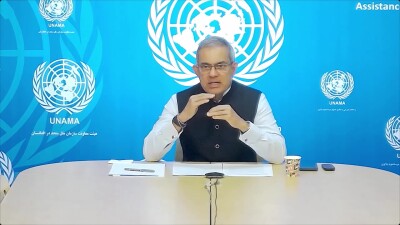
In remote eastern Afghanistan, aid workers are racing to assist survivors of Sunday’s devastating earthquake as the death toll continues to climb, UN humanitarians said on Tuesday.
The magnitude six quake has already left more than 800 dead and at least 2,000 injured but the total impact could be in the “hundreds of thousands” according to the UN’s top aid official in the country, Indrika Ratwatte.
Speaking from Kabul, Mr. Ratwatte said that mud and wooden roof structures were predominant in the affected mountainous provinces.
“When the walls collapse, the roof is what basically falls on individuals, kills them or suffocates them,” he said. “Since this happened in the night, everybody was sleeping,” the senior UN aid official explained, indicating that many more people may be trapped under the debris.
He predicted that hundreds of thousands could be impacted, “as in houses destroyed, injured, casualties, livestock lost and any livelihood systems that they had”.
In the first critical 24 hours after the earthquake hit, access was “very limited”, owing to landslides and rockfalls triggered by the tremors.
“This has posed a huge challenge to us as we deploy right now,” Mr. Ratwatte said, stressing that 20 emergency assessment teams have been mobilized alongside 15 mobile teams “which will enhance the humanitarian flights from Kabul to Jalalabad”, capital of the affected Nangarhar province.
The UN Humanitarian Air Service has scheduled additional flights connecting Kabul and Jalalabad for personnel and cargo to scale up the response.
The aid official also said that the UN and others are trying to set up or repair damaged mobile networks as there is “zero connectivity” with some affected communities, “and even to bring in helicopters and land,” another challenge for the de facto authorities.
“It’s not easy to get to these areas and keep shuttling injured individuals,” he said.
Mr. Ratwatte underscored the importance of protection work, “including psychosocial support for individuals who lost family and loved ones”. He also stressed that it was urgent to dispose of bodies and dead livestock to prevent waterborne diseases, “which can happen very, very fast”.
One of the first responders in the affected areas was the Afghan Red Crescent. Joy Singhal, Acting Head of Delegation for Afghanistan of the International Federation of Red Cross and Red Crescent Societies (IFRC), said that more people could have been saved if road access were easier.
“Our staff and volunteers sometimes have to [walk] for about four to five hours to reach some of those remote villages,” he said. Once they reach their destination “they have to walk back and bring those affected and wounded people into the city centre… the two hospitals there are overwhelmed.”
Afghanistan has long been dealing with what the UN’s Humanitarian Coordinator Mr. Ratwatte called “systemic humanitarian challenges”. Half of its population - or some 22.5 million people - need assistance, while food insecurity has been aggravated by recent drought. Sweeping funding cuts to humanitarian programmes since the beginning of the year have meant that “hundreds” of aid facilities have had to close.
“The earthquake comes at a time where vulnerable communities are going to be super- exposed to additional stresses,” Mr. Ratwatte said.
Another major challenge is the return in 2025 of 2.4 million Afghan refugees from Iran and Pakistan, whom communities in the country have been “struggling to integrate”, said UN refugee agency spokesperson Babar Baloch.
“More than half of these are deportations, people who have been put on buses and other forms of transport and left at the borders to go home, and it has already put a further restraint on our ability to support,” Mr. Baloch said.
He also stressed that the majority of returnees are heading precisely to the earthquake-affected areas. In another “worrying” development, Sunday marked “the end of grace period for registered Afghan refugees in Pakistan” and UNHCR is preparing for “significantly more returns” in the coming days.
“These people already with very little resources are now returned to a disaster zone,” Mr. Baloch said.
“We are at breaking point in terms of response to the multiple humanitarian shocks in the country,” the UN’s Mr. Ratwatte insisted.
The $2.4 billion humanitarian response plan for Afghanistan for 2025 is only 28 per cent funded, “and here we have an emergency on top of the crisis situation”, he concluded.
-Ends -
STORY Afghanistan earthquake update OCHA – IFRC – UNHCR 2 September 2025
TRT: 3:12”
SOURCE: UNTV CH
RESTRICTIONS: NONE
LANGUAGE: ENGLISH/NATS
ASPECT RATIO: 16:9
DATELINE: 2 SEPTEMBER 2025 GENEVA, SWITZERLAND
1. Exterior wide shot: Palais des Nations, Flag Alley.
2. Wide shot: Speakers at the podium of the press conference; speaker on screens; journalists in the Press room.
3. SOUNDBITE (English) – Indrika Ratwatte, UN Humanitarian Coordinator in Afghanistan: “These are mud and wooden roof structures. So when the walls collapse, the roof is what basically falls on individuals, kills them or suffocates them. So it's low density, but since this happened in the night, everybody was sleeping. So I think it's going to be much higher and when we said hundreds of thousands impacted, as in houses destroyed, injured, casualties, livestock lost.”
4. Medium wide shot: Speakers at the podium of the press conference; speaker on screens.
5. SOUNDBITE (English) – Indrika Ratwatte, Humanitarian Coordinator in Afghanistan: “This is extremely mountainous and due to the earthquake, there's been lots of landslides, rockfalls, etcetera, and access has been very limited to everybody in the first 24 hours. So this has posed a huge challenge to us as we deploy. Right now as we speak, 20 of our emergency assessment teams have been deployed.”
6. Wide shot: Speakers at the podium of the press conference; speaker on screens; journalists in the Press room.
7. SOUNDBITE (English) – Indrika Ratwatte, Humanitarian Coordinator in Afghanistan: “The UN and others are trying to set up or repair damaged mobile connectivity because there's zero connectivity with some of these communities and even to bring in helicopters and land, where I see the de facto authorities are having problems as well. It’s not easy to get to these areas and keep shuttling injured individuals.”
8. Wide shot: Speakers at the podium of the press conference.
9. SOUNDBITE (English) – Indrika Ratwatte, Humanitarian Coordinator in Afghanistan: “Protection interventions, including psychosocial support for individuals who lost family and loved ones, remains very important. At the same time, the disposal of bodies and the removal of livestock carcasses [is] extremely important to avoid waterborne diseases which can happen very, very fast.”
10. Medium wide shot: Speakers at the podium of the press conference; speaker on screens.
11. SOUNDBITE (English) – Joy Singhal, Acting Head of Delegation for Afghanistan, International Federation of Red Cross and Red Crescent Societies (IFRC): “We are not able to reach several people who would need our assistance and who could have been saved if the road transport or the networks were easy for us to be able to support those communities.”
12. Wide shot: Speakers at the podium of the press conference; speaker on screens; journalists in the Press room.
13. SOUNDBITE (English) – Joy Singhal, Acting Head of Delegation for Afghanistan, International Federation of Red Cross and Red Crescent Societies (IFRC): “Our staff and volunteers sometimes have to be walking for about four to five hours to reach some of those remote villages and once they reach there, they have to walk back and bring those affected and wounded people into the city centre and the two hospitals there are overwhelmed with capacity.”
14. Wide shot: Speakers at the podium of the press conference; speaker on screens; journalists in the Press room.
15. SOUNDBITE (English) – Babar Baloch, spokesperson, UN Refugee Agency (UNHCR): “The majority of returnees are going to these regions that have been affected by the earthquake and also moving on to another worrying development with 31 August, marking the end of grace period for registered Afghan refugees in Pakistan, we at UNHCR are also preparing for significantly more returns in the coming days.”
16. Various shots of journalists in the Press room.
Broll (16:9) available from Mazar Dara village of Noor Gal district of Kunar province via UNHCR https://we.tl/t-Pu7gumu49R - credit: (NGO) Afghanistan Rehabilitation and Women Education Organization (ARWEO), date: 1 Sep 2025.
Similar Stories

1
1
1
Edited News | OCHA , UNICEF , WFP
Aid agencies warned on Friday of the fast-developing humanitarian emergency inside Taiz City in Yemen, which has been encircled by de facto Houthi forces fighting government troops along the country’s west coast.

2
17
1
2
Edited News , Press Conferences , Images | OCHA , WMO
Two UN agencies teamed up on Wednesday to issue an appeal for immediate assistance to help communities already being impacted by the strongest El Niño on record.

3
16
2
2
Edited News , B-roll , Conferences , Images | UNITED NATIONS , UNOG
Sixth Consultative Meeting on Enhancing Coordination of Peace Initiatives and Efforts for Sudan

1
1
1
Edited News | UNICEF , WHO , UNHCR
Yemen war continues to force families from homes amid hunger and disease
More than 250,000 people have now fled renewed fighting in Yemen, the UN said on Tuesday, citing particular concern for those sheltering in the southwestern city of Taiz and the wider governorate, where access is “essentially blocked”.

1
1
1
Edited News | UNICEF
A little over one year since a ceasefire agreement was announced between Hamas fighters and Israel, more than 340 children have been reported killed and hundreds more injured, the UN Children’s Fund, UNICEF, said on Friday.

1
1
1
Edited News | UNICEF , IFRC
Six weeks after Nepal’s deadly flooding disaster, communities are still struggling to rebuild their lives, but they will need sustained help as global warming increases the risk of another Himalayan catastrophe, the UN Children’s Fund (UNICEF) said on Friday.

1
1
1
Edited News | WHO
In suspected Russia plague death, testing and monitoring underway – WHO
The death of a lab worker in Russia’s Siberia region has sparked concerns about plague being the cause, the UN World Health Organization (WHO) said on Tuesday, adding that it was following the situation closely.

1
1
Edited News | OHCHR , UNOG
UN Human Rights Chief Volker Türk on Friday provided and oral update to the 63rd session of the Human rights Council on Ukraine.

1
1
1
Edited News | OHCHR , UNOG
UN Human Rights Chief Volker Türk on Friday provided and oral update to the 63rd session of the Human rights Council on the human rights situation in Haiti.

1
1
1
Edited News | WHO
Repeated delays in bringing lifesaving medicines, prosthetics and more from Israel into Gaza risk having devastating consequences on Palestinians who urgently need them in the wartorn enclave, the UN World Health Organization (WHO) said on Friday. “A truck full of non-priority supplies or the right supplies arriving too late, doesn't save lives. That's the question that actually matters," said Dr Reinhilde Van De Weerdt, WHO Representative in the OPT.

1
1
1
Edited News | WHO
DRC: Early access to care and oxygen decisive for Ebola patients’ survival – WHO
In the Democratic Republic of the Congo (DRC), health workers fighting the country’s largest-ever Ebola outbreak are struggling to overcome critical challenges to patient care, the UN World Health Organization (WHO) warned on Tuesday.

1
1
1
Edited News | OCHA , UN
Civilians in Iran are continuing to feel the consequences of months of conflict and military escalation, the UN’s top official in the country has said, as loss of life, damage to civilian infrastructure and mounting economic pressures leave many facing continued uncertainty.