

The United Nations Office at Geneva
Multimedia Newsroom
Gaza ‘hungriest place on earth’ with aid stymied – UN humanitarians
Starving Gazans continue to be deprived of aid as international relief efforts are being severely constrained by the Israeli authorities, the UN humanitarian affairs coordination office OCHA said on Friday.
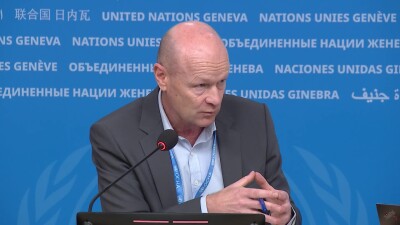
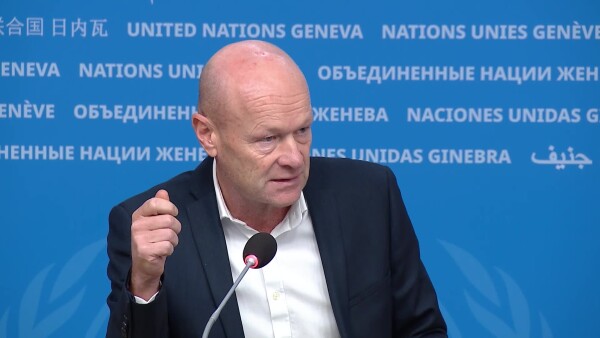
“Gaza is the hungriest place on Earth,” OCHA spokesperson Jens Laerke told reporters in Geneva, stressing that it is the only defined territory in the world where the entire population is at risk of famine.
“The aid operation that we have ready to roll is being put in an operational straitjacket that makes it one of the most obstructed aid operations, not only in the world today, but in recent history,” he said.
Mr. Laerke explained that out of nearly 900 aid trucks that were approved to enter from the Israeli side since the reopening of the Kerem Shalom border crossing between Israel and the war-torn enclave ten days ago, less than 600 have been offloaded on the Gaza side. An even lower number has been picked up for distribution in Gaza, he said, pointing to the “congested, insecure” routes which humanitarians are assigned to use by the Israeli authorities, as well as “significant delays” in the approvals.
The OCHA spokesperson stressed that the limited number of truckloads coming in is a “trickle”.
“It is drip-feeding food into an area on the verge of catastrophic hunger,” he insisted.
Mr. Laerke added that many of the trucks were “swarmed by desperate people” on the way.
“It's a survival reaction by desperate people who want to feed their families,” he said, adding that the aid on the trucks “had been paid for by the donors to go to those people”.
“I don't blame them one second for taking the aid that essentially is already theirs, but it's not distributed in a way we wanted,” he explained.
On Wednesday, hungry crowds overran a UN World Food Programme (WFP) warehouse in Deir Al-Balah in central Gaza, where limited stocks of wheat flour had been pre-positioned for use by the few bakeries able to resume operations. The incident reportedly left two people dead. In a statement WFP reiterated warnings over “the risks imposed by limiting humanitarian aid to hungry people in desperate need of assistance”.
OCHA’s Mr. Laerke insisted once again on the fact that the UN and partners have “tens of thousands of pallets of food and other life-saving assistance” ready to enter Gaza to relieve the suffering.
“The aid has been paid for by the world's donors, who expect us on their behalf to deliver it. It is cleared for customs, it is approved and it's ready to move,” he said.
A new US and Israeli-backed aid distribution scheme run by a private entity called the “Gaza Humanitarian Foundation” started operating independently of the UN this week in the Strip. On Tuesday at least 47 Palestinians were reportedly shot and injured trying to collect aid from its distribution facility in the south, according to information received by UN human rights office, OHCHR.
In reaction to the incident OCHA head in the Occupied Palestinian Territory Jonathan Whittall warned on Wednesday that the US-Israeli distribution scheme was "engineered scarcity: four distribution hubs located in central and southern Gaza, secured by private US security contractors, where those Palestinians who can reach them will receive rations."
Mr. Laerke told reporters that this “alternative modality” is “not working” as it does not meet people’s needs.
He added that it constitutes a “violation of basic principle of impartiality”, and that criteria for getting aid have to be based on need, and not the ability to walk for kilometres to a distribution point.
“It creates chaos, and it creates a situation that is extremely dangerous for people,” Mr. Laerke said. “Even if you enter one of those distribution points, pick up a package, the minute you're out of it… Are you a target for looters again? Yes, you are.”
The OCHA spokesperson reiterated calls by the humanitarian community for the reopening of all crossing points into Gaza, to enable delivery from all corridors, including from Jordan and Egypt.
“We need to be able to deliver food directly to families where they are,” as has been the case in the past, he said.
Highlighting the challenges for humanitarian access, Mr. Laerke said that over 80 per cent of the Gaza Strip is currently within Israeli militarized zones or under displacement orders. Since the ceasefire between Israel and Hamas collapsed on 18 March nearly 635,000 people in the enclave have been displaced yet again.
-ends-
STORY: Gaza aid update OCHA 30 May 2025
TRT: 3:02”
SOURCE: UNTV CH
RESTRICTIONS: NONE
LANGUAGE: ENGLISH/ NATS
ASPECT RATIO: 16:9
DATELINE: 30 MAY 2025 GENEVA, SWITZERLAND
1. Exterior wide shot: Palais des Nations, Flag Alley.
2. Wide shot: Speakers at the podium of the Press room.
3. SOUNDBITE (English) – Jens Laerke, spokesperson, UN Office for the Coordination of Humanitarian Affairs (OCHA): “Gaza is the hungriest place on Earth. And the aid operation that we have ready to roll is being put in an operational straitjacket that makes it one of the most obstructed aid operations, not only in the world today, but in recent history.”
4. Medium shot: Speakers at the podium of the press conference from rear; speaker on screens.
5. SOUNDBITE (English) – Jens Laerke, spokesperson, UN Office for the Coordination of Humanitarian Affairs (OCHA): “Over the past ten days since Kerem Shalom reopened, out of the nearly 900 trucks that were approved to enter, almost 600 of them have been offloaded on the Gaza side. A lower number has been picked up, from the other side. And there are reasons for that. The routes that we are being assigned to use by the Israeli authorities are very often congested, insecure. And there are significant delays in the approvals.”
6. Close shot: Journalist in the Press room.
7. SOUNDBITE (English) – Jens Laerke, spokesperson, UN Office for the Coordination of Humanitarian Affairs (OCHA): “Many of those were swarmed by desperate people on the way, who picked off the items. It's a survival reaction, a survival reaction by desperate people who want to feed their families, themselves and their kids. And by the way, the aid that is on those trucks had been paid for by the donors to go to those people. So, I don't blame them one second for taking the aid that essentially is already theirs, but it's not distributed in a way we wanted.”
8. Medium shot: Journalists in the Press room.
9. SOUNDBITE (English) – Jens Laerke, spokesperson, UN Office for the Coordination of Humanitarian Affairs (OCHA): “Our plan is: we have tens of thousands of pallets of food and other life-saving assistance that are poised to enter Gaza. The aid has been paid for by the world's donors, who, of course, expect us on their behalf to deliver it. It is cleared for customs, it is approved and it's ready to move.”
10. Wide shot: Speakers at the podium of the press conference from rear; speaker on screens.
11. SOUNDBITE (English) – Jens Laerke, spokesperson, UN Office for the Coordination of Humanitarian Affairs (OCHA): “The alternative modality that they have put up is not working. I mean, you have seen, it does not meet the needs of people. It creates chaos, and it creates a situation that is extremely dangerous for people, to pick up the aid and to leave again, because even if you enter one of those distribution points, pick up a package, the minute you're out of it, what do you think? Are you a target for looters again? Yes, you are.”
12. Medium shot: Speakers at the podium of the press conference from rear; speaker on screens.
13. SOUNDBITE (English) – Jens Laerke, spokesperson, UN Office for the Coordination of Humanitarian Affairs (OCHA): “What we need now is a reopening of all crossing points into Gaza. Aid from all corridors, including from Jordan and Egypt. We need to be able to deliver food directly to families, directly to families where they are.”
14. Various shots of speakers and journalists in the Press room.
Similar Stories
1
1
1
Edited News | OCHA , UNICEF , WFP
Aid agencies warned on Friday of the fast-developing humanitarian emergency inside Taiz City in Yemen, which has been encircled by de facto Houthi forces fighting government troops along the country’s west coast.

2
17
1
2
Edited News , Press Conferences , Images | OCHA , WMO
Two UN agencies teamed up on Wednesday to issue an appeal for immediate assistance to help communities already being impacted by the strongest El Niño on record.

3
16
2
2
Edited News , B-roll , Conferences , Images | UNITED NATIONS , UNOG
Sixth Consultative Meeting on Enhancing Coordination of Peace Initiatives and Efforts for Sudan

1
1
1
Edited News | UNICEF , WHO , UNHCR
Yemen war continues to force families from homes amid hunger and disease
More than 250,000 people have now fled renewed fighting in Yemen, the UN said on Tuesday, citing particular concern for those sheltering in the southwestern city of Taiz and the wider governorate, where access is “essentially blocked”.

1
1
1
Edited News | UNICEF
A little over one year since a ceasefire agreement was announced between Hamas fighters and Israel, more than 340 children have been reported killed and hundreds more injured, the UN Children’s Fund, UNICEF, said on Friday.

1
1
1
Edited News | UNICEF , IFRC
Six weeks after Nepal’s deadly flooding disaster, communities are still struggling to rebuild their lives, but they will need sustained help as global warming increases the risk of another Himalayan catastrophe, the UN Children’s Fund (UNICEF) said on Friday.

1
1
1
Edited News | WHO
In suspected Russia plague death, testing and monitoring underway – WHO
The death of a lab worker in Russia’s Siberia region has sparked concerns about plague being the cause, the UN World Health Organization (WHO) said on Tuesday, adding that it was following the situation closely.

1
1
Edited News | OHCHR , UNOG
UN Human Rights Chief Volker Türk on Friday provided and oral update to the 63rd session of the Human rights Council on Ukraine.

1
1
1
Edited News | OHCHR , UNOG
UN Human Rights Chief Volker Türk on Friday provided and oral update to the 63rd session of the Human rights Council on the human rights situation in Haiti.

1
1
1
Edited News | WHO
Repeated delays in bringing lifesaving medicines, prosthetics and more from Israel into Gaza risk having devastating consequences on Palestinians who urgently need them in the wartorn enclave, the UN World Health Organization (WHO) said on Friday. “A truck full of non-priority supplies or the right supplies arriving too late, doesn't save lives. That's the question that actually matters," said Dr Reinhilde Van De Weerdt, WHO Representative in the OPT.

1
1
1
Edited News | WHO
DRC: Early access to care and oxygen decisive for Ebola patients’ survival – WHO
In the Democratic Republic of the Congo (DRC), health workers fighting the country’s largest-ever Ebola outbreak are struggling to overcome critical challenges to patient care, the UN World Health Organization (WHO) warned on Tuesday.

1
1
1
Edited News | OCHA , UN
Civilians in Iran are continuing to feel the consequences of months of conflict and military escalation, the UN’s top official in the country has said, as loss of life, damage to civilian infrastructure and mounting economic pressures leave many facing continued uncertainty.