

The United Nations Office at Geneva
Multimedia Newsroom
Myanmar’s military has continued to launch airstrikes and other attacks against opposition forces in the devastated country, one week since a 7.7 magnitude earthquake struck and despite announcing a ceasefire, UN human rights chief Volker Türk said on Friday.
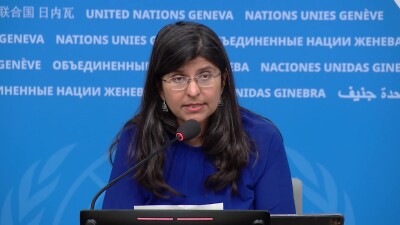
“In the days following the deadly earthquake that tore through central Myanmar last week, the Myanmar military continued operations and attacks, including airstrikes – some of which were launched shortly after tremors subsided,” said Ravina Shamdasani, spokesperson for the High Commissioner for Human Rights.
“We urge a halt to all military operations and for the focus to be on assisting those impacted by the quake,” she told journalists in Geneva, reiterating Mr. Türk’s call for an “inclusive political solution” to end more than four years of fighting sparked by the junta’s February 2021 coup d’état.
Latest data from the UN human rights office, OHCHR, points to at least 61 reported attacks across Myanmar since the disaster happened, including 16 since the ceasefire announced by the military took effect on 2 April.
The tactics of the military – known as the Tatmadaw in Myanmar – include using near-silent adapted paragliders to bomb communities, said James Rodehaver, Head of OHCHR’s Myanmar team: “What those are is an individual military operative who uses a hang-glider with a backpack attached to his back or to his torso with a large fan on it and he uses that to essentially paraglide using the fan as a motor over areas and drop hand-held bombs or munitions onto targets below.”
The development follows an urgent call by UN Secretary-General António Guterres for immediate and unrestricted humanitarian access to the country after the disaster claimed more than 3,000 lives and left millions in urgent need of aid.
Speaking to reporters at UN Headquarters in New York, the UN chief warned that the earthquake had “supercharged the suffering...Myanmar today is the scene of utter devastation and desperation,” he said
The regions most impacted by the earthquake which struck at approximately 12.50pm local time on 28 March are Mandalay – the country’s second city and home to 1.2 million people – Sagaing, Nay Pyi Taw, Bago, Magway, Shan South and East.
Assessments have shown widespread destruction across central Myanmar to critical infrastructure - including health facilities, road networks and bridges.
In an update, the UN World Health Organization also reported that electricity and water supplies remain disrupted, worsening access to health services and heightening risks of waterborne and foodborne disease outbreaks.
The UN refugee agency, UNHCR – which issued an appeal on Friday for $16 million to support 1.2 million survivors - said that up to 80 per cent of structures in Mandalay are estimated to have collapsed.
Spokesperson Babar Baloch explained that the UN agency has already deployed existing emergency relief including plastic sheets and kitchen sets for 25,000 survivors in Mandalay, Sagaing and Bago regions, as well as the capital, Nay Pyi Taw, and parts of Shan State.
UN partner the International Committee of the Red Cross (ICRC) meanwhile reported that 136 townships have been affected by the earthquake “and about 25 per cent are in areas not controlled by the Government, so that's complicating the access”.
Echoing those concerns, Ms. Shamdasani from the UN human rights office said that the scale of the disaster had been made worse by the information blackout caused by internet and telecommunications shutdowns “imposed by the military”.
ends
SHOTLIST
- Exterior medium shot: Palais des Nations, Flag Alley
- Wide shot of podium with speakers.
- SOUNDBITE (English) – Ravina Shamdasani, spokesperson, OHCHR: “In the days following the deadly earthquake that tore through central Myanmar last week, the Myanmar military continued operations and attacks, including airstrikes – some of which were launched shortly after tremors subsided.”
- Wide shot, Press room, podium speakers, TV screens, journalists.
- SOUNDBITE (English) – James Rodehaver, Head of Myanmar team (from Bangkok): “Out of those 61 or so that I've just mentioned, there are 16 of those attacks that have happened since the ceasefire that was announced by the military took effect, which I believe was midnight on 2 April.”
- Wide shot, Press room, podium speakers, TV screens, journalists.
- SOUNDBITE (English) – Ravina Shamdasani, spokesperson, OHCHR: “Sources from the ground describe a catastrophic humanitarian situation in earthquake-hit areas, especially those outside the military’s control; an absence of relief efforts and a lack of clean water, food and medicine.”
- Wide, podium speakers, journalists, TV screens, TV journalists.
- SOUNDBITE (English) – Arnaud Debaecque, Head of ICRC Delegation in Myanmar (from Yangon): “We have about 136 townships that have been affected by the earthquake and about 25 per cent are in areas not controlled by the Government, so that's complicating the access.”
- Medium, Press room participant.
- SOUNDBITE (English) – James Rodehaver, Head of Myanmar team (from Bangkok): “Essentially what those are is an individual military operative who uses a hang-glider with a backpack attached to his back or to his torso with a large fan on it and he uses that to essentially paraglide using the fan as a motor over areas and drop hand-held bombs or munitions onto targets below.”
- Medium, podium speakers, TV screen.
- SOUNDBITE (English) – Babar Baloch, spokesperson, UNHCR: “In this city of Mandalay, which was close to the epicentre, it's estimated that up to 80 per cent of structures in the town have collapsed.”
- Wide, Press room.
- SOUNDBITE (English) – Ravina Shamdasani, spokesperson, OHCHR: “The scale of the disaster has been exacerbated by an information blackout, due to internet and telecommunications shutdowns imposed by the military.”
- Medium, TV journalist filming.
- Medium, journalist.
- Wide, TV journalists, control booths to rear.
Similar Stories

1
1
1
Edited News | OCHA , UNICEF , WFP
Aid agencies warned on Friday of the fast-developing humanitarian emergency inside Taiz City in Yemen, which has been encircled by de facto Houthi forces fighting government troops along the country’s west coast.

2
17
1
2
Edited News , Press Conferences , Images | OCHA , WMO
Two UN agencies teamed up on Wednesday to issue an appeal for immediate assistance to help communities already being impacted by the strongest El Niño on record.

3
16
2
2
Edited News , B-roll , Conferences , Images | UNITED NATIONS , UNOG
Sixth Consultative Meeting on Enhancing Coordination of Peace Initiatives and Efforts for Sudan

1
1
1
Edited News | UNICEF , WHO , UNHCR
Yemen war continues to force families from homes amid hunger and disease
More than 250,000 people have now fled renewed fighting in Yemen, the UN said on Tuesday, citing particular concern for those sheltering in the southwestern city of Taiz and the wider governorate, where access is “essentially blocked”.

1
1
1
Edited News | UNICEF
A little over one year since a ceasefire agreement was announced between Hamas fighters and Israel, more than 340 children have been reported killed and hundreds more injured, the UN Children’s Fund, UNICEF, said on Friday.

1
1
1
Edited News | UNICEF , IFRC
Six weeks after Nepal’s deadly flooding disaster, communities are still struggling to rebuild their lives, but they will need sustained help as global warming increases the risk of another Himalayan catastrophe, the UN Children’s Fund (UNICEF) said on Friday.

1
1
1
Edited News | WHO
In suspected Russia plague death, testing and monitoring underway – WHO
The death of a lab worker in Russia’s Siberia region has sparked concerns about plague being the cause, the UN World Health Organization (WHO) said on Tuesday, adding that it was following the situation closely.

1
1
Edited News | OHCHR , UNOG
UN Human Rights Chief Volker Türk on Friday provided and oral update to the 63rd session of the Human rights Council on Ukraine.

1
1
1
Edited News | OHCHR , UNOG
UN Human Rights Chief Volker Türk on Friday provided and oral update to the 63rd session of the Human rights Council on the human rights situation in Haiti.

1
1
1
Edited News | WHO
Repeated delays in bringing lifesaving medicines, prosthetics and more from Israel into Gaza risk having devastating consequences on Palestinians who urgently need them in the wartorn enclave, the UN World Health Organization (WHO) said on Friday. “A truck full of non-priority supplies or the right supplies arriving too late, doesn't save lives. That's the question that actually matters," said Dr Reinhilde Van De Weerdt, WHO Representative in the OPT.

1
1
1
Edited News | WHO
DRC: Early access to care and oxygen decisive for Ebola patients’ survival – WHO
In the Democratic Republic of the Congo (DRC), health workers fighting the country’s largest-ever Ebola outbreak are struggling to overcome critical challenges to patient care, the UN World Health Organization (WHO) warned on Tuesday.

1
1
1
Edited News | OCHA , UN
Civilians in Iran are continuing to feel the consequences of months of conflict and military escalation, the UN’s top official in the country has said, as loss of life, damage to civilian infrastructure and mounting economic pressures leave many facing continued uncertainty.