

The United Nations Office at Geneva
Multimedia Newsroom
Press Conferences | OHCHR , WHO , UNOG , WFP , WTO , WMO
UNOG Bi-weekly press briefing 10 July 2020
Human Rights Council
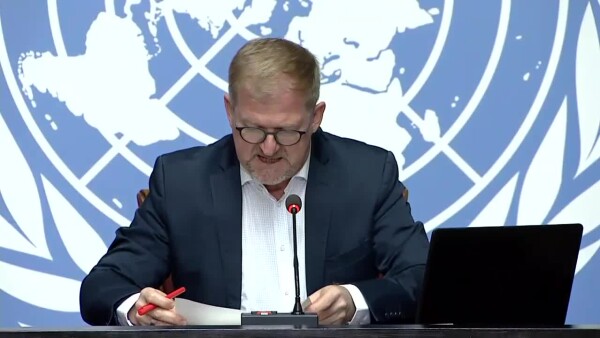
Rhéal LeBlanc, Chief of the Press and External Relations Section at the United Nations Information Service (UNIS), speaking on behalf of the Human Rights Council, informed that this morning an interactive discussion on the freedom to peaceful assembly and association was taking place, to be followed by a discussion on the situation in Belarus. In the afternoon, an interactive discussion would continue on human rights and transnational corporations. Finally, David Kaye, Special Rapporteur on the promotion and protection of the right to freedom of opinion and expression, would present his report on the information amidst the pandemic and his mission to Ethiopia.
More information on the forty-fourth session of the Council can be found here.
COVID-19: impact on food security in Yemen
Elisabeth Byrs, for the World Food Programme (WFP), stressed that the international community had to act now in Yemen. If we waited for famine to be declared, it would already be too late. In 2019, thanks to a massive scale-up, the WFP and partners had been able to pull Yemen back from the brink of famine; this time it could get a lot worse if humanitarian action was delayed. WFP needed USD 737 million to the end of the year to keep this vital safety net for the millions in Yemen who relied on humanitarian assistance to survive.
Ms. Byrs said that Yemen was facing a crisis on multiple fronts. Imports had declined and food prices were soaring, the riyal was in freefall, and foreign currency reserves were nearing total depletion. There had also been an escalation of fighting, and coronavirus was sweeping unchecked across the country. Prices of imported foods had already increased significantly since the start of 2020, remittances were down, with economists predicting a decline of up to 70 per cent in the next few months. Over 20 million people were food insecure, of which 13 million received humanitarian food assistance; nearly 10 million people were facing acute food shortages.
Responding to a question, Ms. Byrs said the WFP needed USD 200 million per month for Yemen. The country was currently importing close to 90 per cent of all food. Three national staff members had been lost to COVID-19, added Ms. Byrs.
Rhéal LeBlanc, Chief of the Press and External Relations Section at the United Nations Information Service (UNIS), said that UN Special Envoy for Yemen Martin Griffiths was working with the parties on the text of a Joint Declaration covering a nationwide ceasefire, economic and humanitarian measures and the resumption of the political process. This process and the Special Envoy had the full support of the Secretary-General, who urged the parties to continue engaging constructively.
COVID-19: questions for the World Health Organization
Answering some questions, Margaret Harris, for the World Health Organization (WHO), said that two members of a WHO advance scoping mission to China were on their way to Beijing. The two-person team would work out a scope for a future, broader mission. One issue to investigate was from which animal species the virus had jumped to humans. Whenever a WHO mission went to any country, explained Ms. Harris, they needed to discuss with the national authorities on the details of access and agenda.
On the newly announced independent commission of inquiry, Ms. Harris said the two co-chairs would select their own secretariat; no WHO staff would be involved. The commission would manage their own media relations as well.
Update on the common services by the World Food Programme
Elisabeth Byrs, for the World Food Programme (WFP), also gave an update on the logistics services provided by the WFP. Some USD 183 million had been confirmed out of the budget of USD 965 million needed for common services and logistics. There were enough funds to deliver 56,000 cubic meters, out of 79,000 in the pipeline. A total of 490 flights had been operated so far, and 7,530 passengers had been transported; 197 organizations had used the service.
Iraq: killing of Husham Al-Husham
Elisabeth Throssell, for the Office of the High Commissioner for Human Rights (OHCHR), said the shocking murder this week of leading researcher and security analyst Hisham Al-Hushami in Baghdad had made obvious the risks faced by people who dared to challenge powerful militias in Iraq and were vocal about pervasive impunity and corruption. The killing of Al-Hushami, who had been shot dead by unidentified attackers outside his house on 6 July, had sent shockwaves through the country. He had been an expert on terrorism, violent extremism, and armed groups and non-state actors in Iraq, including ISIL and militias. He had been a vocal critic of the militias and had also voiced public support for the demonstrations that began on 1 October 2019 against state corruption and impunity.
OHCHR welcomed the pledge by Prime Minister Mustafa Al-Khadami to hold Al-Hushami’s murderers to account. Hushami’s killing, which was the most high-profile in recent months, followed a pattern of killings targeting individuals who had been linked in some way to the demonstrations or who had voiced public criticism of the Government, political parties or militia groups. The UN Mission in Iraq and the UN Human Rights Office had verified the targeted killings of 23 people linked to the demonstrations from 1 October to 9 May, with a further 13 people being injured. OHCHR called on the government to ensure accountability – through thorough, independent and transparent investigations and prosecution – for all violence perpetrated in relation to the demonstrations, and for targeted killings.
Full statement is available here.
Floods in India and East Asia
Clare Nullis, for the World Meteorological Organization (WMO), said that June 2020 was only marginally cooler (0.01°C) than the record-breaking heat of June 2019, according to the Copernicus Climate Change Service, with temperatures in Arctic Siberia a huge 10°C above the long-term average. Russia’s meteorological service Roshydromet had confirmed a temperature reading of 38°C in the Siberian station of Verkhoyansk.
In South Asia, devastating flash floods were currently affecting several countries, and even more heavy rainfall was expected. Flooding had also caused much loss of life and damage in recent weeks in both China and Japan. The situation was expected to be aggravated by further rain. More than 200mm of rainfall could come down in 24 hours in some mountainous regions of Bhutan/Bangladesh, northeast India, Myanmar and Nepal, according to the SE Asia Flash Flood Forecast System. Additional similar amounts could be possible for the following four or five days. In China, severe flooding had reportedly affected millions of people, with dozens of casualties. China's State Flood Control and Drought Relief Headquarters had upgraded the emergency response for flood control from level IV to level III on 7 July, as incessant downpours continued to wreak havoc across vast stretches of the country.
“Global warming is a misleading phrase. Most impacts of climate change are felt through water – drought, flood, disaster and coastal inundation. There is a need to invest more in disaster risk reduction, climate adaptation and resilience,” said WMO Secretary-General Petteri Taalas.
Selection of the next head of the World Trade Organization
Fernando Puchol, for the World Trade Organization (WTO), said that 8 July had been the deadline for receiving applications for the next Director-General of the Organization. Eight candidacies had been submitted: Jesús Seade Kuri (Mexico), Ngozi Okonjo-Iweala (Nigeria), Abdel-Hamid Mamdouh (Egypt), Tudor Ulianovschi (Moldova), Yoo Myung-hee (Republic of Korea), Amina C. Mohamed (Kenya), Mohammad Maziad Al-Tuwaijri (Saudi Arabia), and Liam Fox (United Kingdom).
The following week – on 15, 16 and 17 July – the candidates would make brief presentations before the General Council, to be followed by questions and answers. After their presentations, the candidates would have a chance to individually meet with the media at the WTO building. Given the pandemic, journalists would need to register for press conferences 48 hours in advance. Further details on the exact schedule of presentations and which candidates would be physically present in Geneva would be provided shortly.
Responding to a question, Mr. Puchol said it was too early to say whether the new Director-General would be selected in time to take over by 1 September. Voting was considered as a last-resort option for selecting the new Director-General, if the General Council could not reach consensus.
More information on the WTO DG selection process is available here.
Geneva announcements
Rhéal LeBlanc, for the UN Information Service (UNIS), informed that a hybrid press conference by David Kaye, the outgoing Special Rapporteur on the promotion and protection of the right to freedom of opinion and expression, would take place on 13 July at 4 p.m.
Mr. LeBlanc also informed about the Secretary-General’s message on the occasion of the 25th anniversary of the Srebrenica massacre, the worst atrocity on the European soil since the Second World War.
Similar Stories

1
1
1
Press Conferences | UNHCR
End of UNHCR's 77th Annual Executive Committee (ExCom) meeting week

1
1
1
Press Conferences | UNICEF , IOM , UNHCR
UN Special Assistant to the Personal Envoy Office (SUDAN): Peace Initiatives and Efforts in Sudan; UNICEF: Dire situation of children in Gaza; IOM: Damaged Homes and Energy Attacks Risk Displacing Ukrainians for this winter; UNHCR: update on EXCOM week

1
1
1
Press Conferences | IOM , UNDRR
UN stresses importance of household preparedness for disaster risk reduction.

1
1
1
Statements , Press Conferences | OHCHR

1
1
1
Press Conferences | UNHCR , UNICEF , IFRC , OHCHR , UN WOMEN , IOM , OCHA , WHO
UNHCR – ExCom Meeting, UNICEF – Nepal Recovery, IFRC – Flash Floods, WHO – Mental Health, IOM – South Sudan Floods, OCHA – DRC Humanitarian aid, UNHCR – Sahel Displacement, UNICEF – Yemen Update, IOM – Gaza Shelter, UN Women – Gaza Women, OHCHR – Arrests and detentions of Syrians by Israeli force

2
1
2
Press Conferences | UNCTAD
Presentation of the Trade and Developement Report 2026
Embargoed until 9 October 2026 at 11 a.m. (Geneva Time)
UNCTAD: UNCTAD’s flagship report finds that governments increasingly use industrial, trade, financial and technology policies to pursue economic and national security objectives. Market access and the ability to move into higher-value activities now depend more heavily on technology, finance and geopolitics.

1
1
1
Press Conferences | UPU
Release of the State of the Postal Sector Report 2026
1
1
1
Press Conferences | IOM , ITU , UNECE , UNICEF , WHO , WMO
UNICEF: Ebola, DRC - children orphans or separating them from parents and caregivers; IOM: Humanitarian needs in Djibouti amid arrivals from Yemen and increased migrant movements; WHO: Darfur, scale of health needs far exceeds available resources; WMO co-sponsored Global Heat Forum, Bangkok, monthly Global Seasonal Climate Update; UNECE: UN Forum of Mayors; ITU Plenipotentiary Conference 2026; WHO: child and adolescent obesity guidelines and new global roadmap to tackle pregnancy hypertension, a leading cause of maternal mortality
1
1
1
Press Conferences | OCHA , UN WOMEN , UNHCR , WFP , WHO , WTO , UNEP
OCHA – $160M CERF allocation to 12 underfunded crises; UNHCR – 5.8M refugee children remain out of school amid funding cuts; UN Women – Middle East escalation and food security among women/girls; WHO – Gaza supplies and overall situation; WFP – Yemen food insecurity and impact on global hunger ; UNEP - First International Conference of the Global Framework on Chemicals in Geneva | 16-20 November 2026
1
1
1
Press Conferences | UNHCR , WHO
Yemen's health system nears collapse amid conflict, causing rising casualties and medicine shortages.
1
1
1
Press Conferences | HRC
Update by the Expert Mechanism to Advance Racial Justice and Equality in Law Enforcement
1
1
1
Press Conferences | WIPO , WHO , UNICEF , UNHCR , IOM , WFP , FAO
WIPO Global Innovation Index 2026 launch and press conference, WHO Composition of influenza vaccines for the 2027 Southern Hemisphere flu season, UNICEF Yemen hunger and malnutrition; UNHCR Sudan displacement into Chad; IOM Ebola and population movements in DRC; WFP emergency food assistance in Nepal; and FAO food loss and waste.