

The United Nations Office at Geneva
Multimedia Newsroom
UN’s Bachelet urges Philippines’ President not to sign new anti-terror law
The Human Rights Council should consider supporting new accountability measures against perpetrators of extrajudicial killings in the Philippines’ so-called war on illegal drugs, the UN’s top rights official said on Tuesday.
Michelle Bachelet’s appeal follows publication of a report by her office indicating that many thousands of people – and possibly more than 25,000 - have been killed in police and vigilante operations since the launch of campaign Double Barrel on 1 July 2016 and until 31 January 2020.
In February 2018, the International Criminal Court announced that it intended to open a preliminary examination of the situation in the Philippines and analyse crimes allegedly committed in this State Party since at least 1 July 2016, in the context of the "war on drugs" campaign.
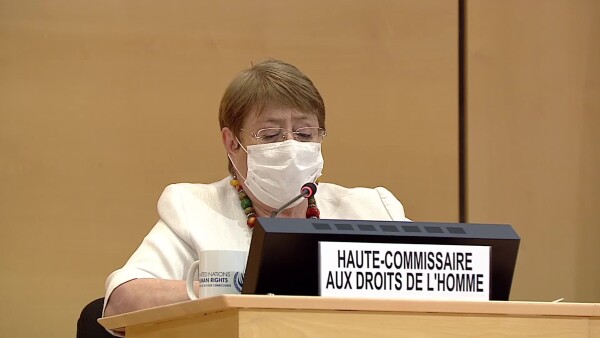
In an address to Member States in Geneva on the opening day of the Council’s 44th session, Michelle Bachelet also reiterated concerns over proposed new anti-terror legislation that are now before President Rodrigo Duterte, for signing into law.
The proposed 2020 Anti-Terrorism Act “dilutes human rights safeguards, broadens the definition of terrorism and expands the period of detention without warrant from three to 14 days, extendable by another 10 days”, the UN human rights office (OHCHR) report insisted.
“The recent passage of the new Anti-Terrorism Act heightens our concerns about the blurring of important distinctions between criticism, criminality and terrorism,” the High Commissioner for Human Rights said. “The law could have a further chilling effect on human rights and humanitarian work, hindering support to vulnerable and marginalized communities…So I would I urge the President to refrain from signing the law, and to initiate a broad-based consultation process to draft legislation that can effectively prevent and counter violent extremism, but which contains some safeguards to prevent its misuse against people engaged in peaceful criticism and advocacy.”
According to Ms. Bachelet’s office, the campaign against illegal drugs has been linked to the deaths of 73 children. These figures “are not exhaustive…the youngest victim was five months old,” the OHCHR report noted.
Echoing these concerns, Ms. Bachelet underscored that the operation was being carried out “without due regard for the rule of law, due process and the human rights of people who may be using or selling drugs. The report finds that the killings have been widespread and systematic – and they are ongoing.”
The High Commissioner also addressed long-running concerns of “near-impunity” for perpetrators of illegal killings during police operations highlighted in the report.
It details how the Philippines Police Internal Affairs Service (IAS) automatically investigates any deaths that occur during police operations, and yet of more than 4,580 investigations, “the Government has cited only one case – that of 17-year-old Kian delos Santos – where three police officers were convicted of a drug campaign-related killing”.
Ms. Bachelet added: “The State has an obligation to conduct independent investigations into the grave violations we have documented. In the absence of clear and measurable outcomes from domestic mechanisms, the Council should consider options for international accountability measures.”
Rejecting to the High Commissioner’s concerns, Philippines Justice Minister Menardo Guevarra said that the report’s claims “find no anchor in a system that provides every avenue to examine, establish and pursue a claim of wrongdoing by a State actor, if such claim is substantiated with facts”.
President Duterte had promised a drug-free Philippines and had “discharged this mandate fruitfully”, the Minister added, noting his “widespread support”.
1. Wide shot: exterior, flag alley, Palais des Nations, United Nations Geneva.
2. Wide shot, from above: Assembly Hall, UN Geneva, temporary home of the UN Human Rights Council.
3. SOUNDBITE (EN) – Michelle Bachelet, High Commissioner for Human Rights: “The recent passage of the new Anti-Terrorism Act heightens our concerns about the blurring of important distinctions between criticism, criminality and terrorism. The law could have a further chilling effect on human rights and humanitarian work, hindering support to vulnerable and marginalized communities.”
4. Medium shot: showing delegates spaced apart, wearing facemasks, typing on laptops.
5. SOUNDBITE (EN) – Michelle Bachelet, High Commissioner for Human Rights: “So I would I urge the President to refrain from signing the law, and to initiate a broad-based consultation process to draft legislation that can effectively prevent and counter violent extremism, but which contains some safeguards to prevent its misuse against people engaged in peaceful criticism and advocacy.”
6. Medium shot: photographer adjusting lens, wearing facemask.
7. SOUNDBITE (EN) – Michelle Bachelet, High Commissioner for Human Rights: “The campaign against illegal drugs is being carried out without due regard for the rule of law, due process and the human rights of people who may be using or selling drugs. The report finds that the killings have been widespread and systematic – and they are ongoing.”
8. Medium shot: delegates wearing facemasks, sitting apart, profile.
9. SOUNDBITE (EN) – Michelle Bachelet, High Commissioner for Human Rights: “The State has an obligation to conduct independent investigations into the grave violations we have documented. In the absence of clear and measurable outcomes from domestic mechanisms, the Council should consider options for international accountability measures.”
10. Medium wide shot: delegates in foreground, facing podium where speakers are also wearing facemasks.
11. SOUNDBITE (EN) – Menardo Guevarra, Justice Secretary (Minister), Philippines (via video message): “Our President ran and won on a campaign promise of a drug-free Philippines. There, our people are safe and their rights protected. The President has discharged this mandate fruitfully. After four years, the President and his anti-drug campaign enjoy the strong and widespread support of our people.”
12. Medium shot: delegates looking at podium (out of shot), wearing facemasks.
13. SOUNDBITE (EN) – Menardo Guevarra, Justice Secretary (Minister), Philippines (via video message): “Claims that there is impunity or near-impunity in the country find no anchor in a system that provides every avenue to examine, establish and pursue a claim of wrongdoing by a State actor, if such claim is substantiated with facts.”
14. Medium shot: delegates wearing facemasks, looking ahead.
15. Medium shot: delegates wearing facemasks, looking ahead.
16. Medium shot: delegate wearing facemask, looking up.
Similar Stories

1
1
1
Edited News | OCHA , UNICEF , WFP
Aid agencies warned on Friday of the fast-developing humanitarian emergency inside Taiz City in Yemen, which has been encircled by de facto Houthi forces fighting government troops along the country’s west coast.

2
17
1
2
Edited News , Press Conferences , Images | OCHA , WMO
Two UN agencies teamed up on Wednesday to issue an appeal for immediate assistance to help communities already being impacted by the strongest El Niño on record.

3
16
2
2
Edited News , B-roll , Conferences , Images | UNITED NATIONS , UNOG
Sixth Consultative Meeting on Enhancing Coordination of Peace Initiatives and Efforts for Sudan

1
1
1
Edited News | UNICEF , WHO , UNHCR
Yemen war continues to force families from homes amid hunger and disease
More than 250,000 people have now fled renewed fighting in Yemen, the UN said on Tuesday, citing particular concern for those sheltering in the southwestern city of Taiz and the wider governorate, where access is “essentially blocked”.

1
1
1
Edited News | UNICEF
A little over one year since a ceasefire agreement was announced between Hamas fighters and Israel, more than 340 children have been reported killed and hundreds more injured, the UN Children’s Fund, UNICEF, said on Friday.

1
1
1
Edited News | UNICEF , IFRC
Six weeks after Nepal’s deadly flooding disaster, communities are still struggling to rebuild their lives, but they will need sustained help as global warming increases the risk of another Himalayan catastrophe, the UN Children’s Fund (UNICEF) said on Friday.

1
1
1
Edited News | WHO
In suspected Russia plague death, testing and monitoring underway – WHO
The death of a lab worker in Russia’s Siberia region has sparked concerns about plague being the cause, the UN World Health Organization (WHO) said on Tuesday, adding that it was following the situation closely.

1
1
Edited News | OHCHR , UNOG
UN Human Rights Chief Volker Türk on Friday provided and oral update to the 63rd session of the Human rights Council on Ukraine.

1
1
1
Edited News | OHCHR , UNOG
UN Human Rights Chief Volker Türk on Friday provided and oral update to the 63rd session of the Human rights Council on the human rights situation in Haiti.

1
1
1
Edited News | WHO
Repeated delays in bringing lifesaving medicines, prosthetics and more from Israel into Gaza risk having devastating consequences on Palestinians who urgently need them in the wartorn enclave, the UN World Health Organization (WHO) said on Friday. “A truck full of non-priority supplies or the right supplies arriving too late, doesn't save lives. That's the question that actually matters," said Dr Reinhilde Van De Weerdt, WHO Representative in the OPT.

1
1
1
Edited News | WHO
DRC: Early access to care and oxygen decisive for Ebola patients’ survival – WHO
In the Democratic Republic of the Congo (DRC), health workers fighting the country’s largest-ever Ebola outbreak are struggling to overcome critical challenges to patient care, the UN World Health Organization (WHO) warned on Tuesday.

1
1
1
Edited News | OCHA , UN
Civilians in Iran are continuing to feel the consequences of months of conflict and military escalation, the UN’s top official in the country has said, as loss of life, damage to civilian infrastructure and mounting economic pressures leave many facing continued uncertainty.