

The United Nations Office at Geneva
Multimedia Newsroom
Gaza polio vaccination campaign Day 2: thousands more children protected
The UN-led mass polio vaccination campaign entered its second day in central Gaza on Monday with pauses in fighting holding sufficiently for thousands more children to receive their dose, in addition to the 87,000 who received their first round on Sunday, UN agencies said.
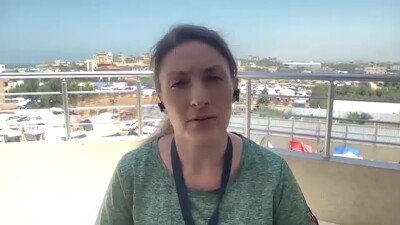
“There were 87,000 vaccinated on the first day out of 156,000 that we are hoping to reach in the Middle Area,” said Louise Wateridge, Senior Communications Officer for UNRWA, the largest UN agency in the Gaza Strip. “It's very promising that already, we have heard interest from parents who have come from Khan Younis, who have come from the southern area, and are asking our staff there and asking our teams, ‘When is the vaccination going to be available for us? When can we take our children?’”
Ms. Wateridge emphasized the urgent need for a ceasefire for the inoculation campaign to be successful, along with the release of all hostages taken during Hamas-led terror attacks in Israel on 7 October. “What these children need most is a ceasefire now," UNRWA said on X.
Speaking on Day Two of the vaccination drive, Ms. Wateridge reported seeing “hundreds of children” at a health centre in Deir Al-Balah and more at an UNRWA school in the central city. “The school reported that 3,000 children were vaccinated yesterday alone, so you know we’re seeing very good numbers and [need] to keep the momentum going,”
On Sunday, vaccination teams operated at UNRWA health centres, mobile medical points, and tents, with similar arrangements in place for Monday. “We are doing everything possible to ensure that all children under the age of 10 are vaccinated. Temporary pauses in the conflict are essential for delivering these vaccines,” UNRWA added on X. “Beyond the pause, these children need a vaccine that has already been delayed for too long.”
First case in 25 years
The initial three-day campaign in Gaza’s Middle Area to protect around 640,000 Palestinian youngsters from the highly infectious disease comes after health authorities detected the first case of polio in Gaza in 25 years. To offer maximum protection, children will need to receive two doses of the vaccine at a four-week interval. More than 1.2 million vaccine doses have been delivered to Gaza, with an additional 400,000 doses expected soon.
UN agencies UNRWA, the UN World Health Organization (WHO), the UN Children’s Fund (UNICEF) and Palestinian health authorities aim to achieve at least 90 per cent vaccination coverage in each round of the campaign to curb the current outbreak and prevent the international spread of polio.
Amid outbreaks of hepatitis, diarrhoea and other preventable diseases linked to 10 months of heavy Israeli bombardment and clashes with Hamas militants, UN agencies underscored the need to for all warring sides to maintain the agreed eight-hour pause in hostilities. “One of the biggest challenges is actually safely distributing the vaccinations because we have some areas in these so-called [humanitarian] pause zones between 6am and 2pm, there needs to be no fighting,” UNRWA’s Ms. Wateridge told UN News. “We are still struggling to get access to facilities and access to families and children in those areas. It’s far too dangerous for them to travel, to move; there is ongoing fighting.”
Ms. Wateridge reported “a lot of strikes” on Monday morning and through the night on Sunday. “So the fighting has not stopped by any means. There are some pauses throughout the day, but it's not guaranteed. We don't have guaranteed safety to people, and we really need that to reach all the children to get that 90 per cent success rate.”
Best vaccine is peace: Tedros
Last week, Israeli authorities agreed to a series of three-day “humanitarian pauses” in central, southern, and northern Gaza, allowing the vaccination campaign to proceed. The UN health agency WHO welcomed these pauses but reiterated that ultimately, “the only solution” to safeguard the health of Gaza’s children was a ceasefire. “The best vaccine for these children is peace,”, said WHO Director-General Tedros Adhanom Ghebreyesus.
The vaccination drive faces significant challenges, including ongoing fighting, devastated roads, and hospital closures caused by the conflict. According to the WHO, insecurity, damaged infrastructure, and population movements make it unlikely that three days in each area will be sufficient for adequate coverage. “It has been agreed that the vaccination period will be extended by a day if necessary,” the WHO noted, stressing that vaccination teams must be protected and allowed to conduct their work safely.
The campaign comes amid a severe humanitarian crisis in Gaza, where the conflict between Israel and Hamas, coupled with Israel’s blockade of the enclave, has led to acute shortages of food, drinking water, and medical supplies. The worsening situation has raised fears of further disease outbreaks, not limited to polio. “Today, children in Gaza are receiving the vaccines they so desperately need,” said WHO Chief Tedros Adhanom Ghebreyesus on X. "Ultimately, the best vaccine for these children is peace.”
Latest UN data indicates that approximately 90 per cent of Gaza’s 2.3 million residents have been displaced within the besieged territory, with hundreds of thousands crowded into overcrowded tent camps. Some enjoyed rare respite from intense fighting that has devastated much of the Gaza Strip.
“The one thing I noticed yesterday was, you know, going an hour without hearing a bomb,” UNRWA’s Ms. Wateridge said. “Going an hour without hearing a strike…it was noticeable that there was a calmer and quieter day yesterday because it has been so relentless for the last few weeks and also so many evacuation orders; 16 evacuation orders in August alone. Thousands, hundreds of thousands of people and families and being forced to flee.”
STORY: Gaza polio vaccination campaign Day 2 - UNRWA
TRT: 3 min 13s
SOURCE: UNTV CH
RESTRICTIONS: NONE
LANGUAGE: ENGLISH / NATS
ASPECT RATIO: 16:9
DATELINE: 2 SEPTEMBER 2024, GENEVA, SWITZERLAND
SHOTLIST
- Exterior medium: UN Geneva flag alley.
- Medium, staff from UNRWA reach a vaccination centre in central Gaza.
- Medium, a medic administers a dose of polio vaccine to a child.
- Medium, UNRWA spokesperson Louise Wateridge marks a child’s finger with an indelible pen as proof that they have had the vaccine.
- Medium, UNRWA worker at the vaccination centre fills out paperwork.
- SOUNDBITE (English) – UNRWA spokesperson Louise Wateridge: “Given the numbers that we had yesterday, it's off to a very good start. We were thrilled that there were 87,000 vaccinated on the first day out of 156,000 that we are hoping to reach in the Middle Area. On Thursday, the vaccination campaign will move to the southern areas. It's very promising that already we have heard interest from parents who have come from Khan Younis, who have come from the southern area and are asking our staff there and asking our teams, ‘when is the vaccination going to be available for us? When can we take our children?’”
- Medium: Child receiving dose of vaccine then having finger marked.
- SOUNDBITE (English) – UNRWA spokesperson Louise Wateridge: “One of the biggest problems we're having and one of the biggest challenges is actually safely distributing the vaccination because we have some areas in these so-called humanitarian pause zones, which means that between the hours of 6am and 2pm, there needs to be no fighting and and temporary ceasing in the fighting. But outside these zones and of course still in the Middle Area, we are still struggling to get access to facilities and access to families and children in those areas.”
- Medium: Child having finger marked after being given vaccine.
- SOUNDBITE (English) – UNRWA spokesperson Louise Wateridge: “It's far too dangerous for them to travel, to move; there is ongoing fighting. There was a lot of strikes this morning and through the night. So, the fighting has not stopped by any means. There are some pauses throughout the day, but it's not guaranteed. We don't have guaranteed safety to people and we really need that to reach all the children to get that 90 per cent success rate.”
- Medium, staff from UN and partner agencies move through packed shelters.
- SOUNDBITE (English) – UNRWA spokesperson Louise Wateridge: “The one thing I noticed yesterday was, you know, going an hour without hearing a bomb, you notice that. Going an hour without hearing a strike, it really was noticeable that there was a calmer and quieter day yesterday, because it has been so relentless for the last few weeks and also so many evacuation orders; 16 evacuation orders in August alone. Thousands, hundreds of thousands of people and families and being forced to flee.”
- Medium, a father looks on and smiles as a child receives their vaccine dose.
- SOUNDBITE (English) – UNRWA spokesperson Louise Wateridge: “We had the first rain yesterday afternoon. It was a pretty torrential downpour for the best part of an hour. And it's just a huge warning for what winter will bring. The sewage water was flooding the streets, everybody here is sleeping on the floor, you know, the shelters aren't waterproof.”
- Medium, humanitarians walking down stairs and out into a busy sheltered community.
- Medium, a vaccinator places the lid back onto the cold box used to store vaccines.
- Medium, a vaccinator administers the vaccine to a child being cradled by an adult.
Similar Stories
1
1
1
Edited News | OCHA , UNICEF , WFP
Aid agencies warned on Friday of the fast-developing humanitarian emergency inside Taiz City in Yemen, which has been encircled by de facto Houthi forces fighting government troops along the country’s west coast.

2
17
1
2
Edited News , Press Conferences , Images | OCHA , WMO
Two UN agencies teamed up on Wednesday to issue an appeal for immediate assistance to help communities already being impacted by the strongest El Niño on record.

3
16
2
2
Edited News , B-roll , Conferences , Images | UNITED NATIONS , UNOG
Sixth Consultative Meeting on Enhancing Coordination of Peace Initiatives and Efforts for Sudan

1
1
1
Edited News | UNICEF , WHO , UNHCR
Yemen war continues to force families from homes amid hunger and disease
More than 250,000 people have now fled renewed fighting in Yemen, the UN said on Tuesday, citing particular concern for those sheltering in the southwestern city of Taiz and the wider governorate, where access is “essentially blocked”.

1
1
1
Edited News | UNICEF
A little over one year since a ceasefire agreement was announced between Hamas fighters and Israel, more than 340 children have been reported killed and hundreds more injured, the UN Children’s Fund, UNICEF, said on Friday.

1
1
1
Edited News | UNICEF , IFRC
Six weeks after Nepal’s deadly flooding disaster, communities are still struggling to rebuild their lives, but they will need sustained help as global warming increases the risk of another Himalayan catastrophe, the UN Children’s Fund (UNICEF) said on Friday.

1
1
1
Edited News | WHO
In suspected Russia plague death, testing and monitoring underway – WHO
The death of a lab worker in Russia’s Siberia region has sparked concerns about plague being the cause, the UN World Health Organization (WHO) said on Tuesday, adding that it was following the situation closely.

1
1
Edited News | OHCHR , UNOG
UN Human Rights Chief Volker Türk on Friday provided and oral update to the 63rd session of the Human rights Council on Ukraine.

1
1
1
Edited News | OHCHR , UNOG
UN Human Rights Chief Volker Türk on Friday provided and oral update to the 63rd session of the Human rights Council on the human rights situation in Haiti.

1
1
1
Edited News | WHO
Repeated delays in bringing lifesaving medicines, prosthetics and more from Israel into Gaza risk having devastating consequences on Palestinians who urgently need them in the wartorn enclave, the UN World Health Organization (WHO) said on Friday. “A truck full of non-priority supplies or the right supplies arriving too late, doesn't save lives. That's the question that actually matters," said Dr Reinhilde Van De Weerdt, WHO Representative in the OPT.

1
1
1
Edited News | WHO
DRC: Early access to care and oxygen decisive for Ebola patients’ survival – WHO
In the Democratic Republic of the Congo (DRC), health workers fighting the country’s largest-ever Ebola outbreak are struggling to overcome critical challenges to patient care, the UN World Health Organization (WHO) warned on Tuesday.

1
1
1
Edited News | OCHA , UN
Civilians in Iran are continuing to feel the consequences of months of conflict and military escalation, the UN’s top official in the country has said, as loss of life, damage to civilian infrastructure and mounting economic pressures leave many facing continued uncertainty.