

The United Nations Office at Geneva
Multimedia Newsroom
Myanmar rights probe warns over ‘incredible brutality’ of warring forces
Conflict in Myanmar between the military junta and opposition forces is increasingly brutal, with both sides likely responsible for international crimes including summary executions, top independent rights investigators said on Tuesday.
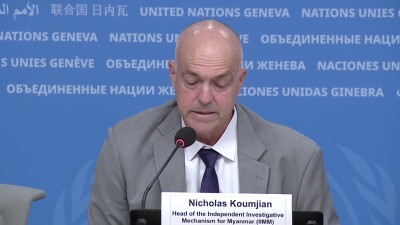
In a call to regional bloc ASEAN to help end the violence and support efforts to bring perpetrators to justice, the head of the Human Rights Council-appointed probe into the Myanmar emergency, Nicholas Koumjian, described an increasingly “desperate” junta whose devastating military tactics were being matched by opposition fighters acting with total impunity.
“Aerial bombings have increased very substantially in this last year,” Mr. Koumjian told journalists in Geneva. “In Kayah state in February of this year, four children were killed and around 10 injured when fighter jets dropped bombs and deployed machine gun fire on the school.”
Mr. Koumjian added that his investigators had also seen a video “that showed resistance forces beheading two captured soldiers in Loikaw in Kayah state in November, December of last year”, along with another video posted on social media of two young men being burned to death in Magway region. “So, this kind of incredible brutality is going on,” he said.
The Independent Investigative Mechanism for Myanmar (IIMM) was created by the Human Rights Council in 2018 to collect evidence of the most serious international crimes committed in Myanmar since 2011. It released its latest annual report on Tuesday.
Civilians frequently targeted
“Unfortunately, what our report conveys is that the number of these crimes is only increasing and the armed conflict is increasing in intensity and in brutality and crimes are happening more and more frequently,” Mr. Koumjian noted.
The veteran rights expert and former international criminal justice prosecutor expressed his opinion that the junta which seized power in Myanmar on 1 February 2021 was becoming more “desperate” over the period covered by the report from 1 July 2023 to 30 June 2024 - a time when armed conflicts increased across Myanmar as challenges to military rule intensified. “The targets of these bombings are usually civilian targets,” Mr. Koumjian said. “Schools and churches and hospitals are often the only structures in the area and those are the structures…that are being bombed.”
ASEAN influence
In a direct appeal to the regional bloc ASEAN, Mr. Koumjian urged it to respond to “substantial evidence” that the Myanmar military was committing war crimes and crimes against humanity “at an alarming rate”, by putting pressure on the junta to halt the conflict.
ASEAN - a “very key player in Myanmar”, according to the human rights investigator – has drawn up a five-point consensus to end the fighting that has been signed by “the junta itself”. Nonetheless, “we see instead an increase in violence and an increase in the violence targeting civilians,” he said. “So, I think absolutely, it's time for ASEAN to put some bite into its consensus. It's not enough simply to say we support ending the violence, there have to be steps taken to ensure that, in fact, the violence has ended.”
Broad reach
The head of the Independent Investigative Mechanism for Myanmar (IIMM) noted that the panel’s report was based on information and evidence collected from more than 900 sources, including more than 400 eyewitness testimonies, along with additional evidence such as photographs, videos, audio material, documents, maps, geospatial imagery, social media posts and forensic evidence.
Fighting impunity remains a core objective of the IIMM which has shared its findings and evidence with authorities at the International Criminal Court, the International Court of Justice and in Argentina, Mr. Koumjian said.
Myanmar conflict – rights probe update
TRT: 2 min 17s
SOURCE: UNTV CH
RESTRICTIONS: NONE
LANGUAGE: ENGLISH / NATS
ASPECT RATIO: 16:9
DATELINE: 13 AUGUST 2024 GENEVA, SWITZERLAND
SHOTLIST
- Exterior medium: UN Geneva flag alley.
- Medium-wide, Press room, UN Geneva.
- SOUNDBITE (English) – Nicholas Koumjian, Head of the Independent Investigative Mechanism for Myanmar (IIMM): “Aerial bombings have increased very substantially in this last year; in Kayah state in February of this year, four children were killed and around 10 injured when fighter jets dropped bombs and deployed machine gun fire on the school.”
- Medium-wide, Press room and podium speakers, UN Geneva.
- SOUNDBITE (English) – Nicholas Koumjian, Head of the Independent Investigative Mechanism for Myanmar (IIMM): “We have a video that showed resistance forces beheading two captured soldiers in Loikaw in Kayah state in November, December of last year. So this kind of incredible brutality is going on.”
- Wide, Press room, UN Geneva.
- SOUNDBITE (English) – Nicholas Koumjian, Head of the Independent Investigative Mechanism for Myanmar (IIMM): “Our mandate is to collect evidence of the most serious international crimes in Myanmar and unfortunately, what our report conveys is that the number of these crimes is only increasing and the armed conflict is increasing in intensity and in brutality and crimes are happening more and more frequently.”
- Medium-wide, Press room, UN Geneva.
- SOUNDBITE (English) – Nicholas Koumjian, Head of the Independent Investigative Mechanism for Myanmar (IIMM): “There’s no doubt that the military, the junta, is becoming more desperate and we've seen, for example, this big increase in the use of aerial bombing and the targets of these bombings are usually civilian targets; schools and churches and hospitals are often the only structures in the area and those are the structures that are being - major structures - that are being bombed.”
- Medium-wide, Press room podium speakers.
- SOUNDBITE (English) – Nicholas Koumjian, Head of the Independent Investigative Mechanism for Myanmar (IIMM): “We see an increase in the violence targeting civilians. So, I think absolutely, it's time for ASEAN to put some bite into its consensus. It's not enough simply to say we support ending the violence, there have to be steps taken to ensure that, in fact, the violence has ended.”
- Medium-wide, journalists, participants, one taking video on mobile phone.
- Medium-wide, participant taking video of proceedings.
- Medium, participant.
Similar Stories
1
1
1
Edited News | OCHA , UNICEF , WFP
Aid agencies warned on Friday of the fast-developing humanitarian emergency inside Taiz City in Yemen, which has been encircled by de facto Houthi forces fighting government troops along the country’s west coast.

2
17
1
2
Edited News , Press Conferences , Images | OCHA , WMO
Two UN agencies teamed up on Wednesday to issue an appeal for immediate assistance to help communities already being impacted by the strongest El Niño on record.

3
16
2
2
Edited News , B-roll , Conferences , Images | UNITED NATIONS , UNOG
Sixth Consultative Meeting on Enhancing Coordination of Peace Initiatives and Efforts for Sudan

1
1
1
Edited News | UNICEF , WHO , UNHCR
Yemen war continues to force families from homes amid hunger and disease
More than 250,000 people have now fled renewed fighting in Yemen, the UN said on Tuesday, citing particular concern for those sheltering in the southwestern city of Taiz and the wider governorate, where access is “essentially blocked”.

1
1
1
Edited News | UNICEF
A little over one year since a ceasefire agreement was announced between Hamas fighters and Israel, more than 340 children have been reported killed and hundreds more injured, the UN Children’s Fund, UNICEF, said on Friday.

1
1
1
Edited News | UNICEF , IFRC
Six weeks after Nepal’s deadly flooding disaster, communities are still struggling to rebuild their lives, but they will need sustained help as global warming increases the risk of another Himalayan catastrophe, the UN Children’s Fund (UNICEF) said on Friday.

1
1
1
Edited News | WHO
In suspected Russia plague death, testing and monitoring underway – WHO
The death of a lab worker in Russia’s Siberia region has sparked concerns about plague being the cause, the UN World Health Organization (WHO) said on Tuesday, adding that it was following the situation closely.

1
1
Edited News | OHCHR , UNOG
UN Human Rights Chief Volker Türk on Friday provided and oral update to the 63rd session of the Human rights Council on Ukraine.

1
1
1
Edited News | OHCHR , UNOG
UN Human Rights Chief Volker Türk on Friday provided and oral update to the 63rd session of the Human rights Council on the human rights situation in Haiti.

1
1
1
Edited News | WHO
Repeated delays in bringing lifesaving medicines, prosthetics and more from Israel into Gaza risk having devastating consequences on Palestinians who urgently need them in the wartorn enclave, the UN World Health Organization (WHO) said on Friday. “A truck full of non-priority supplies or the right supplies arriving too late, doesn't save lives. That's the question that actually matters," said Dr Reinhilde Van De Weerdt, WHO Representative in the OPT.

1
1
1
Edited News | WHO
DRC: Early access to care and oxygen decisive for Ebola patients’ survival – WHO
In the Democratic Republic of the Congo (DRC), health workers fighting the country’s largest-ever Ebola outbreak are struggling to overcome critical challenges to patient care, the UN World Health Organization (WHO) warned on Tuesday.

1
1
1
Edited News | OCHA , UN
Civilians in Iran are continuing to feel the consequences of months of conflict and military escalation, the UN’s top official in the country has said, as loss of life, damage to civilian infrastructure and mounting economic pressures leave many facing continued uncertainty.