

The United Nations Office at Geneva
Multimedia Newsroom
Edited News | UNICEF , OCHA
UNOG Bi-weekly press briefing: Humanitarian Crisis Yemen - UNICEF-OCHA
YEMEN: Severe funding gaps for humanitarian aid as cases of Covid-19 are on the rise
UN Humanitarian agencies warned that aid projects face closure due to a severe lack of funding as Covid-19 spreads in war-torn Yemen.
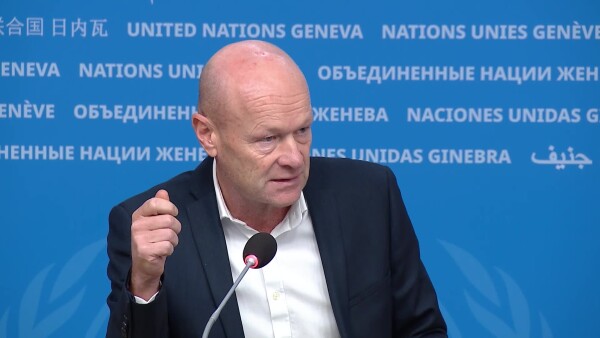
“As of today, UNICEF’s $479 million appeal to sustain essential basic services for children is just 38 per cent funded”, said Marixie Mercado, spokesperson for UNICEF speaking today to a virtual press conference at the United Nations in Geneva. “The most critical and immediate funding gap is for emergency - water, sanitation and hygiene or what we call WASH operations, including for the COVID-19 response”.
At the High-Level Pledging Event for the Humanitarian Crisis in Yemen on June 2nd, 31 international donors announced pledges of a combined US$1.35 billion to meet the humanitarian needs of people affected by the world’s biggest humanitarian crisis. As of today, some 47 per cent ($637 million) of the pledges have been paid.
Of the 8.4 million Yemenis whose access to WASH will be affected because of insufficient funding, a total of 4 million people – nearly half of them children – directly depend on UNICEF.
Unless UNICEF receives U$30 million by the end of June, water, sanitation and hygiene services will start shutting down for these 4 million people in July.
“This means UNICEF will not be able to provide fuel to operate water pumping stations, or de-sludge sewage, or maintain crumbling water and sanitation infrastructure”, UNICEF’s spokesperson said. “It means we will not be able to distribute basic family hygiene kits that include soap, which is so critical for preventing both cholera and COVID in a context where millions don’t have access to handwashing facilities”.
To ensure UNICEF’s WASH services till the end of the year, the organisation requires U$110 million USD.
UNICEF’s spokesperson explained that “the criticality of maintaining safe water, sanitation and hygiene provision cannot be overstated in the context of a running cholera and diarrhea epidemic”. She added that “over 137,000 cases have been recorded since the beginning of the year, nearly a quarter of them among children below 5 years old”.
UNICEF has shipped over 33,000 N95 respirators, 33.000 face shields, and 18,000 gowns for frontline workers. However, this represents only 5 per cent of the Covid-19 supplies UNICEF requires. “Without $48 million immediately, UNICEF will not be able to provide PPE (Personal Protective Equipment) items and operations support to 25,000 frontline workers, including health staff”, UNICEF’s spokesperson said.
According to the World Health Organisation (WHO) between 10 April, when the first case was confirmed, and 11 June, the authorities in Yemen announced 564 confirmed COVID-19 cases including 130 deaths.
Jens Laerke, Spokesperson for the UN Office for the Coordination of Humanitarian Affairs (OCHA) said that “the case fatality rate is alarming high at more than 24 per cent. So that is, I believe, more than 3 times the average case fatality rate. The highest number of confirmed cases are in Aden, where up till the 6 June there were 130 cases including 5 death followed by Hadramaut were 126 cases, including 48 deaths”.
Reports continue to indicate that many more people are symptomatic and are dying with COVID-19-like symptoms.
Due to the lack in funding of humanitarian aid work, OCHA reported already some of the first consequences for the Yemenis. “We know that eight and a half million people in the north are only receiving food every 2 months now, so rations have been cut in half”, Jens Laerke said.
Aid agencies in Yemen continue to scale up the response, prioritizing suppression of virus transmission through community engagement and public information campaigns and to procure and distribute medical supplies and equipment.
1. Wide shot: exterior, UN Geneva flag alley.
SOUNDBITE (EN) – Marixie Mercado, Spokesperson for UNICEF: “As of today, UNICEF’s $479 million appeal to sustain essential basic services for children is just 38 per cent funded. The most critical and immediate funding gap is for emergency - water, sanitation and hygiene or what we call WASH operations, including for the COVID-19 response”.
2. Medium shot: Flag alley in front of UN Geneva building
3. SOUNDBITE (EN) - Marixie Mercado, Spokesperson for UNICEF: “This means UNICEF will not be able to provide fuel to operate water pumping stations, or de-sludge sewage, or maintain crumbling water and sanitation infrastructure. It means we will not be able to distribute basic family hygiene kits that include soap, which is so critical for preventing both cholera and COVID in a context where millions don’t have access to handwashing facilities”.
4. Medium shot: UN entry, Place des Nations with motorcycle passing by
5. SOUNDBITE (EN) - Marixie Mercado, Spokesperson for UNICEF: “The criticality of maintaining safe water, sanitation and hygiene provision cannot be overstated in the context of a running cholera and diarrhea epidemic. Over 137,000 cases have been recorded since the beginning of the year, nearly a quarter of them among children below 5 years old”.
6. Close up : UN Geneva Palais des Nations
7. SOUNDBITE (EN) – Marixie Mercado, Spokesperson for UNICEF: “Without $48 million immediately, UNICEF will not be able to provide PPE (Personal Protective Equipment) items and operations support to 25,000 frontline workers, including health staff”.
8. Medium shot: UN flag alley
SOUNDBITE (EN) – Jens Laerke, Spokesperson for the UN Office for the Coordination of Humanitarian Affairs (OCHA): “The case fatality rate is alarming high at more than 24 per cent. So that is, I believe, more than 3 times the average case fatality rate. The highest number of confirmed cases are in Aden, where up till the 6 June, there were 130 cases including 5 death followed by Hadramaut, where 126 cases, including 48 deaths”.
10. Wide shot: UN flag
- SOUNDBITE (EN) – Jens Laerke, Spokesperson for the UN Office for the Coordination of Humanitarian Affairs (OCHA): “We also know that eight and a half million people in the north are only receiving now every 2 months, so rations have been cut in half”.
12. Medium shot: UN flag in front of UN Palais

Similar Stories
1
1
1
Edited News | OCHA , UNICEF , WFP
Aid agencies warned on Friday of the fast-developing humanitarian emergency inside Taiz City in Yemen, which has been encircled by de facto Houthi forces fighting government troops along the country’s west coast.

2
17
1
2
Edited News , Press Conferences , Images | OCHA , WMO
Two UN agencies teamed up on Wednesday to issue an appeal for immediate assistance to help communities already being impacted by the strongest El Niño on record.
3
16
2
2
Edited News , B-roll , Conferences , Images | UNITED NATIONS , UNOG
Sixth Consultative Meeting on Enhancing Coordination of Peace Initiatives and Efforts for Sudan
1
1
1
Edited News | UNICEF , WHO , UNHCR
Yemen war continues to force families from homes amid hunger and disease
More than 250,000 people have now fled renewed fighting in Yemen, the UN said on Tuesday, citing particular concern for those sheltering in the southwestern city of Taiz and the wider governorate, where access is “essentially blocked”.

1
1
1
Edited News | UNICEF
A little over one year since a ceasefire agreement was announced between Hamas fighters and Israel, more than 340 children have been reported killed and hundreds more injured, the UN Children’s Fund, UNICEF, said on Friday.

1
1
1
Edited News | UNICEF , IFRC
Six weeks after Nepal’s deadly flooding disaster, communities are still struggling to rebuild their lives, but they will need sustained help as global warming increases the risk of another Himalayan catastrophe, the UN Children’s Fund (UNICEF) said on Friday.

1
1
1
Edited News | WHO
In suspected Russia plague death, testing and monitoring underway – WHO
The death of a lab worker in Russia’s Siberia region has sparked concerns about plague being the cause, the UN World Health Organization (WHO) said on Tuesday, adding that it was following the situation closely.

1
1
Edited News | OHCHR , UNOG
UN Human Rights Chief Volker Türk on Friday provided and oral update to the 63rd session of the Human rights Council on Ukraine.

1
1
1
Edited News | OHCHR , UNOG
UN Human Rights Chief Volker Türk on Friday provided and oral update to the 63rd session of the Human rights Council on the human rights situation in Haiti.

1
1
1
Edited News | WHO
Repeated delays in bringing lifesaving medicines, prosthetics and more from Israel into Gaza risk having devastating consequences on Palestinians who urgently need them in the wartorn enclave, the UN World Health Organization (WHO) said on Friday. “A truck full of non-priority supplies or the right supplies arriving too late, doesn't save lives. That's the question that actually matters," said Dr Reinhilde Van De Weerdt, WHO Representative in the OPT.

1
1
1
Edited News | WHO
DRC: Early access to care and oxygen decisive for Ebola patients’ survival – WHO
In the Democratic Republic of the Congo (DRC), health workers fighting the country’s largest-ever Ebola outbreak are struggling to overcome critical challenges to patient care, the UN World Health Organization (WHO) warned on Tuesday.

1
1
1
Edited News | OCHA , UN
Civilians in Iran are continuing to feel the consequences of months of conflict and military escalation, the UN’s top official in the country has said, as loss of life, damage to civilian infrastructure and mounting economic pressures leave many facing continued uncertainty.