

The United Nations Office at Geneva
Multimedia Newsroom
Press Conferences | UNCTAD , WHO , OCHA , UNHCR , OHCHR
UN Geneva Press Briefing - 23 April 2024
UN GENEVA PRESS BRIEFING
23 April 2024
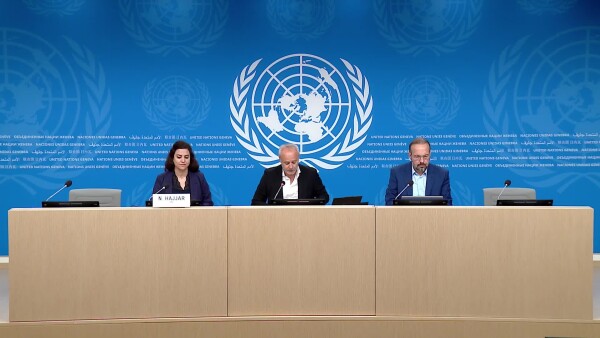
Alessandra Vellucci, Director of the United Nations Information Service in Geneva, chaired a hybrid briefing, which was attended by the spokespersons and representatives of the United Nations Trade and Development, the United Nations Human Rights, the Office for the Coordination of Humanitarian Affairs, the United Nations Refugee Agency, and the World Health Organization.
Situation in Rafah and the West Bank
Ravina Shamdasani, for the United Nations Human Rights (OHCHR), informed that today UN Human Rights Chief Volker Türk decried a series of Israeli strikes on Rafah in the past few days that had killed mostly children and women, repeating his warning against a full-scale incursion on an area where 1.2 million civilians had been forcibly cornered. Such an operation would lead to further breaches of international humanitarian law and international human rights law; it would risk more deaths, injuries, and displacement on a large scale – even further atrocity crimes, for which those responsible would be held accountable. “The world’s leaders stand united on the imperative of protecting the civilian population trapped in Rafah,” the High Commissioner said. Every ten minutes a child was killed or wounded in Gaza.
Türk had also said that grave human rights violations were continuing unabated in the occupied West Bank. Despite international condemnation of massive settler attacks from 12 to 14 April facilitated by the Israeli Security Forces (ISF), settler violence had continued with the support, protection, and participation of the ISF. During a 50-hour long operation into Nur Shams refugee camp and Tulkarem city starting on 18 April, the ISF had deployed ground troops, bulldozers, and drones, and sealed the camp. Fourteen Palestinians had been killed, three of them children, while ten members of the ISF had been hurt.
Full statement is available here.
Replying to questions from the media, Ms. Shamdasani said that OHCHR information indicated that some displaced people from Rafah had tried to return to their homes in the north, but a number of them had come under attack and some had been killed. There was no safe place in Gaza, she reiterated, and any pretense of creating safe places was dangerous; what was needed instead was a humanitarian ceasefire. OHCHR had been warning of war crimes and collective punishment since October. The High Commissioner had repeatedly warned of atrocity crimes, which included war crimes, crimes against humanity, and genocide. There was evidence of the use of weapons with wide-area effects, which could be considered as indiscriminate. Ms. Shamdasani explained that the International Criminal Court and the Commission of Inquiry into Gaza were involved in collecting evidence; the OHCHR would share with them any information it would collect, but it did not have expertise to collect evidence as such. She said that 283 bodies had been reportedly recovered in a mass grave by the Al-Nasser Hospital, including older people, and some had had their hands tied; thirty bodies had been buried in a mass grave next to the Al-Shifa Hospital, some of which also had their hands tied. These reports needed to be subjected to thorough investigations and should not be allowed to pass under the radar. According to UNFPA, an estimated 180 women were giving birth every day in inhuman conditions in Gaza; many of them probably with a C-section without anesthesia.
On the question of pro-Palestinian protests in the United States, Ms. Shamdasani stressed that the freedom of expression and peaceful assembly had to be respected and protected by States; there could be legitimate restrictions on those freedoms, based on the principles of necessity and proportionality. At the same time, antisemitic and anti-Islamic speech had to be condemned.
Jens Laerke, for the Office for the Coordination of Humanitarian Affairs (OCHA), responding to a question, said that the estimates of the internally displaced people in Rafah were only that – estimates. Some movement out of Rafah had been observed after the Israeli army had announced the cessation of operations in Khan Younis. There were now reports that those operations had restarted. UN staff on the ground shared fears that an assault on Rafah might still go ahead. The World Food Programme had had some success in supplying fuel and wheat to northern parts of Gaza; consequently, some bakeries had resumed work, but it was hard to conclude how much impact that would have on the hundreds of thousands of people who were already in the Integrated Food Security Phase Classification (IPC) category 5.
Answering another question, Alessandra Vellucci, for the United Nations Information Service (UNIS), explained that the Independent Review Group’s report into the work of the United Nations Relief and Works Agency (UNRWA) had been shared with the journalists as soon as it had been finalized and made available to UNIS. She informed that Philippe Lazzarini, head of UNRWA, would address the media at the noon press briefing in New York today, which could be followed live on UNTV.
UK Rwanda Law
Responding to questions on the passage of the “Safety of Rwanda” Bill by the Parliament in the United Kingdom, Ravina Shamdasani, for the United Nations Human Rights (OHCHR), referred to a joint press release of the High Commissioners for Refugee and for Human Rights. The two leaders had again sounded the alarm on the harmful impact it would have on global responsibility-sharing, human rights, and refugee protection. “By shifting responsibility for refugees, reducing the UK’s courts’ ability to scrutinise removal decisions, restricting access to legal remedies in the UK and limiting the scope of domestic and international human rights protections for a specific group of people, this new legislation seriously hinders the rule of law in the UK and sets a perilous precedent globally,” said Human Rights High Commissioner Volker Türk. This move ran counter to the basic principles of the rule of law, said Ms. Shamdasani responding to another question. Avenues of appeal were very much narrowed, which was one area of concern.
Matthew Saltmarsh, for the United Nations Refugee Agency (UNHCR), said that it was a somber day for refugee rights, but the UNHCR would not deviate from standing up for those rights. UNHCR had repeatedly raised concerns over the UK Rwanda asylum law and the shifting of responsibility that this legislation brought in. The Refugee Convention was the cornerstone of the international refugee protection regime. International protection of refugees rested with States; this obligation remained unaltered by the transfer arrangements, stressed Mr. Saltmarsh. He reminded that the UK was receiving relatively modest numbers of asylum seekers, when compared to other European countries and major refugee hosting countries in Africa. UNHCR had always noted that Rwanda had been a generous refugee-hosting country, but it needed to further build its asylum processing capacity. There were concerns that this decision by the UK could set a precedent.
Full reaction by the heads of the UN Refugee Agency and the UN Human Rights can be found here.
Global cholera situation
Dr. Philippe Barboza, Cholera Lead at the World Health Organization (WHO), said that the global cholera situation was worsened by two factors: effects of the climate change and the lack of adequate funding. In January 2023, the WHO had ranked the resurgence of cholera as a level three emergency, and since then, the situation had only worsened. Droughts and floods in east and central Africa were creating perfect conditions for cholera to thrive. There had been over 4,000 registered cases of cholera in Ethiopia and close to 4,000 in Zimbabwe in March alone. Cholera prevention had to be boosted now, stressed Dr. Barboza. Some 6,000 cholera-related deaths had been reported globally as of 31 March 2024. Since 2022, the WHO had released USD 16 million from its emergency contingency fund, but, due to the multiple crises the world was facing, the WHO was no longer in a position to provide the same level of support.
On a positive side, as of 15 April the stock of emergency cholera vaccines had stood at 2.3 million doses, which was still below the global target of five million. One-dose strategy was thus still in place. However, vaccines alone would not solve the problem; safe drinking water and sanitation were the only long-term solutions. Continuous funding for both improving access to safe water and sanitation, and vaccine production, was the way forward, concluded Dr. Barboza.
Responding to questions, Dr. Barboza said that the global stock of cholera vaccines for emergencies should stand at five million doses. The objective would be to have two-dose vaccinations, which would provide longer, stronger protection. The current stock did not allow to consider passing to two-dose vaccinations.
Report “Global Economic Divide and Changing Investment Patterns”
Catherine Huissoud, for the United Nations Trade and Development (UNCTAD), informed that UN Trade and Development was today launching its latest report “Global Economic Divide and Changing Investment Patterns”, which highlighted significant shifts in investment priorities across various sectors and regions, redrawn by geopolitical dynamics, and concluded that there was an urgent need to adopt investment policies that are strategically focused on sustainability and development. The report showed that the growth rate of foreign direct investment and global value chains was no longer aligned with GDP and trade growth, revealing a significant change in the global economy, which was due to rising protectionism, geopolitical tensions, and increased investor caution.
Ms. Huissoud also informed that the gap was widening between the manufacturing and service sectors, with investment tilting more and more towards services. The share of new cross-border projects in the service sector had risen from 66 percent in 2004 to 81 percent in 2023, while investment in the manufacturing sector had declined considerably. UNCTAD was calling for immediate action to close investment gaps between sectors and regions, to ensure that the benefits of investment are more equitably distributed and aligned with critical development goals. It was imperative that developing countries revise their economic development strategies, focusing on policies that attract FDI and maximize its benefits by promoting inclusion and sustainability, stressed the report.
Ms. Huissoud introduced her new colleague Marcello Risi, who had taken the lead on editorial policy and strategic communications at UNCTAD.
Announcements
Alessandra Vellucci, for the for the United Nations Information Service (UNIS), informed that the cost-saving measures were now being implemented at the Palais des Nations. New operational hours were from 8 am to 7 pm on working days, and new gates hours were from 7:30 am to 7:30 pm on working days. While the administration was conscious that the press corps had specific needs, all Palais-based journalists were asked to complete this survey so that their needs would be better understood and addressed.
On 24 April at 9:30 am, the Global Network Against Food Crises (GNAFC) would launch its Global Report on Food Crises 2024. Speakers would be Dominique Burgeon, Director of the Food and Agriculture Organization Liaison Office in Geneva; Stefano Fedele, Global Nutrition Cluster Coordinator at the United Nations Children’s Fund in Geneva; and Courtney Blake, Senior Humanitarian Advisor for the Mission of the United States of America in Geneva.
The Committee Against Torture was beginning this morning its review of the report of Azerbaijan.
The Committee on the Elimination of Racial Discrimination would hold an informal meeting with NGOs on 25 April at 3 pm.
Similar Stories
1
1
1
Press Conferences | UN WOMEN , WFP , WHO
UN WOMEN: Sudan Women and girls one year after the fall of El Fasher; increasing drone attacks across the country; WFP: DRC - Ebola spreads to eighth DRC province as WFP delivers food, builds treatment centres and keeps supplies moving; WHO - Update on Ebola (Bundibugyo Virus Disease)
1
12
1
1
Press Conferences , Images | UNOG
Closing Press Conference following the Sixth Consultative Meeting on Enhancing Coordination of Peace Initiatives and Efforts in Sudan

2
17
1
2
Edited News , Press Conferences , Images | OCHA , WMO
Two UN agencies teamed up on Wednesday to issue an appeal for immediate assistance to help communities already being impacted by the strongest El Niño on record.
1
1
1
Press Conferences | CITES
Wildlife trade and conservation policy discussions at the 81st meeting of the CITES Standing Committee (SC81)
1
1
1
Press Conferences | UNHCR , UNCTAD , WMO , OCHA , UNICEF , WHO
UNHCR Hungary’s 1956 Refugee Crisis: 70 Years On, UNCTAD World Investment Forum 2026, Doha, WMO Greenhouse Gas Bulletin and Climate Update for COP31, OCHA Afghanistan: Malnutrition, Girls’ Education and Recovery, UNICEF Yemen: Child Malnutrition and Unsafe Water in Taiz, WHO Inequalities in Noncommunicable Diseases and Risk Factors
1
1
1
Press Conferences | UNHCR
End of UNHCR's 77th Annual Executive Committee (ExCom) meeting week
1
1
1
Press Conferences | UNICEF , IOM , UNHCR
UN Special Assistant to the Personal Envoy Office (SUDAN): Peace Initiatives and Efforts in Sudan; UNICEF: Dire situation of children in Gaza; IOM: Damaged Homes and Energy Attacks Risk Displacing Ukrainians for this winter; UNHCR: update on EXCOM week

1
1
1
Press Conferences | IOM , UNDRR
UN stresses importance of household preparedness for disaster risk reduction.

1
1
1
Statements , Press Conferences | OHCHR

1
1
1
Press Conferences | UNHCR , UNICEF , IFRC , OHCHR , UN WOMEN , IOM , OCHA , WHO
UNHCR – ExCom Meeting, UNICEF – Nepal Recovery, IFRC – Flash Floods, WHO – Mental Health, IOM – South Sudan Floods, OCHA – DRC Humanitarian aid, UNHCR – Sahel Displacement, UNICEF – Yemen Update, IOM – Gaza Shelter, UN Women – Gaza Women, OHCHR – Arrests and detentions of Syrians by Israeli force

2
1
2
Press Conferences | UNCTAD
Presentation of the Trade and Developement Report 2026
Embargoed until 9 October 2026 at 11 a.m. (Geneva Time)
UNCTAD: UNCTAD’s flagship report finds that governments increasingly use industrial, trade, financial and technology policies to pursue economic and national security objectives. Market access and the ability to move into higher-value activities now depend more heavily on technology, finance and geopolitics.

1
1
1
Press Conferences | UPU
Release of the State of the Postal Sector Report 2026