

The United Nations Office at Geneva
Multimedia Newsroom
As Gaza continues slide towards famine, UN humanitarians plead for urgent access
A child dreaming of a slice of cucumber to eat and teenage girls saying they hope for death to “end their nightmare”: these are just some of the facets of the horror unfolding in Gaza, UN humanitarians said on Tuesday.
Briefing the press in Geneva, UN Children’s Fund (UNICEF) spokesperson James Elder expressed his hopes for a “substantive, not symbolic” ceasefire that would offer relief to civilians in the enclave on the brink of famine. On Monday, the UN Security Council adopted a resolution demanding a pause in hostilities during the month of Ramadan as well as the immediate and unconditional release of hostages, emphasizing "the urgent need to expand the flow" of aid into Gaza.
Speaking from Gaza, Mr. Elder described his recent visit to Jabalia in the north, where “up to tens of thousands of people crowd the streets”.
“They make that universal signal as you go through the streets again, as they stand in rubble, that universal signal of hand-to-mouth, desperately asking and seeking for food,” he said.
Mr. Elder stressed that there were “hundreds of trucks of lifesaving humanitarian aid waiting to get to these people in urgent need. But on the wrong side of the border, hundreds of trucks of UN and INGO supplies are currently backlogged,” he said.
The UNICEF spokesperson also highlighted that “an existing old crossing point” in Erez in the north could be used to reach desperate Gazans “10 minutes from where those people are putting their hands to their mouth, pleading for food”.
“Open that and we could turn this humanitarian crisis around in a matter of days,” he insisted.
Last week the UN Food and Agriculture Organization (FAO) said that famine is projected to occur “anytime between now and May 2024” in Gaza’s northern governorates,” following the most recent Integrated Food Security Phase Classification (IPC) report on Gaza. The report’s data indicated that the “entire population” of Gaza – some 2.3 million people – are enduring high levels of “acute” food insecurity. Among them, over 1.1 million are suffering from “catastrophic” food insecurity, known as IPC Phase 5.
Speaking from Cairo, AbdulHakim Elwaer, FAO’s Assistant Director-General and Regional Representative for the Near East and North Africa, confirmed to journalists that the north of the Strip “remains [under] a total blockade and it's inaccessible”.
Asked by journalists about comments from Israeli politicians refuting the notion of famine in Gaza, Mr. Elwaer insisted that “definitely, we have enough evidence that shows there is ongoing starvation and extreme acute food insecurity, a lack of major food supplies and water”.
“Those who claim otherwise probably have to provide evidence for that,” he added.
“There are cases of death as a result of starvation, and those are the early indications of famine,” Mr. Elwaer said. “I hope we're not waiting for full famine declaration because the situation as it exists calls for action, which is long overdue.”
Jens Laerke, spokesperson for the UN Humanitarian Affairs Coordination Office (OCHA), insisted that according to international humanitarian law, the parties to the conflict “must allow and facilitate rapid and unimpeded passage of humanitarian relief for civilians in need”, creating an “enabling environment” so that lifesaving aid can reach those who need it most.
“You cannot claim to adhere to these international provisions of law when you block [UN Palestine refugee agency] UNRWA food convoys, when you just last week denied five missions to the north, when we have now reports of Israeli attacks on warehouses and the police that are supposed to help secure this aid inside Gaza,” he said.
“This is not a facilitated or enabled environment at all,” Mr. Laerke stressed, repeating UN Secretary-General António Guterres’ call for the Israeli authorities to revoke their decision barring UNRWA from reaching north Gaza with aid.
- ENDS -
STORY: Gaza humanitarian update: UNICEF - FAO - OCHA
TRT: 2:37”
SOURCE: UNTV CH
RESTRICTIONS: NONE
LANGUAGE: ENGLISH / NATS
ASPECT RATIO: 16:9
DATELINE: 26 March 2024 GENEVA, SWITZERLAND
1. Exterior medium shot: UN flag alley
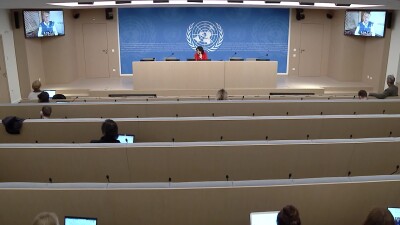
2. Wide shot: speaker at the podium of the press conference
3. SOUNDBITE (English) – James Elder, spokesperson, UN Children’s Fund (UNICEF): “Yesterday I was again in Jabalia, up tens of thousands of people crowd the streets. So they make that universal signal, sign, as you go through the streets again, as they stand in rubble, that universal signal of hand-to-mouth, desperately asking and seeking for food.”
4. Medium shot: Journalists in the press room
5. SOUNDBITE (English) – James Elder, spokesperson, UN Children’s Fund (UNICEF): “When I came to the Gaza strip just over a week ago, there were hundreds of trucks of lifesaving humanitarian aid waiting to get to these people in urgent need. But on the wrong side of the border, hundreds of trucks of UN and INGO supplies are currently backlogged, waiting to get into Gaza.”
6. Medium shot: Journalists in press room
7. SOUNDBITE (English) – James Elder, spokesperson, UN Children’s Fund (UNICEF): “Now there is an existing old crossing point that could be used in the north. 10 minutes from where those people are putting their hands to their mouth, pleading for food. 10 minutes. Open that and we could turn this humanitarian crisis around in a matter of days.”
8. Wide shot: speakers at the podium filmed from behind during the press conference with journalists in the press room
9. SOUNDBITE (English) – AbdulHakim Elwaer, Assistant Director-General and Regional Representative for the Near East and North Africa, UN Food and Agriculture Organization (FAO): “The north remains [under] a total blockade and it's inaccessible. And definitely we have enough evidence that shows there is ongoing starvation and is extreme acute food insecurity, a lack of major food supplies and water. And then those who claim otherwise probably have to provide evidence for that.”
10. Wide shot: Journalists in press room
11. SOUNDBITE (English) AbdulHakim Elwaer, Assistant Director-General and Regional Representative for the Near East and North Africa, UN Food and Agriculture Organization (FAO): “There are cases of death as a result of starvation. And those are the early indications of famine. And I hope we're not waiting for full famine declaration because the situation as it exists calls for action, which is long overdue.”
12. Wide shot: Journalists in the press room
13. SOUNDBITE (English) - Jens Laerke, spokesperson, UN Office for the Coordination of Humanitarian Affairs (OCHA): “You cannot claim to adhere to these international provisions of law when you block UNRWA food convoys, when you just last week denied five missions to the north, when we have now reports of Israeli attacks on warehouses and the police that are supposed to help secure this aid inside Gaza.”
16. Medium shot: journalists in the press room
17. Medium shot: Journalists, cameraman and people in the gallery of the press room
18. Medium shot: journalists in the press room
Similar Stories

2
17
1
2
Edited News , Press Conferences | OCHA , WMO
Two UN agencies teamed up on Wednesday to issue an appeal for immediate assistance to help communities already being impacted by the strongest El Niño on record.

3
16
2
2
B-roll , Conferences , Edited News | UNITED NATIONS , UNOG
Sixth Consultative Meeting on Enhancing Coordination of Peace Initiatives and Efforts for Sudan

1
1
1
Edited News | UNICEF , WHO , UNHCR
Yemen war continues to force families from homes amid hunger and disease
More than 250,000 people have now fled renewed fighting in Yemen, the UN said on Tuesday, citing particular concern for those sheltering in the southwestern city of Taiz and the wider governorate, where access is “essentially blocked”.

1
1
1
Edited News | UNICEF
A little over one year since a ceasefire agreement was announced between Hamas fighters and Israel, more than 340 children have been reported killed and hundreds more injured, the UN Children’s Fund, UNICEF, said on Friday.

1
1
1
Edited News | UNICEF , IFRC
Six weeks after Nepal’s deadly flooding disaster, communities are still struggling to rebuild their lives, but they will need sustained help as global warming increases the risk of another Himalayan catastrophe, the UN Children’s Fund (UNICEF) said on Friday.

1
1
1
Edited News | WHO
In suspected Russia plague death, testing and monitoring underway – WHO
The death of a lab worker in Russia’s Siberia region has sparked concerns about plague being the cause, the UN World Health Organization (WHO) said on Tuesday, adding that it was following the situation closely.

1
1
Edited News | OHCHR , UNOG
UN Human Rights Chief Volker Türk on Friday provided and oral update to the 63rd session of the Human rights Council on Ukraine.

1
1
1
Edited News | OHCHR , UNOG
UN Human Rights Chief Volker Türk on Friday provided and oral update to the 63rd session of the Human rights Council on the human rights situation in Haiti.

1
1
1
Edited News | WHO
Repeated delays in bringing lifesaving medicines, prosthetics and more from Israel into Gaza risk having devastating consequences on Palestinians who urgently need them in the wartorn enclave, the UN World Health Organization (WHO) said on Friday. “A truck full of non-priority supplies or the right supplies arriving too late, doesn't save lives. That's the question that actually matters," said Dr Reinhilde Van De Weerdt, WHO Representative in the OPT.

1
1
1
Edited News | WHO
DRC: Early access to care and oxygen decisive for Ebola patients’ survival – WHO
In the Democratic Republic of the Congo (DRC), health workers fighting the country’s largest-ever Ebola outbreak are struggling to overcome critical challenges to patient care, the UN World Health Organization (WHO) warned on Tuesday.

1
1
1
Edited News | OCHA , UN
Civilians in Iran are continuing to feel the consequences of months of conflict and military escalation, the UN’s top official in the country has said, as loss of life, damage to civilian infrastructure and mounting economic pressures leave many facing continued uncertainty.
1
1
1
Edited News | WHO , UNICEF
Aid agencies in Yemen highlighted the growing hunger emergency sparked by renewed fighting between Houthi opposition forces and Government troops, after mobile health clinics reported that hundreds of children displaced by the violence are suffering from the most deadly form of malnutrition.