

The United Nations Office at Geneva
Multimedia Newsroom
Press Conferences , Edited News
HRC Press Conference - Fact-Finding Mission Report on Iran - 18 March 2024
“Iran: repression continues two years after nationwide protests – rights investigators"
Extra-judicial and unlawful killings and murder by the Government of Iran are some of the violations and crimes under international law committed in the context of the “Women, Life, Freedom” protests that began in September 2022. This according to members of the Independent International Fact-Finding Mission on Iran (FFM on Iran) in their presentation on Monday to the Human Rights Council at the UN in Geneva.
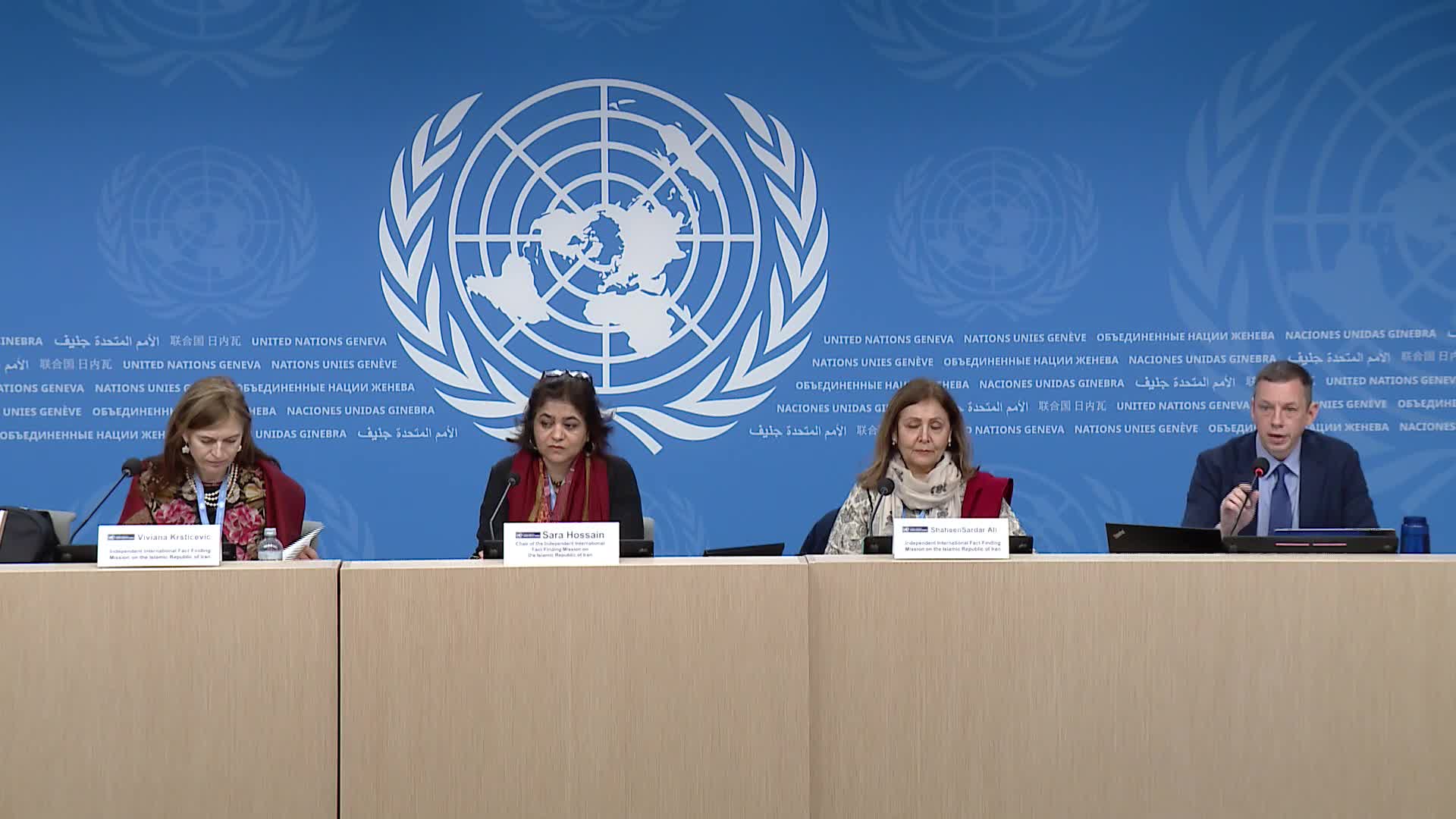
“We saw quite brutal responses, the entire state apparatus was mobilized with security forces using firearms, including AK-47 and Uzis, as we documented in some areas, resulting in injuries and deaths,” said Sara Hossain, Chairperson of the FFM on Iran when briefing journalists at the United Nations. “Credible figures that we found of up to 551 deaths, at least 49 women and 68 children and we found that those occurred in 26 out of the 31 provinces of Iran over multiple months.”
The investigators also established that the death of Jina Mahsa Amini, the 22-year-old Iranian- Kurdish woman whose death in custody of the “morality police” sparked the protests in September two years ago, was unlawful and caused by physical violence in the custody of State authorities.
Following Jina Mahsa’s death, young women and school children were at the forefront of the “Woman, Life, Freedom” movement, with many removing their hijab in public places as an act of defiance against long-standing discriminatory laws and practices. Men and boys joined in solidarity, along with people from diverse backgrounds, including minorities, demanding equality, justice, and social and political reforms and articulating long-standing grievances.
”What we found was that security forces shot at protesters and also at bystanders at very short distances in a targeted fashion, causing injuries to their heads, necks, torsos, genital areas, but particularly to the eyes,” reported Ms. Hossain. “We found hundreds of protesters had these life changing injuries, with many of them now blinded and branded essentially for life marked as dissidents.”
The members of the FFM on Iran gathered evidence that these acts were conducted in the context of a widespread and systematic attack against women and girls, and other persons expressing support for human rights. Some of these serious violations of human rights thus rose to the level of crimes against humanity, including murder, torture, rape, and also gender persecution, intersecting with ethnicity and religion.
In detention, the State authorities tortured victims to extract confessions or to intimidate, humiliate of inflict punishment, the investigators concluded.
“We also found that there were mass arbitrary arrests and detentions. We found incidents of torture and ill treatment in custody of protesters being beaten even while they were being arrested and then when they were in custody as well,” said the Chair of the Mission. “We found cases of torture, particularly of sexual violence, gender-based violence. We found cases of gang rape, rape with an object, a woman being routinely groped and touched throughout the process and often spoken to in extraordinarily misogynist terms.”
Despite the many challenges the Mission was facing, such as no access to the country and no collaboration with the Iranian Government, it was able to collect and preserve over 27,000 evidence items. It conducted a total of 134 in-depth interviews with victims and witnesses, including 49 women, and 85 men, both inside and outside the country, and gathered evidence and analysis from experts on digital and medical forensics, and domestic and international law, among others.
The investigation also highlighted that there were disproportionately high numbers of deaths in minority-populated regions. On just one day, 30 September 2022, in Zahedan city, Sistan and Baluchistan province, credible information indicates that security forces killed 104 protesters and bystanders, mostly of men and boys. “We recorded the highest number of deaths in a single day, with more than 100 killings committed by security forces in the so-called Bloody Friday incident,” said Shaheen Sardar Ali, a member of the Fact-Finding Mission.
The authorities in Iran have prevented and obstructed efforts of victims and their families to obtain a remedy and reparation.
Viviana Krsticevic, a member of the Fact-Finding Mission, warned that "the Islamic Republic of Iran is obligated to adhere to these principles and accordingly take tangible measures to redress the harm inflicted on thousands of protesters, address the ongoing violations and eradicate the root causes of those violations.”
In November 2022, the Council established this Mission to investigate “the alleged human rights violations in Iran in connection with the protests that began there on 16 September 2022, especially with respect to women and children”.
-ends-
STORY: Report: Fact-Finding Mission on Iran
TRT: 2:36”
SOURCE: UNTV CH
RESTRICTIONS: NONE
LANGUAGE: ENGLISH / NATS
ASPECT RATIO: 16:9
DATELINE: 18 March 2024 GENEVA, SWITZERLAND
- Exterior medium shot: UN flag alley
- Wide shot: speakers at the press conference
- SOUNDBITE (English) – Sara Hossain, Chairperson of the Fact-Finding Mission: “We saw quite brutal responses. The entire state apparatus was mobilized with security forces using firearms, including AK-47 and Uzis, as we documented in some areas, resulting in injuries and deaths. Credible figures that we found of up to 551 deaths, at least 49 women and 68 children and we found that those occurred in 26 out of the 31 provinces of Iran over multiple months.”
- Wide shot: speakers at the podium during the press conference
- SOUNDBITE (English) – Sara Hossain, Chairperson of the Fact-Finding Mission: “We also found that there were mass arbitrary arrests and detentions. We found incidents of torture and ill treatment in custody of protesters being beaten even while they were being arrested. And then when they were in custody as well. We found cases of torture, particularly of sexual violence, gender-based violence. We found cases of gang rape, rape with an object, a woman being routinely groped and touched throughout the process and often spoken to in extraordinarily misogynist terms.”
- Wide shot: Camera people filming
- SOUNDBITE (English) – Sara Hossain, Chairperson of the Fact-Finding Mission:” What we found was that security forces shot at protesters and also at bystanders at very short distances in a targeted fashion, causing injuries to their heads, necks, torsos, genital areas, but particularly to the eyes. And we found hundreds of protesters had these life changing injuries, with many of them now blinded and branded essentially for life marked as dissidents.”
- Medium shot: speaker at the podium with journalists in press room
- SOUNDBITE (English) – Shaheen Sardar Ali, Member of the Fact-Finding Mission: “We recorded the highest number of deaths in a single day, with more than 100 killings committed by security forces in the so-called Bloody Friday incident.”
- Wide shot: speakers at the press conference
- SOUNDBITE (English) - Viviana Krsticevic, Member of the Fact-Finding Mission: ”The Islamic Republic of Iran is obligated to adhere to these principles and accordingly take tangible measures to redress the harm inflicted on thousands of protesters, address the ongoing violations and eradicate the root causes of those violations.”
- Wide shot, journalists in press briefing room
- Close up, journalist listening
- Close up, journalist
Similar Stories
1
1
1
Press Conferences | UNHCR
End of UNHCR's 77th Annual Executive Committee (ExCom) meeting week

1
1
1
Edited News | UNICEF
A little over one year since a ceasefire agreement was announced between Hamas fighters and Israel, more than 340 children have been reported killed and hundreds more injured, the UN Children’s Fund, UNICEF, said on Friday.
1
1
1
Press Conferences | UNICEF , IOM , UNHCR
UN Special Assistant to the Personal Envoy Office (SUDAN): Peace Initiatives and Efforts in Sudan; UNICEF: Dire situation of children in Gaza; IOM: Damaged Homes and Energy Attacks Risk Displacing Ukrainians for this winter; UNHCR: update on EXCOM week
1
1
1
Press Conferences | IOM , UNDRR
UN stresses importance of household preparedness for disaster risk reduction.

1
1
1
Edited News | UNICEF , IFRC
Six weeks after Nepal’s deadly flooding disaster, communities are still struggling to rebuild their lives, but they will need sustained help as global warming increases the risk of another Himalayan catastrophe, the UN Children’s Fund (UNICEF) said on Friday.
1
1
1
Statements , Press Conferences | OHCHR
1
1
1
Press Conferences | UNHCR , UNICEF , IFRC , OHCHR , UN WOMEN , IOM , OCHA , WHO
UNHCR – ExCom Meeting, UNICEF – Nepal Recovery, IFRC – Flash Floods, WHO – Mental Health, IOM – South Sudan Floods, OCHA – DRC Humanitarian aid, UNHCR – Sahel Displacement, UNICEF – Yemen Update, IOM – Gaza Shelter, UN Women – Gaza Women, OHCHR – Arrests and detentions of Syrians by Israeli force
2
1
2
Press Conferences | UNCTAD
Presentation of the Trade and Developement Report 2026
Embargoed until 9 October 2026 at 11 a.m. (Geneva Time)
UNCTAD: UNCTAD’s flagship report finds that governments increasingly use industrial, trade, financial and technology policies to pursue economic and national security objectives. Market access and the ability to move into higher-value activities now depend more heavily on technology, finance and geopolitics.
1
1
1
Press Conferences | UPU
Release of the State of the Postal Sector Report 2026

1
1
1
Edited News | WHO
In suspected Russia plague death, testing and monitoring underway – WHO
The death of a lab worker in Russia’s Siberia region has sparked concerns about plague being the cause, the UN World Health Organization (WHO) said on Tuesday, adding that it was following the situation closely.
1
1
1
Press Conferences | IOM , ITU , UNECE , UNICEF , WHO , WMO
UNICEF: Ebola, DRC - children orphans or separating them from parents and caregivers; IOM: Humanitarian needs in Djibouti amid arrivals from Yemen and increased migrant movements; WHO: Darfur, scale of health needs far exceeds available resources; WMO co-sponsored Global Heat Forum, Bangkok, monthly Global Seasonal Climate Update; UNECE: UN Forum of Mayors; ITU Plenipotentiary Conference 2026; WHO: child and adolescent obesity guidelines and new global roadmap to tackle pregnancy hypertension, a leading cause of maternal mortality

1
1
Edited News | OHCHR , UNOG
UN Human Rights Chief Volker Türk on Friday provided and oral update to the 63rd session of the Human rights Council on Ukraine.