

The United Nations Office at Geneva
Multimedia Newsroom
STORYLINE
Only 30 per cent of women globally have access to the Internet, says ITU
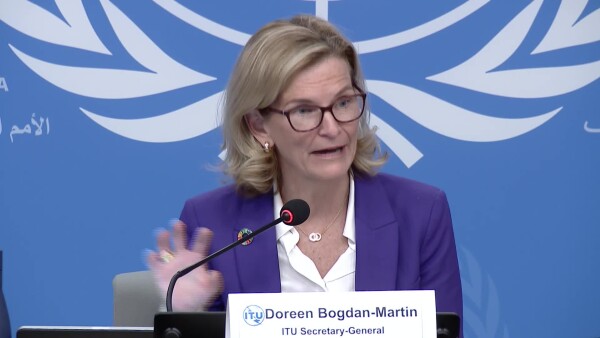
Women still account for a disproportionate and growing share of the global offline population – with only 30 per cent having access to the internet in the least developed countries. This according to the first female Secretary-General of the International Telecommunication Union (ITU), Doreen Bogdan-Martin, who spoke to reporters in Geneva on the eve of International Women’s Day (8 March).
“I've seen women who can't afford a smartphone, women in countries where entry level handsets can exceed 70 per cent of average household monthly incomes,” said Ms. Bogdan- Martin during a briefing at the United Nations in Geneva on ITU’s global priorities for 2024 - which include narrowing this gender gap in internet access.
“Women still account for a disproportionate and growing share of the global offline population, outnumbering men by some 20 per cent in least developed countries. Only 30 per cent of women have access to the Internet,” she said.
For 2024, ITU Member States have set two clear strategic goals for the Union going forward: universal connectivity and sustainable digital transformation.
After 14 months at the helm of ITU, Ms. Bogdan-Martin said that she had "experienced in my time as ITU Secretary-General two worlds, … one in high income countries where almost 90 per cent of the population is covered by a 5G network and a much bigger and also poorer world where service is nearly absent and when available, it's not affordable.”
Turning to the fight against climate change, ITU’s Secretary-General stressed that Artificial Intelligence (AI) can mitigate 10 per cent of greenhouse gas emission by 2030. Digital solutions such as AI can help to boost progress on climate change, education and poverty, she said.
“There are incredible opportunities that we can leverage from AI in general, from generative AI,” she said. “But there are risks and we need to be able to manage and mitigate the risks. It's a challenge to find how to balance between regulating and stifling innovation. And that's the current debate that we're seeing, not just here in Geneva, but I think globally.”
According to ITU, 2.6 billion people today are not connected, and they have never been connected to the Internet. For Ms. Bogdan-Martin “this is really one of the biggest challenges of our generation.”
“My biggest fear and what keeps me up at night is the 2.6 billion people that are not connected and I say that because if you're not part of the digital world, then you're not part of the AI world. And I do think we have to close that gap and in parallel find ways to make AI safer.”
-ends-
STORY: ITU
TRT: 2:43”
SOURCE: UNTV CH
RESTRICTIONS: NONE
LANGUAGE: ENGLISH / NATS
ASPECT RATIO: 16:9
DATELINE: 7 March 2024 GENEVA, SWITZERLAND
- Exterior medium shot: UN flag alley
- Wide shot: speakers at the press conference
- SOUNDBITE (English) – Doreen Bogdan-Martin, Secretary-General of the International Telecommunication Union (ITU): “I've seen women who can't afford a smartphone, women in countries where entry level handsets can exceed 70 per cent, 70 pe cent of average household monthly incomes.”
- Wide shot: press room with journalists
- SOUNDBITE (English) – Doreen Bogdan-Martin, Secretary-General of the International Telecommunication Union (ITU): “Women still account for a disproportionate and growing share of the global offline population, outnumbering men by some 20 per cent. In the least developed countries only 30% of women have access to the Internet.”
- Wide shot: podium with speaker and photographer
- SOUNDBITE (English) – Doreen Bogdan-Martin, Secretary-General of the International Telecommunication Union (ITU): “I've experienced in my time as ITU Secretary-General two worlds: I would say one in high income countries where almost 90 per cent of the population is covered by a 5G network and a much bigger and also poorer world where service is nearly absent and when available, it's not affordable.”
- Medium shot: speaker at the podium, filmed from behind
- SOUNDBITE (English) – Doreen Bogdan-Martin, Secretary-General of the International Telecommunication Union (ITU): “There are incredible opportunities that we can leverage from AI in general, from generative AI. But there are risks and we need to be able to manage and mitigate the risks. It's a challenge to find how to balance between regulating and stifling innovation. And that's the current debate that we're seeing, not just here in Geneva, but I think globally.”
- Medium shot: speaker at the podium with photographer
- SOUNDBITE (English) – Doreen Bogdan-Martin, Secretary-General of the International Telecommunication Union (ITU): “My biggest fear and what keeps me up at night is the 2.6 billion people that are not connected and I say that because if you're not part of the digital world, then you're not part of the AI world. And I do think we have to close that gap and in parallel find ways to make AI safer.”
- Close up: journalist listening
- Close up: journalist listening
- Medium shot: camera people and photographer in press room
- Medium shot: press room with journalists
- Wide shot: press briefing room with journalists
- Wide shot: press briefing room with journalists and speakers at the podium
Similar Stories

1
1
1
Edited News | OCHA , UNICEF , WFP
Aid agencies warned on Friday of the fast-developing humanitarian emergency inside Taiz City in Yemen, which has been encircled by de facto Houthi forces fighting government troops along the country’s west coast.

2
17
1
2
Edited News , Press Conferences , Images | OCHA , WMO
Two UN agencies teamed up on Wednesday to issue an appeal for immediate assistance to help communities already being impacted by the strongest El Niño on record.

3
16
2
2
Edited News , B-roll , Conferences , Images | UNITED NATIONS , UNOG
Sixth Consultative Meeting on Enhancing Coordination of Peace Initiatives and Efforts for Sudan

1
1
1
Edited News | UNICEF , WHO , UNHCR
Yemen war continues to force families from homes amid hunger and disease
More than 250,000 people have now fled renewed fighting in Yemen, the UN said on Tuesday, citing particular concern for those sheltering in the southwestern city of Taiz and the wider governorate, where access is “essentially blocked”.

1
1
1
Edited News | UNICEF
A little over one year since a ceasefire agreement was announced between Hamas fighters and Israel, more than 340 children have been reported killed and hundreds more injured, the UN Children’s Fund, UNICEF, said on Friday.

1
1
1
Edited News | UNICEF , IFRC
Six weeks after Nepal’s deadly flooding disaster, communities are still struggling to rebuild their lives, but they will need sustained help as global warming increases the risk of another Himalayan catastrophe, the UN Children’s Fund (UNICEF) said on Friday.

1
1
1
Edited News | WHO
In suspected Russia plague death, testing and monitoring underway – WHO
The death of a lab worker in Russia’s Siberia region has sparked concerns about plague being the cause, the UN World Health Organization (WHO) said on Tuesday, adding that it was following the situation closely.

1
1
Edited News | OHCHR , UNOG
UN Human Rights Chief Volker Türk on Friday provided and oral update to the 63rd session of the Human rights Council on Ukraine.

1
1
1
Edited News | OHCHR , UNOG
UN Human Rights Chief Volker Türk on Friday provided and oral update to the 63rd session of the Human rights Council on the human rights situation in Haiti.

1
1
1
Edited News | WHO
Repeated delays in bringing lifesaving medicines, prosthetics and more from Israel into Gaza risk having devastating consequences on Palestinians who urgently need them in the wartorn enclave, the UN World Health Organization (WHO) said on Friday. “A truck full of non-priority supplies or the right supplies arriving too late, doesn't save lives. That's the question that actually matters," said Dr Reinhilde Van De Weerdt, WHO Representative in the OPT.

1
1
1
Edited News | WHO
DRC: Early access to care and oxygen decisive for Ebola patients’ survival – WHO
In the Democratic Republic of the Congo (DRC), health workers fighting the country’s largest-ever Ebola outbreak are struggling to overcome critical challenges to patient care, the UN World Health Organization (WHO) warned on Tuesday.

1
1
1
Edited News | OCHA , UN
Civilians in Iran are continuing to feel the consequences of months of conflict and military escalation, the UN’s top official in the country has said, as loss of life, damage to civilian infrastructure and mounting economic pressures leave many facing continued uncertainty.