

The United Nations Office at Geneva
Multimedia Newsroom
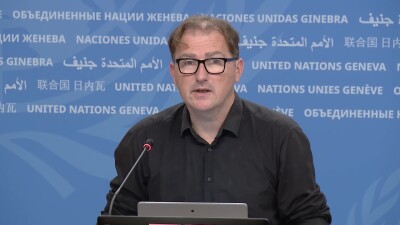
A total of 645 people have died since 7 October and another 818 were injured as a result of these incidents, said WHO spokesperson Tarik Jasarevic, his comments coming amid allegations that a nurse was shot and critically injured while inside an operating theatre at a hospital in Khan Younis.
“These attacks have affected 98 healthcare facilities including 27 hospitals damaged out of 36 and affected 90 ambulances, including 50 which sustained damage,” Mr. Jazarevic told journalists in Geneva.
Driven out
In its latest update on the crisis, the UN aid coordination office, OCHA, reported more “intense fighting” in Khan Younis in southern Gaza on Thursday involving shelling and heavy gunfire.
Citing UN partner the Palestinian Red Crescent Society (PCRS), the UN aid coordination office said that Nasser hospital and Al Amal hospital – reportedly under siege for 17 days - had continued to be particularly badly affected by the violence which “is driving thousands of people” from the city further south, to Rafah.
Hospital focus
The OCHA update also relayed reports from the Gazan health authority of continuing “allegations of sniper shooting in the vicinity of Nasser hospital” and allegations that the Israeli military had prevented the movement of ambulances and access to Nasser hospital.
“On 8 February, a nurse was reportedly shot and critically injured while inside the operations room in Nasser hospital and two Palestinians were reportedly shot and killed in the vicinity of the hospital,” the OCHA update said. “On 7 February, a Palestinian woman was reportedly shot and killed while purportedly fetching water from Nasser hospital.”
West Bank escalation
Latest WHO data also highlighted the growing number of attacks on healthcare in the occupied West Bank since the Gaza-Israel war erupted on 7 October, after widely condemned Hamas-led terror attacks left 1,200 Israeli and foreign nationals butchered and more than 250 taken hostage.
Some 364 attacks (on healthcare) have happened in the West Bank, resulting in 10 fatalities and 62 injuries, Mr. Jasarevic said. He noted that 44 health facilities had been affected, including 15 mobile clinics and 24 ambulances.
The latest toll from the fighting in Gaza is at least 27,840 fatalities with more than 67,300 injured, according to the local health authority. As of 8 February, 225 Israeli soldiers have been killed with 1,314 injured in Gaza since the beginning of the ground operation, according to the Israeli military.
Renewed famine fears
UN humanitarians continued to highlight that the risk of famine in Gaza is increasing “by the day”, particularly in northern Gaza.
Hundreds of thousands of people there have been “predominantly cut off from assistance”, OCHA said, despite the fact that this is where the greatest needs are, with many reportedly grinding animal feed to make flour.
Since the onset of the crisis, the UN World Food Programme (WFP) has delivered 1,940 trucks - 19 per cent of all aid trucks, it said - carrying over 32,413 tons of life-saving food supplies.
The last time UNRWA was able to carry out a food distribution in the north of Wadi Gaza was 23 January, OCHA’s update noted.
Buffer rebuff
And as UN humanitarians reiterated deep concerns on Friday about any further escalation of fighting in overcrowded Rafah in the far south of the Gaza Strip, the UN human rights office, OHCHR, insisted that any reported attempt by Israel to create a “buffer zone” with Gaza could constitute a war crime.
“Article 53 of the Geneva Convention prohibits destruction by the occupying power of property belonging to private persons, except where such destruction is rendered absolutely necessary by military operations,” said OHCHR spokesperson Marta Hurtado. “Destruction carried out to create a buffer zone for general security purposes do not appear consistent with the …military operations.”
Commando comment
Asked for a reaction to an Israeli counter-terrorism operation inside a West Bank hospital that left three Palestinian militants dead late last month, Ms. Hurtado noted that the Israeli Security Forces had claimed that one of those targeted had a gun - “ a claim denied by hospital staff. No exchange of fire was reported. Under applicable international human rights law, firearms may only be used when strictly necessary to prevent an imminent threat to life or serious injury and is otherwise unlawful.”
STORY: Gaza update: WHO, OHCHR
TRT: 02 min 13s
SOURCE: UNTV CH
RESTRICTIONS: NONE
LANGUAGE: ENGLISH / NATS
ASPECT RATIO: 16:9
DATELINE: 9 FEBRUARY 2024 GENEVA, SWITZERLAND
SHOTLIST
- Exterior medium shot: UN flag alley
- Wide shot: speakers at the podium during a press conference
- SOUNDBITE (English) – Tarik Jasarevic, UN World Health Organization (WHO) spokesperson: “WHO has documented 721 attacks on health care in the Occupied Palestinian Territory since 7 October. Out of those 721, 357 attacks in the Gaza, resulting in 645 fatalities and 818 injuries.”
- Medium shot: press room with journalists
- SOUNDBITE (English) – Tarik Jasarevic, UN World Health Organization (WHO) spokesperson: “Health facilities are protected under international humanitarian law. And we keep really repeating our appeal to all parties to the conflict to respect that the health workers, ambulances, hospitals, patients should never be a target and should be protected.”
- Medium shot: press room with journalists
- SOUNDBITE (English) – Tarik Jasarevic, UN World Health Organization (WHO) spokesperson: “These attacks have affected 98 health care facilities, including 27 hospitals damaged out of 36, and affected 90 ambulances, including 50 which sustained damage.”
- Wide shot: press room with journalists
- SOUNDBITE (English) - Marta Hurtado, spokesperson, Office of the High Commissioner for Human Rights (OHCHR): “The (Israeli Security Forces) also claimed that one of them had a gun, a claim denied by hospital staff. No exchange of fire was reported. Under applicable international human rights law, firearms may only be used when strictly necessary to prevent an imminent threat to life or serious injury and is otherwise unlawful.”
- Wide shot: press room with journalists
- SOUNDBITE (English) - Marta Hurtado, spokesperson, Office of the High Commissioner for Human Rights (OHCHR): “Article 53 of the Fourth Geneva Convention prohibits destruction by the occupying power of property belonging to private persons, except where such destruction is rendered absolutely necessary by military operations. Destructions carried out to create a buffer zone for general security purposes do not appear consistent with the narrow military operations.”
- Medium shot: press room with journalists, interpreters working.
Similar Stories

1
1
1
Edited News | OCHA , UNICEF , WFP
Aid agencies warned on Friday of the fast-developing humanitarian emergency inside Taiz City in Yemen, which has been encircled by de facto Houthi forces fighting government troops along the country’s west coast.

2
17
1
2
Edited News , Press Conferences , Images | OCHA , WMO
Two UN agencies teamed up on Wednesday to issue an appeal for immediate assistance to help communities already being impacted by the strongest El Niño on record.

3
16
2
2
Edited News , B-roll , Conferences , Images | UNITED NATIONS , UNOG
Sixth Consultative Meeting on Enhancing Coordination of Peace Initiatives and Efforts for Sudan

1
1
1
Edited News | UNICEF , WHO , UNHCR
Yemen war continues to force families from homes amid hunger and disease
More than 250,000 people have now fled renewed fighting in Yemen, the UN said on Tuesday, citing particular concern for those sheltering in the southwestern city of Taiz and the wider governorate, where access is “essentially blocked”.

1
1
1
Edited News | UNICEF
A little over one year since a ceasefire agreement was announced between Hamas fighters and Israel, more than 340 children have been reported killed and hundreds more injured, the UN Children’s Fund, UNICEF, said on Friday.

1
1
1
Edited News | UNICEF , IFRC
Six weeks after Nepal’s deadly flooding disaster, communities are still struggling to rebuild their lives, but they will need sustained help as global warming increases the risk of another Himalayan catastrophe, the UN Children’s Fund (UNICEF) said on Friday.

1
1
1
Edited News | WHO
In suspected Russia plague death, testing and monitoring underway – WHO
The death of a lab worker in Russia’s Siberia region has sparked concerns about plague being the cause, the UN World Health Organization (WHO) said on Tuesday, adding that it was following the situation closely.

1
1
Edited News | OHCHR , UNOG
UN Human Rights Chief Volker Türk on Friday provided and oral update to the 63rd session of the Human rights Council on Ukraine.

1
1
1
Edited News | OHCHR , UNOG
UN Human Rights Chief Volker Türk on Friday provided and oral update to the 63rd session of the Human rights Council on the human rights situation in Haiti.

1
1
1
Edited News | WHO
Repeated delays in bringing lifesaving medicines, prosthetics and more from Israel into Gaza risk having devastating consequences on Palestinians who urgently need them in the wartorn enclave, the UN World Health Organization (WHO) said on Friday. “A truck full of non-priority supplies or the right supplies arriving too late, doesn't save lives. That's the question that actually matters," said Dr Reinhilde Van De Weerdt, WHO Representative in the OPT.

1
1
1
Edited News | WHO
DRC: Early access to care and oxygen decisive for Ebola patients’ survival – WHO
In the Democratic Republic of the Congo (DRC), health workers fighting the country’s largest-ever Ebola outbreak are struggling to overcome critical challenges to patient care, the UN World Health Organization (WHO) warned on Tuesday.

1
1
1
Edited News | OCHA , UN
Civilians in Iran are continuing to feel the consequences of months of conflict and military escalation, the UN’s top official in the country has said, as loss of life, damage to civilian infrastructure and mounting economic pressures leave many facing continued uncertainty.