

The United Nations Office at Geneva
Multimedia Newsroom
Edited News | UNITED NATIONS
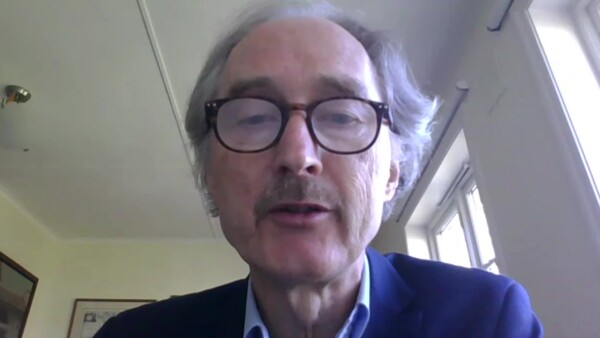
UNOG Bi-weekly press briefing: UN Special Envoy for Syria-Geir Pedersen
Syria’s warring parties will resume talks in Geneva, says UN envoy
Syria’s opposing parties have agreed to resume talks in Geneva over their war-torn country as soon as travel restrictions linked to the COVID-19 pandemic allow, UN Special Envoy Geir Pedersen said on Tuesday.
“As soon as the pandemic situation allows, they have agreed to come to Geneva, and as I said, they have agreed on an agenda for the next meeting,” Mr. Pedersen told journalists via videoconference from Oslo, without setting a date.
To date, the spread of the new coronavirus has been limited, with most cases in Government-controlled areas and no cases reported in the last opposition-held areas in the northwest.
“In terms of COVID itself, so far the official case count in Syria is very low; it’s 64 and there is of course great relief that the numbers are not a lot worse when it comes to Syria,” Mr. Pedersen said. “But, at the same time, this is also what I’m hearing from Syrians when I’m talking to them, there is of course a risk of a wider spread that is ever-present, so there is no cause for complacency.”
Dismissing the possibility of holding a virtual meeting between delegates who have previously participated in UN-led Constitutional Committee discussions in the Swiss city, the negotiator highlighted fears that a fragile truce in Syria could disintegrate at any moment.
“There is a relative calm in Idlib, the ceasefire that Turkey and Russia entered into in the beginning of March is still by and large holding,” he said, echoing comments delivered on Monday to the Security Council in New York.
“And I have said that this is indeed good news, but I’ve also warned that hostilities could resume and that would have devastating consequences of course not only in Idlib, but in many other parts of Syria as well.”
Ordinary Syrians remained deeply concerned about the plight of their country, the UN official explained, citing anxiety over food shortages and disappointment at the lack of progress on reaching a political agreement to stop widespread, ongoing violence.
These developments include “mutual attempts at cross-line offensives”, he told the Security Council, “most notably by the extremist wa-Harid al-Mu’minin operations room. A number of Syrian soldiers were killed during this attack. This prompted an escalation, including increased artillery strikes on areas inside Idlib, as well as rocket fire towards Hmeimim airbase in Latakia, before the episode was contained.”
Elsewhere, “mutual shelling” incidents have been reported along with improvised explosive device attacks around Afrin and the northeast, Mr. Pedersen earlier told the Security Council, along with “targeted killings and a military build-up and clashes in the southwest”, further reports of Israeli airstrikes in Deir-ez-Zor and Aleppo and evidence of an ISIL “resurgence” in the east.
“So obviously, (it’s) very important that the US and Russia continue to work together,” he told journalists on Tuesday. “They’ve done it before with success, without the US-Russia cooperation we would never have had Security Council resolution 2254. And so, my appeal is for them to strengthen that cooperation and to move on and to support the process.”
Underscoring the profound apprehension and worry among many Syrians about the fate of detainees, abductees and missing persons since the country descended into civil war more than nine years ago, Mr. Pedersen called for their release, as part of confidence-building measures between the warring parties.
“I said have stressed again and again that the time has come now for more meaningful actions on all of these issues, you know, as I said on detainees, abductees and indeed also on missing persons.”
UN-brokered talks between the Syrian Government, opposition forces and civil society as part of the Constitutional Committee process began last November.
Should they happen, the new talks would bring together the smaller Constitutional Committee body for the third time; it comprises 15 members from the Government, the opposition and civil society. The full Constitution Committee numbers 150 participants, 50 from each delegation.
- Wide shot: exterior, UN Geneva flag alley.
- SOUNDBITE (EN) – Geir Pedersen, UN Special Envoy for Syria: “In terms of COVID itself, so far the official case count in Syria is very low; it’s 64 and there is of course great relief that the numbers are not a lot worse when it comes to Syria. But, at the same time, this is also what I’m hearing from Syrians when I’m talking to them, there is of course a risk of a wider spread that is ever-present, so there is no cause for complacency.”
- Wide shot: UN Geneva main entrance, raised angle.
- SOUNDBITE (EN) – Geir Pedersen, UN Special Envoy for Syria: “There is a relative calm in Idlib, the ceasefire that Turkey and Russia entered into in the beginning of March is still by and large holding. And I have said that this is indeed good news, but I’ve also warned that hostilities could resume and that would have devastating consequences of course not only in Idlib, but in many other parts of Syria as well.”
- Medium shot: UN Geneva flag alley, UN Palais des Nations entrance with UN lettering and logo.
- SOUNDBITE (EN) – Geir Pedersen, UN Special Envoy for Syria: “So obviously, (it’s) very important that the US and Russia continue to work together; as I said, they’ve done it before with success, without the US-Russia cooperation we would never have had Security Council resolution 2254. And so my appeal is for them to strengthen that cooperation and to move on and to support the process.”
- Medium shot: UN Geneva Palais des Nations building with UN lettering and UN logo.
- SOUNDBITE (EN) – Geir Pedersen, UN Special Envoy for Syria: “As soon as the pandemic situation allows, they have agreed to come to Geneva, and as I said, they have agreed on an agenda for the next meeting.”
- Medium shot: UN Geneva flag alley.
- SOUNDBITE (EN) – Geir Pedersen, UN Special Envoy for Syria: “I said have stressed again and again that the time has come now for more meaningful actions on all of these issues, you know, as I said on detainees, abductees and indeed also on missing persons.”
- Wide shot: UN Geneva Palais des Nations building with UN flag flying.
Similar Stories

1
1
1
Edited News | OCHA , UNICEF , WFP
Aid agencies warned on Friday of the fast-developing humanitarian emergency inside Taiz City in Yemen, which has been encircled by de facto Houthi forces fighting government troops along the country’s west coast.

2
17
1
2
Edited News , Press Conferences , Images | OCHA , WMO
Two UN agencies teamed up on Wednesday to issue an appeal for immediate assistance to help communities already being impacted by the strongest El Niño on record.

3
16
2
2
Edited News , B-roll , Conferences , Images | UNITED NATIONS , UNOG
Sixth Consultative Meeting on Enhancing Coordination of Peace Initiatives and Efforts for Sudan

1
1
1
Edited News | UNICEF , WHO , UNHCR
Yemen war continues to force families from homes amid hunger and disease
More than 250,000 people have now fled renewed fighting in Yemen, the UN said on Tuesday, citing particular concern for those sheltering in the southwestern city of Taiz and the wider governorate, where access is “essentially blocked”.

1
1
1
Edited News | UNICEF
A little over one year since a ceasefire agreement was announced between Hamas fighters and Israel, more than 340 children have been reported killed and hundreds more injured, the UN Children’s Fund, UNICEF, said on Friday.

1
1
1
Edited News | UNICEF , IFRC
Six weeks after Nepal’s deadly flooding disaster, communities are still struggling to rebuild their lives, but they will need sustained help as global warming increases the risk of another Himalayan catastrophe, the UN Children’s Fund (UNICEF) said on Friday.

1
1
1
Edited News | WHO
In suspected Russia plague death, testing and monitoring underway – WHO
The death of a lab worker in Russia’s Siberia region has sparked concerns about plague being the cause, the UN World Health Organization (WHO) said on Tuesday, adding that it was following the situation closely.

1
1
Edited News | OHCHR , UNOG
UN Human Rights Chief Volker Türk on Friday provided and oral update to the 63rd session of the Human rights Council on Ukraine.

1
1
1
Edited News | OHCHR , UNOG
UN Human Rights Chief Volker Türk on Friday provided and oral update to the 63rd session of the Human rights Council on the human rights situation in Haiti.

1
1
1
Edited News | WHO
Repeated delays in bringing lifesaving medicines, prosthetics and more from Israel into Gaza risk having devastating consequences on Palestinians who urgently need them in the wartorn enclave, the UN World Health Organization (WHO) said on Friday. “A truck full of non-priority supplies or the right supplies arriving too late, doesn't save lives. That's the question that actually matters," said Dr Reinhilde Van De Weerdt, WHO Representative in the OPT.

1
1
1
Edited News | WHO
DRC: Early access to care and oxygen decisive for Ebola patients’ survival – WHO
In the Democratic Republic of the Congo (DRC), health workers fighting the country’s largest-ever Ebola outbreak are struggling to overcome critical challenges to patient care, the UN World Health Organization (WHO) warned on Tuesday.

1
1
1
Edited News | OCHA , UN
Civilians in Iran are continuing to feel the consequences of months of conflict and military escalation, the UN’s top official in the country has said, as loss of life, damage to civilian infrastructure and mounting economic pressures leave many facing continued uncertainty.