

The United Nations Office at Geneva
Multimedia Newsroom
STORYLINE
“Trauma wards resemble battlefields, we need a ceasefire now”, says WHO
Describing the disastrous situation in Gaza two months after the start of the Israeli retaliation following Hamas' 7 October terror attacks in southern Israel, the UN health agency (WHO) warned on Friday that the war-torn enclave faced a "breakdown" of society.
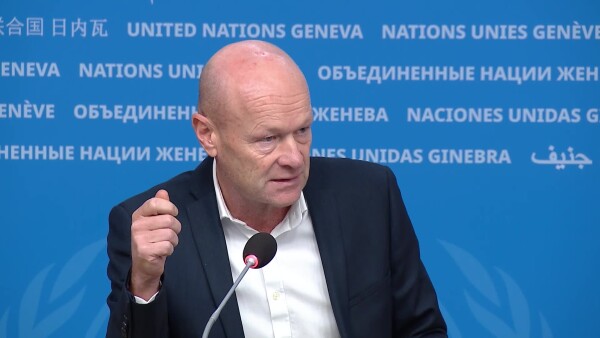
“People are starting to cut down telephone poles to have a little bit of firewood to still keep warm, to maybe cook if they have anything available. So we are at that level where really the civilisation is about to break down,” WHO spokesperson Christian Lindmeier told journalists in Geneva.
Intense Israeli bombardment of Gaza and fighting with Palestinian armed groups on the ground continues to hinder urgently needed aid operations.
The WHO spokesperson reported that on Friday “we had a convoy supposed to go up with medical supplies and to evacuate 12 patients from Al-Ahli [hospital] in the north to the south. That mission, we were told this morning, had to be suspended because of the security situation.” He added that WHO is trying to evacuate some patients to the United Arab Emirates.
“Health workers need to flee and take care of themselves on top of it. They don't have food. They don't have water to continue working. Patients are bleeding on the floor,” said WHO’s spokesperson. “Trauma wards resemble battlefields, literally. This must end. This callousness must end. We need a ceasefire and we need it now.”
WHO has documented 212 attacks on health care in the Gaza Strip since 7 October affecting 56 health care facilities (including 24 hospitals damaged) and 59 ambulances.
Mr. Lindmeier reported that children were "actually begging and crying for water".
"We're at that level where the most normal and basic supplies are not available anymore,” he said.
Usually “in any refugee camp situation”, he stressed, there would be a minimum of seven litres of water per day per person, while in Gaza that number is currently between one and two litres.
Currently, only 14 out of 36 hospitals in the Gaza Strip are functional and able to admit new patients, and even in these facilities services are limited. Only two of the partially functioning hospitals are in the north. The two major hospitals in southern Gaza are operating three times above their bed capacity, facing critical shortages of basic supplies and fuel.
According to the Ministry of Health in Gaza, the occupancy rates are reaching 206 per cent in inpatient departments and 250 per cent in intensive care units. Additionally, these hospitals are providing shelter to thousands of IDPs.
“The situation in Gaza is beyond belief. Literally, the health system is on its knees,” reiterated WHO’s spokesperson. “Gaza cannot afford to lose any more health facility, any more single ambulance, any more hospital. We're seeing, what we're fearing, that the south will experience the same as the north.”
According to the Ministry of Health in Gaza, between 7 October and 7 December afternoon, at least 17,177 Palestinians have been killed in the Strip, about 70 per cent of whom are said to be women and children, and 46,000 are reportedly injured. Many more are missing, presumably under the rubble, awaiting rescue or recovery.
-ends-
STORY: Update Gaza humanitarian crisis - WHO
TRT: 1:54”
SOURCE: UNTV CH
LANGUAGE: ENGLISH
ASPECT RATIO: 16:9
DATELINE: 08 December 2023 - GENEVA, SWITZERLAND
SHOTLIST
- Exterior medium shot: UN building with UN flag, UN Geneva.
- Wide shot, press briefing room with moderator UN Geneva
- SOUNDBITE (ENGLISH) – Christian Lindmeier, WHO spokesperson: “People are starting to cut down telephone poles to have a little bit of firewood still to keep warm, to maybe cook if they have anything available. So we are at that level where really the civilization is about to break down.”
- Cutaway: Wide shot, press briefing room with moderator, UN Geneva
- SOUNDBITE (ENGLISH) – Christian Lindmeier, WHO spokesperson: “Health workers need to flee and take care of themselves on top of it. They don't have food. They don't have water to continue working. Patients are bleeding on the floor. Trauma wards resemble battlefields, literally. This must end. This callousness must end. We need a cease fire and we need it now.”
- Cutaway: Wide shot, press briefing room with journalists and screens, UN Geneva
- SOUNDBITE (ENGLISH) – Christian Lindmeier, WHO spokesperson: “Children and people actually begging and crying for water. We're at that level where the most normal and basic supplies are not available anymore.”
- Cutaway: Wide shot, press briefing room with journalists, UN Geneva
- SOUNDBITE (ENGLISH) - Christian Lindmeier, WHO spokesperson : “Today we had a convoy supposed to go up with medical supplies and to evacuate 12 patients from Al-Ahli in the north to the south. That mission, we were told this morning had to be suspended because of the security situation. We're trying to evacuate some patients to the UAE.”
- Cutaway: Wide shot, press briefing room with journalists and screens, UN Geneva
- SOUNDBITE (ENGLISH) - Christian Lindmeier, WHO spokesperson : “The situation in Gaza is beyond belief. Literally, the health system is on its knees. Gaza cannot afford to lose any more health facility, anymore single ambulance, any more hospital. We're seeing, what we're fearing, that the South will experience the same as the North.”
- Cutaway: medium shot, screen and moderator, UN Geneva
- Cutaway: medium shot, journalist listening, UN Geneva
- Cutaway: medium shot, journalist listening, UN Geneva

Similar Stories
1
1
1
Edited News | OCHA , UNICEF , WFP
Aid agencies warned on Friday of the fast-developing humanitarian emergency inside Taiz City in Yemen, which has been encircled by de facto Houthi forces fighting government troops along the country’s west coast.

2
17
1
2
Edited News , Press Conferences , Images | OCHA , WMO
Two UN agencies teamed up on Wednesday to issue an appeal for immediate assistance to help communities already being impacted by the strongest El Niño on record.

3
16
2
2
Edited News , B-roll , Conferences , Images | UNITED NATIONS , UNOG
Sixth Consultative Meeting on Enhancing Coordination of Peace Initiatives and Efforts for Sudan

1
1
1
Edited News | UNICEF , WHO , UNHCR
Yemen war continues to force families from homes amid hunger and disease
More than 250,000 people have now fled renewed fighting in Yemen, the UN said on Tuesday, citing particular concern for those sheltering in the southwestern city of Taiz and the wider governorate, where access is “essentially blocked”.

1
1
1
Edited News | UNICEF
A little over one year since a ceasefire agreement was announced between Hamas fighters and Israel, more than 340 children have been reported killed and hundreds more injured, the UN Children’s Fund, UNICEF, said on Friday.

1
1
1
Edited News | UNICEF , IFRC
Six weeks after Nepal’s deadly flooding disaster, communities are still struggling to rebuild their lives, but they will need sustained help as global warming increases the risk of another Himalayan catastrophe, the UN Children’s Fund (UNICEF) said on Friday.

1
1
1
Edited News | WHO
In suspected Russia plague death, testing and monitoring underway – WHO
The death of a lab worker in Russia’s Siberia region has sparked concerns about plague being the cause, the UN World Health Organization (WHO) said on Tuesday, adding that it was following the situation closely.

1
1
Edited News | OHCHR , UNOG
UN Human Rights Chief Volker Türk on Friday provided and oral update to the 63rd session of the Human rights Council on Ukraine.

1
1
1
Edited News | OHCHR , UNOG
UN Human Rights Chief Volker Türk on Friday provided and oral update to the 63rd session of the Human rights Council on the human rights situation in Haiti.

1
1
1
Edited News | WHO
Repeated delays in bringing lifesaving medicines, prosthetics and more from Israel into Gaza risk having devastating consequences on Palestinians who urgently need them in the wartorn enclave, the UN World Health Organization (WHO) said on Friday. “A truck full of non-priority supplies or the right supplies arriving too late, doesn't save lives. That's the question that actually matters," said Dr Reinhilde Van De Weerdt, WHO Representative in the OPT.

1
1
1
Edited News | WHO
DRC: Early access to care and oxygen decisive for Ebola patients’ survival – WHO
In the Democratic Republic of the Congo (DRC), health workers fighting the country’s largest-ever Ebola outbreak are struggling to overcome critical challenges to patient care, the UN World Health Organization (WHO) warned on Tuesday.

1
1
1
Edited News | OCHA , UN
Civilians in Iran are continuing to feel the consequences of months of conflict and military escalation, the UN’s top official in the country has said, as loss of life, damage to civilian infrastructure and mounting economic pressures leave many facing continued uncertainty.