

The United Nations Office at Geneva
Multimedia Newsroom
Storyline
Unabated attacks on schools have left many Ukrainian school children without a safe space to learn - UNICEF
Many of Ukraine’s 6.7 million children between the ages of three and 18 will be missing out again on their education when the new school year starts later this week amid "relentless" Russian attacks on schools, the UN Children’s Fund (UNICEF) said on Tuesday.
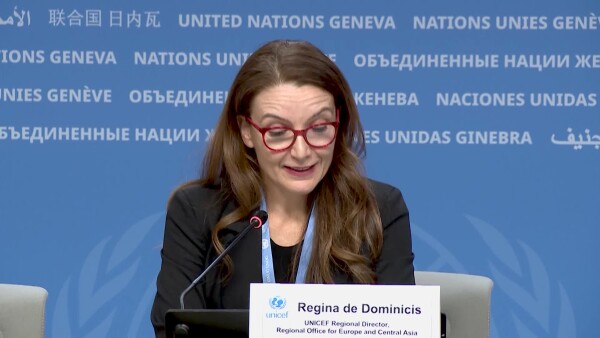
“Attacks on schools have continued unabated throughout the war in Ukraine. Just last week, teachers were among casualties of an attack on a civilian area in the city of Romny. The attack ripped through a school where teachers were preparing lessons for the new academic year,” said Regina de Dominicis, UNICEF’s Regional Director for Europe and Central Asia when briefing reporters at the United Nations in Geneva.
For Ms. de Dominicis “the war in Ukraine has become a war on children, and yet when it ends, children and young people will be essential to the country’s recovery and future.”
“These senseless and reckless attacks have left many Ukrainian children deeply distressed and without a safe place to learn,” said UNICEF’s Regional Director. “Just one in three schoolchildren in Ukraine are learning in person full time. We know that three quarters of children of preschool age in frontline areas are not attending kindergarten.”
As a result, children in Ukraine are showing signs of widespread learning loss, UNICEF said. Russia's full-scale invasion of the country in February 2022, preceded by the COVID-19 pandemic, have left students facing a fourth year of disruption to education.
According to Regina de Dominicis, “more than 1,300 schools have been totally destroyed and there are others that have been heavily damaged and are therefore not ready to be reopened for the academic year.”
Latest survey data showed that up to 57 per cent of teachers reported a deterioration in students’ Ukrainian language abilities, up to 45 per cent reported a reduction in mathematics skills, and up to 52 per cent reported a decrease in foreign language abilities.
UNICEF also pointed out that more than half of the millions of children who have fled Ukraine are not enrolled in national education systems in their host countries at the beginning of this school year.
Among the refugees, pre-schoolers and secondary-age students are the most likely to miss out on their education. Language barriers, difficulty in accessing school, and overstretched education systems are among the reasons for low enrolment rates.
According to UNICEF, refugee children who are not enrolled in local schools are likely attempting to study online, either via the Ukrainian curriculum or through other distance learning platforms. Some of them may have completely abandoned their education.
Throughout the crisis, UNICEF has been supporting children’s mental health through counselling and psychosocial support, provides learning materials including those on mine safety, and rehabilitating school shelters.
“Our priority is the rehabilitation of school shelters from kindergarten to primary, exactly to fight against this bottleneck of security and safety," said Regina de Dominicis. She added that she had visited a number of such shelters and was "amazed" at how well they were organized. "The children know exactly that if there is a bomb alarm they need to quickly go down,” she said.
-ends-
STORY: Widespread learning loss for Ukraine’s children - UNICEF
DURATION (TRT): 1’48”
SOURCE: UNTV CH
LANGUAGE: ENGLISH, NATS
ASPECT RATIO: 16:9
DATELINE: 29 August 2023, GENEVA, SWITZERLAND
FORMAT: HYBRID PRESS BRIEFING
- Exterior medium shot: UN flag alley, UN Geneva
- Wide shot: speakers behind podium, attendees and cameramen at the press conference, screens with speakers
- SOUNDBITE (English) – Regina de Dominicis, UNICEF’s Regional Director for Europe and Central Asia: “Attacks on schools have continued unabated throughout the war in Ukraine. Just last week, teacher were amongst casualties of an attack on a civilian area in the city of Romny. The attack ripped through a school where teachers were preparing lessons for the new academic year.”
- Medium shot: attendees and cameramen at the press conference, screen with speaker
- SOUNDBITE (English) – Regina de Dominicis, UNICEF’s Regional Director for Europe and Central Asia: “These senseless and reckless attacks have left many Ukrainian children deeply distressed and without a safe place to learn. Just one in three schoolchildren in Ukraine are learning in person full time. We know that three quarters of children of preschool age in frontline areas are not attending kindergarten.”
- Wide shot: attendees and camerawoman at the press conference, screens with speakers
- SOUNDBITE (English) – Regina de Dominicis, UNICEF’s Regional Director for Europe and Central Asia: “More than 1,300 schools have been totally destroyed and there are others that have been heavily damaged and are therefore not ready to be reopened for the academic year.”
- Medium shot: speakers behind podium, screen with speaker
- SOUNDBITE (English) – Regina de Dominicis, UNICEF’s Regional Director for Europe and Central Asia: “Our priority is the rehabilitation of school shelters from kindergarten to primary, exactly to fight against this bottleneck of security and safety. So, I visited myself a couple of them. Especially in kindergarten, I was amazed at how well they were organized. So the children know exactly that if there is a bomb alarm they need to quickly go down.”
- Wide shot: attendees and camerawoman at the press conference, screens with speakers
- Medium shot: camerawoman and cameraman at the press conference
Similar Stories

1
1
1
Edited News | OCHA , UNICEF , WFP
Aid agencies warned on Friday of the fast-developing humanitarian emergency inside Taiz City in Yemen, which has been encircled by de facto Houthi forces fighting government troops along the country’s west coast.

2
17
1
2
Edited News , Press Conferences , Images | OCHA , WMO
Two UN agencies teamed up on Wednesday to issue an appeal for immediate assistance to help communities already being impacted by the strongest El Niño on record.

3
16
2
2
Edited News , B-roll , Conferences , Images | UNITED NATIONS , UNOG
Sixth Consultative Meeting on Enhancing Coordination of Peace Initiatives and Efforts for Sudan

1
1
1
Edited News | UNICEF , WHO , UNHCR
Yemen war continues to force families from homes amid hunger and disease
More than 250,000 people have now fled renewed fighting in Yemen, the UN said on Tuesday, citing particular concern for those sheltering in the southwestern city of Taiz and the wider governorate, where access is “essentially blocked”.

1
1
1
Edited News | UNICEF
A little over one year since a ceasefire agreement was announced between Hamas fighters and Israel, more than 340 children have been reported killed and hundreds more injured, the UN Children’s Fund, UNICEF, said on Friday.

1
1
1
Edited News | UNICEF , IFRC
Six weeks after Nepal’s deadly flooding disaster, communities are still struggling to rebuild their lives, but they will need sustained help as global warming increases the risk of another Himalayan catastrophe, the UN Children’s Fund (UNICEF) said on Friday.

1
1
1
Edited News | WHO
In suspected Russia plague death, testing and monitoring underway – WHO
The death of a lab worker in Russia’s Siberia region has sparked concerns about plague being the cause, the UN World Health Organization (WHO) said on Tuesday, adding that it was following the situation closely.

1
1
Edited News | OHCHR , UNOG
UN Human Rights Chief Volker Türk on Friday provided and oral update to the 63rd session of the Human rights Council on Ukraine.

1
1
1
Edited News | OHCHR , UNOG
UN Human Rights Chief Volker Türk on Friday provided and oral update to the 63rd session of the Human rights Council on the human rights situation in Haiti.

1
1
1
Edited News | WHO
Repeated delays in bringing lifesaving medicines, prosthetics and more from Israel into Gaza risk having devastating consequences on Palestinians who urgently need them in the wartorn enclave, the UN World Health Organization (WHO) said on Friday. “A truck full of non-priority supplies or the right supplies arriving too late, doesn't save lives. That's the question that actually matters," said Dr Reinhilde Van De Weerdt, WHO Representative in the OPT.

1
1
1
Edited News | WHO
DRC: Early access to care and oxygen decisive for Ebola patients’ survival – WHO
In the Democratic Republic of the Congo (DRC), health workers fighting the country’s largest-ever Ebola outbreak are struggling to overcome critical challenges to patient care, the UN World Health Organization (WHO) warned on Tuesday.

1
1
1
Edited News | OCHA , UN
Civilians in Iran are continuing to feel the consequences of months of conflict and military escalation, the UN’s top official in the country has said, as loss of life, damage to civilian infrastructure and mounting economic pressures leave many facing continued uncertainty.