

The United Nations Office at Geneva
Multimedia Newsroom
STORYLINE
Ukraine: Around 700,000 people affected by fast depletion of Kakhovka Reservoir after dam's destruction
UN humanitarians have continued to respond to serious food and water shortages in Ukraine following the Kakhovka dam disaster, delivering relief supplies on Friday to vulnerable families in the rural Kherson Region, close to the front line.
Hundreds of thousands of people have been affected by the destruction of the dam on 6 June 2023 which has impacted water supplies, sanitation and sewage systems, in addition to health services.
As part of the aid effort, the UN Children’s Fund and the UN World Food Programme (WFP) transported live-saving water and food to families by boat, only 15 kilometres from the contact line.
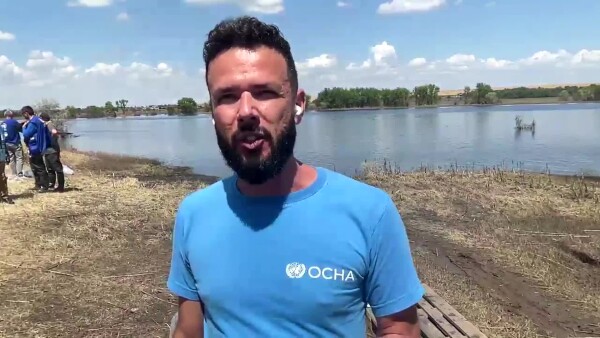
“We are using today four boats to deliver assistance to these 500 families, a small community that is here close by where I am now”, said Saviano Abreu, head of communications for the UN Office for the Coordination of Humanitarian Affairs (OCHA) in Ukraine. “These communities, they already have been facing the consequences of the war. This area was before under Russian control. Late last year around November, it was retaken by Ukraine and now, they are now facing this new catastrophe with the flooding here.”
The emptying of Kakhovka Reservoir has left tens of thousands of people in southern Ukraine without access to piped water, mainly in Dnipropetrovska oblast.
The reservoir – one of the largest in Europe and a source of drinking water to hundreds of thousands of people – is reportedly 70 per cent empty, according to Ukrainian authorities. The width of the reservoir has also decreased from three kilometres to one, while the water level is now at around seven meters, which is below the 12-metre operational threshold, OCHA reported.
“Our calculation is that 200,000 people in the Dnipro region, for example, they have already been cut off from the water from their houses,” said Mr. Abreu. “But a number of families, of people, that could face this kind of this same situation goes up to more than 700,000 people because these are the people that the reservoir would be the source of drinking water around southern Ukraine, not only here in the Kherson region.”
Large urban areas in Dnipropetrovska oblast, including Pokrovska, Nikopolska and Marhanetska, are completely cut off from centralized water and others like Apostolivska and Zelenodolska have extremely limited access. This has left over 210,000 people in this area alone in urgent need of life-saving water, according to estimates from the United Nations and its humanitarian partners.
The receding floodwater has also created other deadly challenges in the form of landmines that have been scattered far and wide.
“This area, I think it is one of the most mine contaminated parts of the world,” said Mr Saviano. “We already know that, and here in the southern part of the country it is one of the main issues. It is the reason, why for example, agriculture in Kherson, in Mykolaiv, Zaporizhzhia have been impacted because of the mine contamination, so the floodwater is moving the mines, that is a reality.”
Abigail Hartley, Chief of Policy, Advocacy and Donor Relations section from the UN Mine Action Service (UNMAS) added that “when the water subsides the mines are there. (The) good thing is that mines float, so they do stay on the surface. But, of course, there's a lot of other flood debris and they can get buried in sediment. So, it is a challenge as the already awful situation there. But the Ukrainian state services have done a good job of de-mining so far in Ukraine.”
Since the destruction of Kakhovka dam, OCHA and its humanitarian partners have continued life-saving operations and delivered at least 10 inter-agency convoys with vital items to thousands of people affected by the disaster.
-ends-
Please note that corresponding b-roll was made available by OCHA!!
https://drive.google.com/drive/folders/1g8lrbYeQ7TQ7EKbUfD-64IuDGmUGPVqC?usp=drive_link
SHOTLIST
- Medium shot, UN Palais with flags
- Wide shot, spokesperson in press briefing room
- SOUNDBITE (English), Saviano Abreu, OCHA Head of Communications in Ukraine : “We are using today four boats to deliver assistance to these 500 families, a small community that is here close by where I am now. These communities, they already have been facing the consequences of the war. This area was before under Russian control. Late last year around November, it was retaken by Ukraine and now, they are now facing this new catastrophe with the flooding here.”
- Medium shot, journalists in the briefing room
- SOUNDBITE (English), Saviano Abreu, OCHA Head of Communications in Ukraine : “Our calculation is that 200,000 people in the Dnipro region, for example, they have already been cut off from the water from their houses. But a number of families, of people, that could face this kind of this same situation goes up to more than 700,000 people because these are the people that the reservoir would be the source of drinking water around southern Ukraine, not only here in the Kherson region.”
- Medium shot, spokesperson at podium with screen in the background
- SOUNDBITE (English), Saviano Abreu, OCHA Head of Communications in Ukraine : “This area, I think it is one of the most of the mine contaminated parts of the world. We already know that, and here in the southern part of the country it is one of the main issues. It is the reason, why for example, agriculture in Kherson, in Mykolaiv, Zaporizhzhia have been impacted because of the mine contamination, so the floodwater is moving the mines, that is a reality.”
- Medium shot, journalist with speakers at the podium
- SOUNDBITE (English), Abigail Hartley, Chief of Policy, Advocacy, Donor Relations and Outreach section from the UN Mine Action Service (UNMAS): “When the water subside the mines are there. Good thing is that mines float, so they do stay on the surface. But of course there's a lot of other flood debris and they can get buried in sediment. So it is a challenge as the already awful situation there. But the Ukrainian state services have done a good job of de-mining so far in the Ukraine.”
- Wide shot, speakers at podium with camera
- Medium shot, handy typing
- Wide shot, press briefing room
Similar Stories

1
1
1
Edited News | UNICEF
A little over one year since a ceasefire agreement was announced between Hamas fighters and Israel, more than 340 children have been reported killed and hundreds more injured, the UN Children’s Fund, UNICEF, said on Friday.

1
1
1
Edited News | UNICEF , IFRC
Six weeks after Nepal’s deadly flooding disaster, communities are still struggling to rebuild their lives, but they will need sustained help as global warming increases the risk of another Himalayan catastrophe, the UN Children’s Fund (UNICEF) said on Friday.

1
1
1
Edited News | WHO
In suspected Russia plague death, testing and monitoring underway – WHO
The death of a lab worker in Russia’s Siberia region has sparked concerns about plague being the cause, the UN World Health Organization (WHO) said on Tuesday, adding that it was following the situation closely.

1
1
Edited News | OHCHR , UNOG
UN Human Rights Chief Volker Türk on Friday provided and oral update to the 63rd session of the Human rights Council on Ukraine.

1
1
1
Edited News | OHCHR , UNOG
UN Human Rights Chief Volker Türk on Friday provided and oral update to the 63rd session of the Human rights Council on the human rights situation in Haiti.

1
1
1
Edited News | WHO
Repeated delays in bringing lifesaving medicines, prosthetics and more from Israel into Gaza risk having devastating consequences on Palestinians who urgently need them in the wartorn enclave, the UN World Health Organization (WHO) said on Friday. “A truck full of non-priority supplies or the right supplies arriving too late, doesn't save lives. That's the question that actually matters," said Dr Reinhilde Van De Weerdt, WHO Representative in the OPT.

1
1
1
Edited News | WHO
DRC: Early access to care and oxygen decisive for Ebola patients’ survival – WHO
In the Democratic Republic of the Congo (DRC), health workers fighting the country’s largest-ever Ebola outbreak are struggling to overcome critical challenges to patient care, the UN World Health Organization (WHO) warned on Tuesday.

1
1
1
Edited News | OCHA , UN
Civilians in Iran are continuing to feel the consequences of months of conflict and military escalation, the UN’s top official in the country has said, as loss of life, damage to civilian infrastructure and mounting economic pressures leave many facing continued uncertainty.
1
1
1
Edited News | WHO , UNICEF
Aid agencies in Yemen highlighted the growing hunger emergency sparked by renewed fighting between Houthi opposition forces and Government troops, after mobile health clinics reported that hundreds of children displaced by the violence are suffering from the most deadly form of malnutrition.
1
1
1
Edited News | UNHCR
Displacement on the rise in Yemen as fighting continues - UNHCR
As hostilities worsen in Yemen, more people have been fleeing their homes, further intensifying the humanitarian crisis within the region, the UN Refugee Agency (UNHCR) warned on Tuesday.
1
1
1
Edited News | IOM , OHCHR , UNFPA , UNOG , UNHCR , WHO
Yemen’s humanitarian crisis growing by the hour amid spike in displacement
Yemenis displaced by renewed fighting have described fleeing for their lives amid shelling and gunfire, aid agencies reported on Friday, while highlighting the dramatic increase in humanitarian needs in the country and in Djibouti, where thousands have sought shelter.
1
1
1
Edited News | OHCHR , UNOG
The UN Human Rights Office issued on Friday a report documenting a shocking pattern of sexual violence amid Russia’s full-scale armed attack on Ukraine.