

The United Nations Office at Geneva
Multimedia Newsroom
Cholera and other health emergencies in Mozambique multiplied by Cyclone Freddy - WHO
Over a million people across Mozambique’s eight provinces have been affected by the compounding effects of cholera, cyclone Freddy and its floods, polio, Covid-19 and a protracted humanitarian crisis in the north, the UN World Health Organization (WHO) said on Friday.
“The numbers are sobering,” said Dr. Severin von Xylander, WHO Representative for Mozambique. “More than a million people across eight provinces are being impacted by cholera, the floods and Cyclone Freddy.”
The cyclone’s destructive path laid waste to more than 132 homes and displaced 184,000 people. “Mostly closed accommodation centers were opened in many districts and shelter for families in need. In the cyclone destroyed path 163 health facilities were damaged, jeopardizing access to routine care,” the WHO official added.
Storm damage to public services and infrastructure has been staggering, WHO said, after flooding in early February triggered by heavy seasonal rains, combined with the effects of Freddy making landfall – twice - on 24 February and on 11 March.
“The country was hit twice by the cyclone in a matter of days and (is) now receding,” said the WHO Representative. “But access to safe water and sanitation is still challenging and about one third of the crops have been destroyed and cholera cases are being reported from an increasing number of affected districts.”
In the coming weeks, WHO expects that the number of malaria cases will increase drastically and the malnutrition rate – already very high – will go up. Climate change is not a future problem – it’s here and now, Dr. von Xylander maintained.
His comments came as a cholera outbreak continues to spread. More than 132 people have been admitted to cholera treatment centers in the last 24 hours, 350 people have received ambulatory care for cholera. After Freddy hit Mozambique, the number of cases exploded from less than 20 a day to more than 200.
“While the cholera outbreaks regularly occur in Mozambique between October and April of every year with more than 21,000 cases currently and 95 deaths, this is the largest outbreak in the last 20 years,” said Dr. von Xylander. “For example, Manica province bordering Zimbabwe had not seen a case of cholera in the last 15 years.”
A first cholera vaccination campaign took place in late February in four provinces. Over 715,000 people were vaccinated using the single-dose strategy. A second campaign was launched on Thursday in the city of Quelimane – the most affected city - targeting 410,000 people.
“Luckily, the case fatality rate for the cholera treatment center is below the threshold of one per cent which means we are able to save lives,” said WHO’s Mozambique Representative. “I really have to acknowledge the wonderful work that the Ministry of Health is doing, deploying people that at the same time need to look after their families and meanwhile treating people.”
There is also a very real likelihood that the country will suffer a food crisis. An Integrated Phase Classification (IPC) report which describes the severity of food emergencies covering the period between November 2022 to March 2023 indicated that an estimated 3.15 million people in the country face acute food insecurity (2.8 million people in IPC3 and 400,000 people in IPC 4). For northern Mozambique, where there is only one planting season, the crop destruction means that the lean season will last a year.
-ends-
STORY: Cholera and Health Emergencies Mozambique - WHO
TRT: 1:59”
SOURCE: UNTV CH
RESTRICTIONS: NONE
LANGUAGE: ENGLISH/NATS
ASPECT RATIO: 16:9
DATELINE: 31 March 2023 GENEVA, SWITZERLAND
SHOTLIST
- Medium shot, UN Geneva flag alley.
- Wide shot, press room with spokesperson on the podium
- SOUNDBITE (ENGLISH) – Dr. Severin von Xylander, WHO Representative for Mozambique: “The numbers are sobering. More than a million people across eight provinces are being impacted by cholera, the floods and Cyclone Freddy. Cyclone Freddy destroyed over 132 homes and 184,000 people were displaced. Now ready, mostly closed accommodation centers were opened in many districts and shelter for families in need. In the cyclone destroyed path 163 health facilities were damaged, jeopardizing access to routine care.”
- Close up, journalists
- SOUNDBITE (ENGLISH) – Dr. Severin von Xylander, WHO Representative for Mozambique: “The country was hit twice by the cyclone in a matter of days and now receding. But access to safe water and sanitation is still challenging and about one third of the crops have been destroyed and cholera cases are being reported from an increasing number of affected districts.”
- Close up, journalists listening
- SOUNDBITE (ENGLISH) - Dr. Severin von Xylander, WHO Representative for Mozambique: “While the cholera outbreaks regularly occur in Mozambique between October and April of every year with more than 21,000 cases currently and 95 deaths, this is the largest outbreak in the last 20 years. For example, Manica province bordering Zimbabwe had not seen a case of cholera in the last 15 years.”
- Medium shot, journalists listening
- SOUNDBITE (ENGLISH) - Dr. Severin von Xylander, WHO Representative for Mozambique: “Luckily, the case fatality rate for the cholera treatment center is below the threshold of one per cent, which means we are able to save lives. And I really have to acknowledge the wonderful work that the Ministry of Health is doing, deploying people that at the same time need to look after their families and meanwhile treating people.”
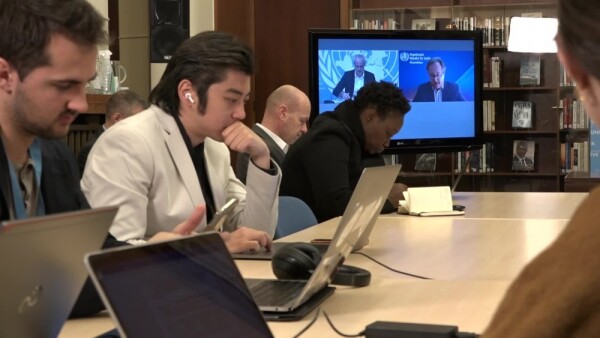
- Medium shot, journalists and screen with speakers in the background
- Close up, hands writing
- Close up, hands typing on laptop
Similar Stories

1
1
1
Edited News | UNICEF
A little over one year since a ceasefire agreement was announced between Hamas fighters and Israel, more than 340 children have been reported killed and hundreds more injured, the UN Children’s Fund, UNICEF, said on Friday.

1
1
1
Edited News | UNICEF , IFRC
Six weeks after Nepal’s deadly flooding disaster, communities are still struggling to rebuild their lives, but they will need sustained help as global warming increases the risk of another Himalayan catastrophe, the UN Children’s Fund (UNICEF) said on Friday.

1
1
1
Edited News | WHO
In suspected Russia plague death, testing and monitoring underway – WHO
The death of a lab worker in Russia’s Siberia region has sparked concerns about plague being the cause, the UN World Health Organization (WHO) said on Tuesday, adding that it was following the situation closely.

1
1
Edited News | OHCHR , UNOG
UN Human Rights Chief Volker Türk on Friday provided and oral update to the 63rd session of the Human rights Council on Ukraine.

1
1
1
Edited News | OHCHR , UNOG
UN Human Rights Chief Volker Türk on Friday provided and oral update to the 63rd session of the Human rights Council on the human rights situation in Haiti.

1
1
1
Edited News | WHO
Repeated delays in bringing lifesaving medicines, prosthetics and more from Israel into Gaza risk having devastating consequences on Palestinians who urgently need them in the wartorn enclave, the UN World Health Organization (WHO) said on Friday. “A truck full of non-priority supplies or the right supplies arriving too late, doesn't save lives. That's the question that actually matters," said Dr Reinhilde Van De Weerdt, WHO Representative in the OPT.

1
1
1
Edited News | WHO
DRC: Early access to care and oxygen decisive for Ebola patients’ survival – WHO
In the Democratic Republic of the Congo (DRC), health workers fighting the country’s largest-ever Ebola outbreak are struggling to overcome critical challenges to patient care, the UN World Health Organization (WHO) warned on Tuesday.

1
1
1
Edited News | OCHA , UN
Civilians in Iran are continuing to feel the consequences of months of conflict and military escalation, the UN’s top official in the country has said, as loss of life, damage to civilian infrastructure and mounting economic pressures leave many facing continued uncertainty.
1
1
1
Edited News | WHO , UNICEF
Aid agencies in Yemen highlighted the growing hunger emergency sparked by renewed fighting between Houthi opposition forces and Government troops, after mobile health clinics reported that hundreds of children displaced by the violence are suffering from the most deadly form of malnutrition.
1
1
1
Edited News | UNHCR
Displacement on the rise in Yemen as fighting continues - UNHCR
As hostilities worsen in Yemen, more people have been fleeing their homes, further intensifying the humanitarian crisis within the region, the UN Refugee Agency (UNHCR) warned on Tuesday.
1
1
1
Edited News | IOM , OHCHR , UNFPA , UNOG , UNHCR , WHO
Yemen’s humanitarian crisis growing by the hour amid spike in displacement
Yemenis displaced by renewed fighting have described fleeing for their lives amid shelling and gunfire, aid agencies reported on Friday, while highlighting the dramatic increase in humanitarian needs in the country and in Djibouti, where thousands have sought shelter.
1
1
1
Edited News | OHCHR , UNOG
The UN Human Rights Office issued on Friday a report documenting a shocking pattern of sexual violence amid Russia’s full-scale armed attack on Ukraine.