

The United Nations Office at Geneva
Multimedia Newsroom
Headline:
Plant pests destroy up to 40% of agriculture and crops, adding to an increasingly hungry world - FAO
Even though plants provide 98% or more of the oxygen people breathe, and nearly 80% of our daily calorie intake, they are under siege.
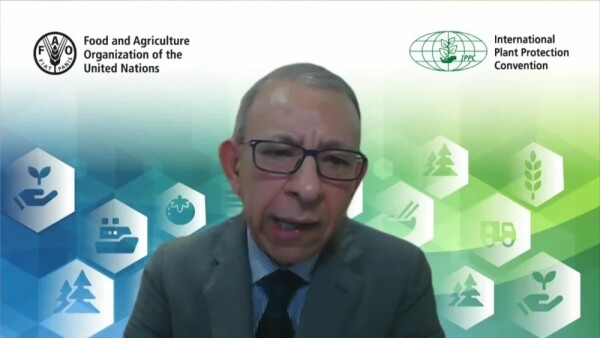
“Pests currently destroy up to 40% of agriculture and crops, including food crops- 40% each year. This costs the world about $220 billion- that would be $220 billion annually in global trade losses,” said Dr. Osama El-Lissy, Secretary- General of the International Plant Protection Convention (IPPC) today to the media at the United Nations in Geneva ahead of its annual meeting.
The IPPC, an intergovernmental treaty involving 184 countries, is overseen by the UN Food and Agriculture Organization (FAO) to safeguard agriculture and natural resources against plan pest and to facilitate safe trade.
In an increasingly hungry world, with 828 million people experiencing hunger in 2021 based on the UN Food and Agriculture Organization (FAO) estimates, this is alarming and set back global efforts towards achieving the Sustainable Development Goal 2, Zero Hunger, by 2030.
For example, the most widely traded fruit in the world, worth USD 7.5 billion, is under attack from the devastating banana fusarium (TR4), a fungus that attacks the roots causing bananas to wilt.
“80% of the global banana production is currently under attack from a disease called banana fusarium,” Mr. El-Lissy said. “That is basically a fungus that attacks and kills bananas. And more recently, just two weeks ago, Venezuela actually reached out to us to report the detection of this particular banana fusarium in banana production and declared an emergency”.
Next week, the IPPC’s governing body, the Commission on Phytosanitary Measures, will convene in Rome for its 17th annual session to adopt standard and to take stock of the progress in the global protection of plants.
“We are concerned about insecticide resistance and that's why we promote environmentally friendly tools that could be just as effective in controlling some of these pests, including biological control in sterile insect technology and other practices that can really minimize the use of insecticides while at the same time providing the necessary safeguarding against some of these invasive pests,” said Dr. Osama El-Lissy.
He also emphasized that “based on scientific review that the IPPC conducted last year, climate change is increasing the risk of pests spreading in agriculture and forestry areas. And we see this in the distribution of desert locusts, the world's most destructive migratory pests”.
- ends-
STORY: FAO: Plant Pests and Impacts on Food Security
TRT: 2 min 23s
SOURCE: UNTV CH
RESTRICTIONS: NONE
LANGUAGE: ENGLISH/NATS
ASPECT RATIO: 16:9
DATELINE: 24 March 2023 GENEVA, SWITZERLAND
SHOTLIST
- Medium shot, UN Geneva flag alley.
- Wide shot, Briefing room, Palais des Nations
- SOUNDBITE (ENGLISH) – Dr. Osama El-Lissy, Secretary of the International Plant Protection Convention (IPPC), FAO: “Pests currently destroy up to 40% of agriculture and crops, including food crops- 40% each year. This costs the world about $220 billion- that would be $220 billion annually in global trade losses".
- Medium shot, journalists
- SOUNDBITE (ENGLISH) - Dr. Osama El-Lissy, Secretary of the International Plant Protection Convention (IPPC), FAO: “ 80% of the global banana production is currently under attack from a disease called banana fusarium. That is basically a fungus that attacks and kills bananas. And more recently, just two weeks ago, Venezuela actually reached out to us to report the detection of this particular banana fusarium in banana production and declared an emergency.”
- Close-up of journalist with monitors in the background
- SOUNDBITE (ENGLISH) - Dr. Osama El-Lissy, Secretary of the International Plant Protection Convention (IPPC), FAO: “We are concerned about insecticide resistance and that's why we promote environmentally friendly tools that could be just as effective in controlling some of these pests, including biological control in sterile insect technology and other practices that can really minimize the use of insecticides while at the same time providing the necessary safeguarding against some of these invasive pests.”
- Close up, journalists typing
- SOUNDBITE (ENGLISH) – Dr. Osama El-Lissy, Secretary of the International Plant Protection Convention (IPPC), FAO: “Based on scientific review that the IPPC (International Plant Protection Convention) conducted last year, climate change is increasing the risk of pests spreading in agriculture and forestry areas. And we see this in the distribution of desert locusts, the world's most destructive migratory pests.”
- Medium shot, Screens with camera in the foreground
- Close up, journalist
- Close up, journalists typing
Similar Stories

1
1
1
Edited News | UNICEF
A little over one year since a ceasefire agreement was announced between Hamas fighters and Israel, more than 340 children have been reported killed and hundreds more injured, the UN Children’s Fund, UNICEF, said on Friday.

1
1
1
Edited News | UNICEF , IFRC
Six weeks after Nepal’s deadly flooding disaster, communities are still struggling to rebuild their lives, but they will need sustained help as global warming increases the risk of another Himalayan catastrophe, the UN Children’s Fund (UNICEF) said on Friday.

1
1
1
Edited News | WHO
In suspected Russia plague death, testing and monitoring underway – WHO
The death of a lab worker in Russia’s Siberia region has sparked concerns about plague being the cause, the UN World Health Organization (WHO) said on Tuesday, adding that it was following the situation closely.

1
1
Edited News | OHCHR , UNOG
UN Human Rights Chief Volker Türk on Friday provided and oral update to the 63rd session of the Human rights Council on Ukraine.

1
1
1
Edited News | OHCHR , UNOG
UN Human Rights Chief Volker Türk on Friday provided and oral update to the 63rd session of the Human rights Council on the human rights situation in Haiti.

1
1
1
Edited News | WHO
Repeated delays in bringing lifesaving medicines, prosthetics and more from Israel into Gaza risk having devastating consequences on Palestinians who urgently need them in the wartorn enclave, the UN World Health Organization (WHO) said on Friday. “A truck full of non-priority supplies or the right supplies arriving too late, doesn't save lives. That's the question that actually matters," said Dr Reinhilde Van De Weerdt, WHO Representative in the OPT.

1
1
1
Edited News | WHO
DRC: Early access to care and oxygen decisive for Ebola patients’ survival – WHO
In the Democratic Republic of the Congo (DRC), health workers fighting the country’s largest-ever Ebola outbreak are struggling to overcome critical challenges to patient care, the UN World Health Organization (WHO) warned on Tuesday.

1
1
1
Edited News | OCHA , UN
Civilians in Iran are continuing to feel the consequences of months of conflict and military escalation, the UN’s top official in the country has said, as loss of life, damage to civilian infrastructure and mounting economic pressures leave many facing continued uncertainty.
1
1
1
Edited News | WHO , UNICEF
Aid agencies in Yemen highlighted the growing hunger emergency sparked by renewed fighting between Houthi opposition forces and Government troops, after mobile health clinics reported that hundreds of children displaced by the violence are suffering from the most deadly form of malnutrition.
1
1
1
Edited News | UNHCR
Displacement on the rise in Yemen as fighting continues - UNHCR
As hostilities worsen in Yemen, more people have been fleeing their homes, further intensifying the humanitarian crisis within the region, the UN Refugee Agency (UNHCR) warned on Tuesday.
1
1
1
Edited News | IOM , OHCHR , UNFPA , UNOG , UNHCR , WHO
Yemen’s humanitarian crisis growing by the hour amid spike in displacement
Yemenis displaced by renewed fighting have described fleeing for their lives amid shelling and gunfire, aid agencies reported on Friday, while highlighting the dramatic increase in humanitarian needs in the country and in Djibouti, where thousands have sought shelter.
1
1
1
Edited News | OHCHR , UNOG
The UN Human Rights Office issued on Friday a report documenting a shocking pattern of sexual violence amid Russia’s full-scale armed attack on Ukraine.