

The United Nations Office at Geneva
Multimedia Newsroom
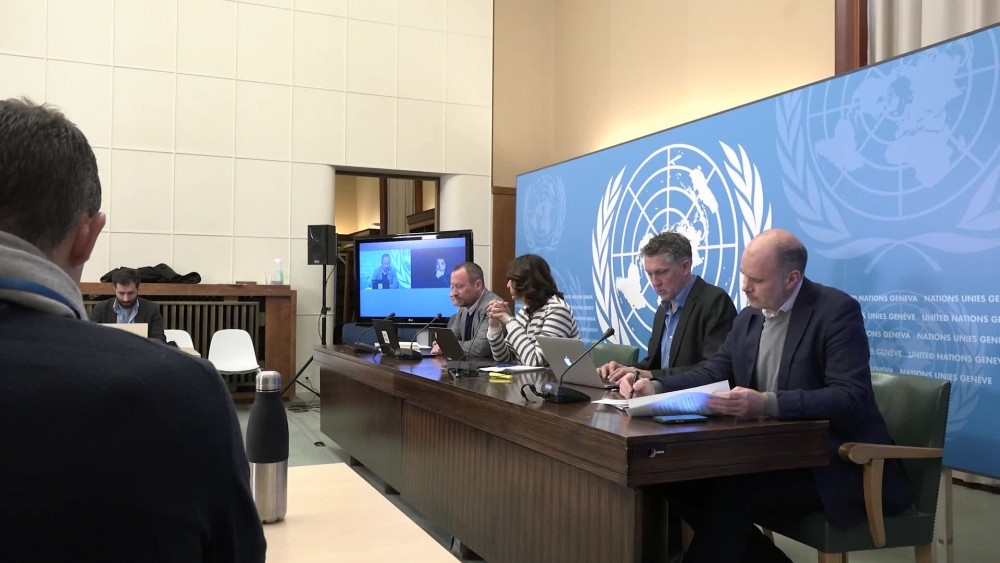
Türkiye, Syria quake latest: full scale of disaster still unfolding, UN humanitarians warn
The full scale of the double earthquake disaster in Türkiye and Syria is still unfolding, UN humanitarians said on Tuesday, as they stressed the critical need to step up search and rescue efforts for victims and ensure that lifesaving aid reaches all those who need it.
According to the Government of Türkiye, at least 3,381 people died and more than 20,000 were injured after a 7.8 magnitude quake struck close to the southern city of Gaziantep early on Monday, followed by another 7.5 magnitude earthquake several hours later. Almost 6,000 buildings have reportedly collapsed in the country, too, said Jens Laerke, spokesperson for the UN Office for the Coordination of Humanitarian Affairs (OCHA).
Syria’s needs are massive too, the OCHA spokesperson continued, as he relayed information from the country’s health authorities which reported 769 deaths and 1,448 injuries from the earthquakes, in Aleppo, Latakia, Hama, Idlib countryside and Tartus.
After enduring the initial massive earthquakes, traumatized communities in Syria then faced more than 200 aftershocks. “This of course came at the worst possible time for many, many vulnerable children in those areas who were already in need of humanitarian support,” said James Elder, spokesperson for the UN Children’s Fund (UNICEF). “They went to bed as normal, they were woken by the screams of their neighbours, by breaking glass and by the terrifying sound of crumbling concrete.”
Although Syria is in crisis after 13 years of war, there is particular concern for all those affected by Monday’s disaster who live in opposition-held areas in the north-west of the country, often after being forced to flee their homes multiple times because of heavy fighting.
“It was already an emergency situation across north-west Syria where four million people receive humanitarian support. Communities there are grappling with cholera outbreak, a brutal winter and of course ongoing conflict,” Mr. Elder explained.
Echoing those concerns, the UN refugee agency, UNHCR, said that the situation is tragic in the 10 Turkish provinces affected by the earthquakes.
In some of these affected provinces in Türkiye, 50 per cent of people are now refugees, while in Syria, UNHCR spokesperson Matthew Saltmarsh described the earthquake emergency as a “hammer blow” for displaced populations who have no work and whose savings have been exhausted. “We’re in the depths of winter, we’ve been seeing snowstorms and of course, you know, the war has been going on for over a decade,” he said.
As international search and rescue teams arrive in the region, coordinated by the UN Office for the Coordination of Humanitarian Affairs (OCHA), spokesperson Jens Laerke stressed that “there’s a window of about seven days…where we’ll find alive survivors. It can happen later, but it’s really critical that these teams get out there as soon as possible.”
Aside from the material damage to roads and public infrastructure which has made the work of emergency teams more difficult, Syria’s dire economic situation has also slowed the relief effort. “Search and rescue efforts are currently hampered by lack of equipment to remove debris,” said Tommaso Della Longa, spokesperson for the International Federation of Red Cross and Red Crescent Societies (IFRC). “There is a severe lack of fuel all over Syria and this has hampered operational heavy machinery, transport of personnel and emergency ambulance services.”
In line with the UN Secretary-General’s appeal for all countries to support all those “already in dire need of humanitarian aid”, OCHA spokesperson Mr. Laerke issued a heartfelt appeal for help.
“It is imperative that everybody sees this…for what it is: a humanitarian crisis where lives are at stake. Please, don’t politicize any of this, let’s get the aid out to the people who so desperately need it.”
To date, around 8,000 people have been rescued by emergency teams coordinated by the Turkish Disaster and Emergency Management Authority (AFAD), according to UNHCR.
Other UN agencies and partners have also provided lifesaving support on the ground, including the World Health Organization (WHO). “We’ve actually been able to move trauma and surgical kits cross-border from Gaziantep where of course we have prepositioned supplies and we have been able to supply 16 hospitals in Syria, in the affected areas in Syria, as of yesterday,” said Dr. Margaret Harris, WHO spokesperson.
According to the United Nations Relief and Works Agency (UNRWA), about 90 per cent of those Palestinian refugee families in Syria require humanitarian assistance because of the earthquakes. Some 438,000 Palestinian refugees live in Syria’s 12 refugee camps and northern Syria is home to 62,000 Palestine refugees in Latakia, Neirab, Ein-el Tal and Hama.
Adding his voice to those expressing sympathy for all those affected by the disaster, the UN Special Envoy for Syria, Geir Pedersen, said that he was deeply saddened by the tragic loss of life and massive destruction.
ends
STORY: Türkiye, Syria Earthquakes: Updates
TRT: 3’27
SOURCE: UNTV CH
LANGUAGE: ENGLISH/NATS
ASPECT RATIO: 16:9
DATELINE: GENEVA, SWITZERLAND
RELEASED: 7 February 2023
SHOTLIST
- Exterior wide, UN flag alley, UN Geneva.
- Wide of speakers seated in press room, in front of UN backdrop.
- SOUNDBITE (ENGLISH) Jens Laerke, UN Office for the Coordination of Humanitarian Affairs (OCHA): “This morning the Government of Türkiye has confirmed at least 3,381 deaths and over 20,000 injuries; almost 6,000 buildings have reportedly collapsed in the country. From Syria, we have heard from the Syrian Ministry of Health has reported 769 deaths and 1,448 injuries due to the earthquake, and that is from Aleppo, Latakia, Hama, Idlib countryside and Tartus.”
- Wide, journalists.
- SOUNDBITE (ENGLISH) James Elder, UN Children’s Fund (UNICEF): “This of course came of course at the worst possible time for many, many vulnerable children in those areas who were already in need of humanitarian support. They went to bed as normal, they were woken by the screams of their neighbours, by breaking glass and by the terrifying sound of crumbling concrete.”
- Medium: journalists seated, looking down at laptop (out of shot).
- SOUNDBITE (ENGLISH) James Elder, UN Children’s Fund (UNICEF): “It was already an emergency situation across north-west Syria where four million people receive humanitarian support. Communities there are grappling with cholera outbreak, a brutal winter and of course ongoing conflict.”
- Medium-wide, panel of speakers, side shot.
- SOUNDBITE (ENGLISH) Matthew Saltmarsh, UN Refugee Agency (UNHCR): “This is an absolute hammer blow for Syria’s displaced populations; the refugees and those who have been displaced within Syria itself already suffering from an economic crisis; we’re in the depths of winter, we’ve been seeing snowstorms and of course, you know, the war has been going on for over a decade.”
- Medium, journalist watching proceedings (out of shot).
- SOUNDBITE (ENGLISH) Dr. Margaret Harris, World Health Organization (WHO): “We’ve actually been able to move trauma and surgical kits cross-border from Gaziantep where of course we have prepositioned supplies and we have been able to supply 16 hospitals in Syria, in the affected areas in Syria, as of yesterday.”
- Wide, press room, journalists and speakers.
- SOUNDBITE (ENGLISH) Jens Laerke, UN Office for the Coordination of Humanitarian Affairs (OCHA): “The first effort is really search and rescue. There’s a window of about seven days, that’s what experience tells us where we’ll find alive survivors, it can happen later, but it’s really critical that these teams get out there as soon as possible.”
- Medium, journalist checking mobile phone.
- SOUNDBITE (ENGLISH) Tommaso Della Longa, International Federation of Red Cross and Red Crescent Societies (IFRC): “Search and rescue efforts are currently hampered by lack of equipment to remove debris. The authorities have not enough machinery and machineries to be rented from the private sector, there is a severe lack of fuel all over Syria and this has hampered operational heavy machinery, transport of personnel and emergency ambulance services.”
- Wide, participants at press conference, TV camera on tripod.
- SOUNDBITE (ENGLISH) Jens Laerke, UN Office for the Coordination of Humanitarian Affairs (OCHA): “It is imperative that everybody sees this as the humanitarian - for what it is: a humanitarian crisis where lives are at stake. Please, don’t politicise any of this, let’s get the aid out to the people who so desperately need it.”
- Medium, participant wearing headphones, looks at laptop.
- Medium-wide, participants seated.
- Medium, journalists listening or typing on laptops.
Similar Stories

1
1
1
Edited News | UNICEF
A little over one year since a ceasefire agreement was announced between Hamas fighters and Israel, more than 340 children have been reported killed and hundreds more injured, the UN Children’s Fund, UNICEF, said on Friday.

1
1
1
Edited News | UNICEF , IFRC
Six weeks after Nepal’s deadly flooding disaster, communities are still struggling to rebuild their lives, but they will need sustained help as global warming increases the risk of another Himalayan catastrophe, the UN Children’s Fund (UNICEF) said on Friday.

1
1
1
Edited News | WHO
In suspected Russia plague death, testing and monitoring underway – WHO
The death of a lab worker in Russia’s Siberia region has sparked concerns about plague being the cause, the UN World Health Organization (WHO) said on Tuesday, adding that it was following the situation closely.

1
1
Edited News | OHCHR , UNOG
UN Human Rights Chief Volker Türk on Friday provided and oral update to the 63rd session of the Human rights Council on Ukraine.

1
1
1
Edited News | OHCHR , UNOG
UN Human Rights Chief Volker Türk on Friday provided and oral update to the 63rd session of the Human rights Council on the human rights situation in Haiti.

1
1
1
Edited News | WHO
Repeated delays in bringing lifesaving medicines, prosthetics and more from Israel into Gaza risk having devastating consequences on Palestinians who urgently need them in the wartorn enclave, the UN World Health Organization (WHO) said on Friday. “A truck full of non-priority supplies or the right supplies arriving too late, doesn't save lives. That's the question that actually matters," said Dr Reinhilde Van De Weerdt, WHO Representative in the OPT.

1
1
1
Edited News | WHO
DRC: Early access to care and oxygen decisive for Ebola patients’ survival – WHO
In the Democratic Republic of the Congo (DRC), health workers fighting the country’s largest-ever Ebola outbreak are struggling to overcome critical challenges to patient care, the UN World Health Organization (WHO) warned on Tuesday.

1
1
1
Edited News | OCHA , UN
Civilians in Iran are continuing to feel the consequences of months of conflict and military escalation, the UN’s top official in the country has said, as loss of life, damage to civilian infrastructure and mounting economic pressures leave many facing continued uncertainty.
1
1
1
Edited News | WHO , UNICEF
Aid agencies in Yemen highlighted the growing hunger emergency sparked by renewed fighting between Houthi opposition forces and Government troops, after mobile health clinics reported that hundreds of children displaced by the violence are suffering from the most deadly form of malnutrition.
1
1
1
Edited News | UNHCR
Displacement on the rise in Yemen as fighting continues - UNHCR
As hostilities worsen in Yemen, more people have been fleeing their homes, further intensifying the humanitarian crisis within the region, the UN Refugee Agency (UNHCR) warned on Tuesday.
1
1
1
Edited News | IOM , OHCHR , UNFPA , UNOG , UNHCR , WHO
Yemen’s humanitarian crisis growing by the hour amid spike in displacement
Yemenis displaced by renewed fighting have described fleeing for their lives amid shelling and gunfire, aid agencies reported on Friday, while highlighting the dramatic increase in humanitarian needs in the country and in Djibouti, where thousands have sought shelter.
1
1
1
Edited News | OHCHR , UNOG
The UN Human Rights Office issued on Friday a report documenting a shocking pattern of sexual violence amid Russia’s full-scale armed attack on Ukraine.