

The United Nations Office at Geneva
Multimedia Newsroom
After a historic drought triggered by five consecutive poor rainy seasons, skyrocketing food prices and an intensifying conflict, Somalia has been lingering on the brink of famine.
Although famine has officially not yet been declared, the latest Integrated Food Security Phase Classification (IPC) which describes the severity of food emergencies has drawn a grim picture.
“The IPC Report found out about 6.4 million Somalis are facing acute food insecurity in the coming months”, said Etienne Peterschmitt, the Somalia Representative for the UN Food and Agriculture Organization (FAO) when talking to media at the United Nations in Geneva. “That number could increase to 8.3 million people by April next year, and the number of Somalis facing catastrophic food insecurity, or famine conditions, could increase to over 700,000 people by June 2023”.
According to FAO, humanitarian assistance needs to be both scaled up and sustained to prevent famine in Somalia. The prolonged drought conditions have left pastoral, agropastoral and farming communities unable to cope and as their livelihoods collapse, many are leaving their homes and moving to already crowded displacement camps in towns to seek humanitarian assistance.
“While the situation remains dire, there is still time to turn the tide by addressing the immediate needs of rural communities who are among those who are at greatest risk from a food security but also nutrition, health as well as water and sanitation perspective”, noted FAO’s Mr. Peterschmitt.
The affected rural communities require urgent assistance between now and June 2023, with famine projected in three areas if assistance doesn’t reach the most vulnerable. Approximately 1.8 million children are of particular concern, including over 500,000 of them who are likely to be severely malnourished till July 2023.
“Earlier projections of famine have so far been averted because funding to humanitarian assistance has covered a sufficient portion of the most basic needs for a few months at a time, keeping Famine thresholds at bay – at least for now,” stressed Mr. Peterschmitt.
The generous funding has also allowed the World Food Programme (WFP) stepping up to deliver life-saving food and nutrition close to 5 million people in November.
“The longest drought in over 40 years is still ongoing, with no end in sight”, said El-Khidir Daloum, WFP’s Somalia Country Director. “It is still destroying lives and it is still killing people. On the ground, we see the impacts every day. We hear from the people whose children have died on the journey after leaving their homes in search of assistance.”
WFP stresses that significant investment in resilience programmes that combine nutrition, education, livelihoods, and long-term food security support are needed as the way forward. Even if the worst outcomes of this drought could be kept at bay, the next drought could come back again, warned WFP’s Somalia Country Director.
”We must also continue to invest in recovery and in long-term, sustainable solutions, under the leadership of the Government of Somalia, to protect Somalis against future climate shocks. The current drought it is unusually long but it is not an isolated incident in a country on the front lines of the climate change.”
-ends-
STORY: Somalia Update – Food security FAO-WFP
TRT: 2 min 17s
SOURCE: UNTV CH
RESTRICTIONS: NONE
LANGUAGE: ENGLISH/NATS
ASPECT RATIO: 16:9
DATELINE: 20 December 2022 GENEVA, SWITZERLAND
SHOTLIST
- Medium shot, UN Geneva flag alley.
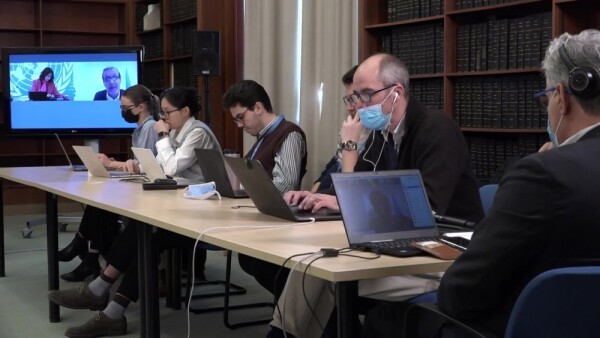
- Wide shot, press room with spokesperson and panel of speakers on screens.
- SOUNDBITE (ENGLISH) - Etienne Peterschmitt, FAO Somalia Representative:” The IPC Report found out about 6.4 million Somalis are facing acute food insecurity in the coming months. That number could increase to 8.3 million people by April next year, and the number of Somalis facing catastrophic food insecurity, or famine conditions, could increase to over 700,000 people by June 2023”.
- Close-up shot, hands typing on laptop
- SOUNDBITE (ENGLISH) - Etienne Peterschmitt, FAO Somalia Representative:” While the situation remains dire, there is still time to turn the tide by addressing the immediate needs of rural communities who are among those who are at greatest risk from a food security but also nutrition, health as well as water and sanitation perspective”.
- Close up, journalists listening.
- SOUNDBITE (ENGLISH) - Etienne Peterschmitt, FAO Somalia Representative: “Earlier projections of famine have so far been averted because funding to humanitarian assistance has covered a sufficient portion of the most basic needs for a few months at a time, keeping Famine thresholds at bay – at least for now”.
- Medium shot, journalists writing with screens of speakers in the background.
- SOUNDBITE (ENGLISH) - El-Khidir Daloum, WFP Somalia Country Director:” The longest drought in over 40 years is still ongoing, with no end in sight. It is still destroying lives and it is still killing people. On the ground, we see the impacts every day. We hear from the people whose children have died on the journey after leaving their homes in search of assistance.”
- Medium shot, journalists taking notes.
- SOUNDBITE (ENGLISH) - El-Khidir Daloum, WFP Somalia Country Director:” We must also continue to invest in recovery and in long-term, sustainable solutions, under the leadership of the Government of Somalia, to protect Somalis against future climate shocks. The current drought it is unusually long but it is not an isolated incident in a country on the front lines of the climate change.”
- Medium shot, pressroom with journalists.
- Close-up, journalist writing by hand.
- Close-up, journalists listening.
Similar Stories

2
17
1
2
Edited News , Press Conferences | OCHA , WMO
Two UN agencies teamed up on Wednesday to issue an appeal for immediate assistance to help communities already being impacted by the strongest El Niño on record.

3
16
2
2
B-roll , Conferences , Edited News | UNITED NATIONS , UNOG
Sixth Consultative Meeting on Enhancing Coordination of Peace Initiatives and Efforts for Sudan

1
1
1
Edited News | UNICEF , WHO , UNHCR
Yemen war continues to force families from homes amid hunger and disease
More than 250,000 people have now fled renewed fighting in Yemen, the UN said on Tuesday, citing particular concern for those sheltering in the southwestern city of Taiz and the wider governorate, where access is “essentially blocked”.

1
1
1
Edited News | UNICEF
A little over one year since a ceasefire agreement was announced between Hamas fighters and Israel, more than 340 children have been reported killed and hundreds more injured, the UN Children’s Fund, UNICEF, said on Friday.

1
1
1
Edited News | UNICEF , IFRC
Six weeks after Nepal’s deadly flooding disaster, communities are still struggling to rebuild their lives, but they will need sustained help as global warming increases the risk of another Himalayan catastrophe, the UN Children’s Fund (UNICEF) said on Friday.

1
1
1
Edited News | WHO
In suspected Russia plague death, testing and monitoring underway – WHO
The death of a lab worker in Russia’s Siberia region has sparked concerns about plague being the cause, the UN World Health Organization (WHO) said on Tuesday, adding that it was following the situation closely.

1
1
Edited News | OHCHR , UNOG
UN Human Rights Chief Volker Türk on Friday provided and oral update to the 63rd session of the Human rights Council on Ukraine.

1
1
1
Edited News | OHCHR , UNOG
UN Human Rights Chief Volker Türk on Friday provided and oral update to the 63rd session of the Human rights Council on the human rights situation in Haiti.

1
1
1
Edited News | WHO
Repeated delays in bringing lifesaving medicines, prosthetics and more from Israel into Gaza risk having devastating consequences on Palestinians who urgently need them in the wartorn enclave, the UN World Health Organization (WHO) said on Friday. “A truck full of non-priority supplies or the right supplies arriving too late, doesn't save lives. That's the question that actually matters," said Dr Reinhilde Van De Weerdt, WHO Representative in the OPT.

1
1
1
Edited News | WHO
DRC: Early access to care and oxygen decisive for Ebola patients’ survival – WHO
In the Democratic Republic of the Congo (DRC), health workers fighting the country’s largest-ever Ebola outbreak are struggling to overcome critical challenges to patient care, the UN World Health Organization (WHO) warned on Tuesday.

1
1
1
Edited News | OCHA , UN
Civilians in Iran are continuing to feel the consequences of months of conflict and military escalation, the UN’s top official in the country has said, as loss of life, damage to civilian infrastructure and mounting economic pressures leave many facing continued uncertainty.
1
1
1
Edited News | WHO , UNICEF
Aid agencies in Yemen highlighted the growing hunger emergency sparked by renewed fighting between Houthi opposition forces and Government troops, after mobile health clinics reported that hundreds of children displaced by the violence are suffering from the most deadly form of malnutrition.