

The United Nations Office at Geneva
Multimedia Newsroom
Edited News | OHCHR
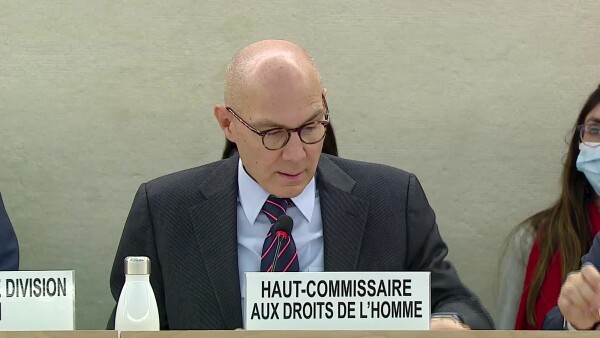
UN High Commissioner Volker Türk on Human Rights situation in Ukraine at HRC.
“My visit to Ukraine ended a week ago. But the horrors, suffering and the daily toll that this war is having on people in the country remain with me. The deaths. The lives uprooted. The families ripped apart. With more than 18 million people in Ukraine in need of humanitarian aid,” he said.
Some 7.83 million have fled the country and 6.5 million are internally displaced. An estimated 1.5 million children are at risk of depression, anxiety, post-traumatic stress disorder and other mental conditions.
“A war that continues to be marked by gross violations of international human rights law and serious violations of international humanitarian law.”
As requested, the UN High Commissioner presented the report focused on killings of civilians by Russian armed forces through summary executions and attacks on individual civilians which took place in 102 villages and towns in Kyiv, Chernihiv, and Sumy regions between 24 February and 6 April 2022.
The findings are based on information gathered during field visits to the three regions following the retreat of Russian troops, interviews with witnesses and survivors, and other sources of information.
HRMMU documented the killings of 441 civilians: 341 men, 72 women, 20 boys, and 8 girls.
The actual figures are likely to be considerably higher as we are working to corroborate an additional 198 alleged killings in these regions. The office is also documenting new cases in parts of Kharkiv and Kherson regions that were recently retaken by Ukrainian forces.
“In some cases, Russian soldiers executed civilians in makeshift places of detention. Others were summarily executed on the spot following security checks – in their houses, yards, and doorways. Even where the victim had shown clearly that they were not a threat, for example, by holding their hands in the air. There are strong indications that the summary executions documented in the report may constitute the war crime of wilful killing,” Türk said.
Men and boys comprised 88 percent of all victims of summary executions presented in the report, suggesting that they were disproportionately targeted based on their gender.
Russian forces carried out other types of attacks on individual civilians, in violation of international humanitarian law. Armoured vehicles and tanks fired at residential buildings, killing civilians in their homes.
Civilians were struck on roads while moving within or between settlements or while commuting to work.
Bucha was the town worst hit, where we documented the killings of 73 civilians (54 men, 16 women, 2 boys and 1 girl) between 4 and 30 March. Over a 150-meter stretch of Yablunska Street, 14 civilians (10 men, 3 women and 1 girl) were shot dead and left where they fell. My Office is in the process of corroborating 105 additional alleged killings of civilians in Bucha.
More broadly Türk stated that his team on the ground continues to document violations of international human rights law and international humanitarian law affecting both civilians and combatants, including arbitrary detention, enforced disappearance, torture and ill-treatment, and conflict-related sexual violence.
“My plea is to everyone engaged in armed activities fully to respect international humanitarian law. This body of law is an important achievement of humanity. A body of law which the international community must unequivocally defend. I urge support for the International Committee of the Red Cross and its work – the tried and tested custodian of international humanitarian law,” he stated.
The HC said that all allegations of violations of international humanitarian law and international human rights law – by whomever and wherever committed – must be promptly investigated and the perpetrators of serious violations must be brought to justice, under a fair and independent legal process. But until now, accountability remains sorely lacking.
“My Office could not identify any case in which a member of the Russian armed forces – soldier or commander in rank – was held accountable by Russian authorities for carrying out or failing to take measures to stop or punish the killings. And Ukraine is facing resource and capacity constraints to investigate cases, even while numerous initiatives have been set up to assist it with accountability. From our perspective, it is important for the international community to support Ukraine in the development of reparation and assistance programmes for victims and survivors, to fill the gap until those who are responsible meet their obligations, ” Türk said.
“The scars of war run deep. Accountability is one of the remedies to heal the wounds of war.
Another is to envisage the kind of Ukraine that the people would like to live in once this horror is over. Human rights can help trace the path to peace, in line with the United Nations Charter and international law,” he said.
They are the building blocks to ensure social cohesion and trust among the different communities.
To guarantee that free expression, freedom of religious belief, social security, equality on all grounds, including ethnicity and language, and cultural rights are all part of the Ukraine of tomorrow.
In conclusion he stated “To bolster a judicial system that delivers fair trials and justice to the people; ensuring that all allegations of violations – recent violations and since 2014 – are investigated promptly and transparently and alleged perpetrators prosecuted, regardless of their affiliation; ensuring that laws under consideration are fully in line with international human rights standards. To create the space for a vibrant civil society to thrive.”
For more information and media requests, please contact:
In Geneva
Ravina Shamdasani - + 41 22 917 9169 / ravina.shamdasani@un.org or
Liz Throssell + 41 22 917 9296 / elizabeth.throssell@un.org or
Jeremy Laurence + +41 22 917 9383 / jeremy.laurence@un.org or
Marta Hurtado - + 41 22 917 9466 / marta.hurtadogomez@un.org
For audiovisual requests:
Anthony Headley – anthony.headley@un.org / +41 79 444 4557
Tag and share
Twitter @UNHumanRights
Facebook unitednationshumanrights
Instagram @unitednationshumanrights
Tag and share - Twitter: @UNHumanRights and Facebook: unitednationshumanrights
- Medium shot : Palais des Nations
- Exterior shots: Briefing room
- SOUNDBITE (English)—Volker Türk, UN High Commissioner for Human Rights (OHCHR): “My visit to Ukraine ended a week ago. But the horrors, suffering and the daily toll that this war is having on people in the country remain with me. The deaths. The lives uprooted. The families ripped apart. With more than 18 million people in Ukraine in need of humanitarian aid.”
- Medium shot: HC in Izium speaking to a man 2022-12-07 Izium, Ukraine
- SOUNDBITE (English)—Volker Türk, UN High Commissioner for Human Rights (OHCHR): “A war that continues to be marked by gross violations of international human rights law and serious violations of international humanitarian law.”
- Wide shot: HC at site of building destroyed in Izium 2022-12-07 Izium, Ukraine
- SOUNDBITE (English)—Volker Türk, UN High Commissioner for Human Rights (OHCHR): “In some cases, Russian soldiers executed civilians in makeshift places of detention. Others were summarily executed on the spot following security checks – in their houses, yards, and doorways. Even where the victim had shown clearly that they were not a threat, for example, by holding their hands in the air. There are strong indications that the summary executions documented in the report may constitute the war crime of wilful killing.”
- Wide shot: HC at site of graves in Izium 2022-12-07 Izium, Ukraine
- SOUNDBITE (English)—Volker Türk, UN High Commissioner for Human Rights (OHCHR): “My plea is to everyone engaged in armed activities fully to respect international humanitarian law. This body of law is an important achievement of humanity. A body of law which the international community must unequivocally defend. I urge support for the International Committee of the Red Cross and its work – the tried and tested custodian of international humanitarian law.”
- Cut away: room 20 Palais des nations
- SOUNDBITE (English)—Volker Türk, UN High Commissioner for Human Rights (OHCHR): “My Office could not identify any case in which a member of the Russian armed forces – soldier or commander in rank – was held accountable by Russian authorities for carrying out or failing to take measures to stop or punish the killings. And Ukraine is facing resource and capacity constraints to investigate cases, even while numerous initiatives have been set up to assist it with accountability. From our perspective, it is important for the international community to support Ukraine in the development of reparation and assistance programmes for victims and survivors, to fill the gap until those who are responsible meet their obligations.
- Cut away: room 20 Palais des nations
- SOUNDBITE (English)—Volker Türk, UN High Commissioner for Human Rights (OHCHR): “The scars of war run deep. Accountability is one of the remedies to heal the wounds of war. Another is to envisage the kind of Ukraine that the people would like to live in once this horror is over. Human rights can help trace the path to peace, in line with the United Nations Charter and international law”
- Cut away: room 20 Palais des nations
- SOUNDBITE (English)—Volker Türk, UN High Commissioner for Human Rights (OHCHR): “To bolster a judicial system that delivers fair trials and justice to the people; ensuring that all allegations of violations – recent violations and since 2014 – are investigated promptly and transparently and alleged perpetrators prosecuted, regardless of their affiliation; ensuring that laws under consideration are fully in line with international human rights standards. To create the space for a vibrant civil society to thrive.”
- Cut away: room 20 Palais des nations
Similar Stories

1
1
1
Edited News | UNICEF
A little over one year since a ceasefire agreement was announced between Hamas fighters and Israel, more than 340 children have been reported killed and hundreds more injured, the UN Children’s Fund, UNICEF, said on Friday.

1
1
1
Edited News | UNICEF , IFRC
Six weeks after Nepal’s deadly flooding disaster, communities are still struggling to rebuild their lives, but they will need sustained help as global warming increases the risk of another Himalayan catastrophe, the UN Children’s Fund (UNICEF) said on Friday.

1
1
1
Edited News | WHO
In suspected Russia plague death, testing and monitoring underway – WHO
The death of a lab worker in Russia’s Siberia region has sparked concerns about plague being the cause, the UN World Health Organization (WHO) said on Tuesday, adding that it was following the situation closely.

1
1
Edited News | OHCHR , UNOG
UN Human Rights Chief Volker Türk on Friday provided and oral update to the 63rd session of the Human rights Council on Ukraine.

1
1
1
Edited News | OHCHR , UNOG
UN Human Rights Chief Volker Türk on Friday provided and oral update to the 63rd session of the Human rights Council on the human rights situation in Haiti.

1
1
1
Edited News | WHO
Repeated delays in bringing lifesaving medicines, prosthetics and more from Israel into Gaza risk having devastating consequences on Palestinians who urgently need them in the wartorn enclave, the UN World Health Organization (WHO) said on Friday. “A truck full of non-priority supplies or the right supplies arriving too late, doesn't save lives. That's the question that actually matters," said Dr Reinhilde Van De Weerdt, WHO Representative in the OPT.

1
1
1
Edited News | WHO
DRC: Early access to care and oxygen decisive for Ebola patients’ survival – WHO
In the Democratic Republic of the Congo (DRC), health workers fighting the country’s largest-ever Ebola outbreak are struggling to overcome critical challenges to patient care, the UN World Health Organization (WHO) warned on Tuesday.

1
1
1
Edited News | OCHA , UN
Civilians in Iran are continuing to feel the consequences of months of conflict and military escalation, the UN’s top official in the country has said, as loss of life, damage to civilian infrastructure and mounting economic pressures leave many facing continued uncertainty.

1
1
1
Edited News | WHO , UNICEF
Aid agencies in Yemen highlighted the growing hunger emergency sparked by renewed fighting between Houthi opposition forces and Government troops, after mobile health clinics reported that hundreds of children displaced by the violence are suffering from the most deadly form of malnutrition.
1
1
1
Edited News | UNHCR
Displacement on the rise in Yemen as fighting continues - UNHCR
As hostilities worsen in Yemen, more people have been fleeing their homes, further intensifying the humanitarian crisis within the region, the UN Refugee Agency (UNHCR) warned on Tuesday.
1
1
1
Edited News | IOM , OHCHR , UNFPA , UNOG , UNHCR , WHO
Yemen’s humanitarian crisis growing by the hour amid spike in displacement
Yemenis displaced by renewed fighting have described fleeing for their lives amid shelling and gunfire, aid agencies reported on Friday, while highlighting the dramatic increase in humanitarian needs in the country and in Djibouti, where thousands have sought shelter.
1
1
1
Edited News | OHCHR , UNOG
The UN Human Rights Office issued on Friday a report documenting a shocking pattern of sexual violence amid Russia’s full-scale armed attack on Ukraine.