

The United Nations Office at Geneva
Multimedia Newsroom
Edited News | UNICEF , UNHCR , OCHA , WHO , UNOG , WFP
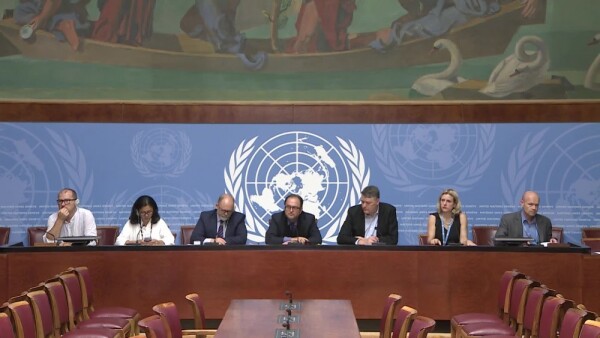
Bi-weekly press briefing: Northern Syria update - WHO/UNHCR/OCHA/UNICEF/WFP
Shelling and clashes in northern Syria on the border with Turkey continue to cause hundreds of people to flee, the UN said today (18 Oct), despite a cessation of hostilities deal between Turkish forces and Syrian-backed Kurdish military.
Hailed as a ceasefire by some Governments and a five-day pause in hostilities by others, the agreement comes nine days into a military campaign launched by Turkey against Kurdish-held territory on its southern border, east of the Euphrates river.
“Despite the announcement of the ceasefire – it’s called different things, pauses by others – shelling and intermittent clashes continue to be reported around Ras-al-Ain as of this morning, although the situation is reportedly calm elsewhere,” said Jens Laerke from the Office for the Coordination of Humanitarian Affairs (OCHA).
Updating journalists in Geneva, several UN agencies confirmed that they were continuing to deliver aid and provide basic services in the conflict zone “where access allows.”
Highlighting critical needs, the World Health Organization (WHO) appealed for the humanitarian response to be scaled-up urgently.
Spokesperson Tarik Jasarevic noted that 40 tonnes of medical supplies had been airlifted from Damascus to Qamishli earlier this week, while Ras al Ain and Tal Abyad hospitals remain closed.
This has made Tal Tamr Hospital “the main reception point for wounded persons coming from conflict at Ras al Ain”, he explained, before adding that it has “struggled to cope of the influx of patients and patients”, who have been sent to Al Hasakeh and Qamishli.
The WHO supplies – which include more than 100,000 treatments and 620 trauma kits – will be distributed to WHO-supported facilities in Al-Hasakeh, rural Ar-Raqqa and rural Deir-ez-Zor.
Meanwhile, the World Food Programme (WFP) announced on Friday that it plans reach 580,000 people in affected areas this month.
Since 9 October, the UN agency has provided assistance to 170,000 people, spokesperson Herve Verhoosel said, expressing concern at the mass displacement caused by the violence.
“There are more than 165,000 people on the move in the north-east, and they seek shelter in Al-Hassakeh and in Raqqa,” he said. “Many people in those cities choose to stay with family and friends rather than in collective shelters, so that figure in fact can even be higher.”
Lack of drinking water to hundreds of thousands of people is still a serious concern in Al-Hassakeh, UN Children’s Fund (UNICEF) said.
“The Alouk water pumping station in Hassakeh is still non-functional due to the damage on the main power lines, affecting water supply to 400,000 people,” said Marixie Mercado, spokesperson.
“Deconfliction is needed to allow UNICEF to supply 16,000 litres of fuel on a daily basis in order to run the back-up generators.”
Asked to comment on Turkey’s reported wish to send home nearly four million Syrian refugees who have been sheltering in the country for years, UNHCR’s Mr. Mahecic replied that it had not seen any proposals “from any party.”
Reiterating the agency’s stance on the return of refugees, he insisted that any return of refugees to Syria or any other place in the world “has to be voluntary, it has to be dignified and it has to be safe at the time when it is safe to return.”
1. Wide shot, exterior, Palais des Nations flag alley
2. Wide shot, podium with speakers
3. SOUNDBITE (English) Jens Laerke, spokesperson, Office for the Coordination of Humanitarian Affairs (OCHA):
“Despite the announcement of the ceasefire – it’s called different things, pauses by others – shelling and intermittent clashes continue to be reported around Ras-al-Ain as of this morning, although the situation is reportedly calm elsewhere.”
4. Wide shot, podium with speakers
5. SOUNDBITE (English) Tarik Jasarevic, spokesperson, World Health Organization (WHO):
“Tal Tamr Hospital has been the main reception point for wounded persons coming from the conflict zone at Ras al Ain. The hospital has struggled to cope of the influx of patients and patients have been subsequently referred onwards to Al Hasakeh and Qamishli.”
6. Wide shot, TV camera and journalists
7. SOUNDBITE (English) Hervé Verhoosel senior spokesperson, World Food Programme (WFP):
“There are more than 165,000 people on the move in the north-east, and they seek shelter in Hasakeh and in Raqqa. Many people in those cities choose to stay with family and friends rather than in collective shelters, so that figure in fact can even be higher.”
8. Wide shot, journalists
9. SOUNDBITE (English) Andrej Mahecic, spokesperson, UN Refugee Agency (UNHCR):
“Another 734 refugees have entered Iraq last night. That is in addition to the 1,600 that we have moved to Bardarash camp over the past four days.”
10. Med shot, journalists
11. SOUNDBITE (English) Marixie Mercado, spokesperson, UN Children’s Fund (UNICEF):
“The Alouk water pumping station in Hassakeh is still non-functional due to the damage on the main power lines, affecting water supply to 400,000 people. Deconfliction is needed to allow UNICEF to supply 16,000 litres of fuel on a daily basis in order to run the back-up generators.”
12. Med shot, journalists on their laptops
13. SOUNDBITE (English) Andrej Mahecic, spokesperson, UN Refugee Agency (UNHCR):
“We haven’t seen any specific proposals from any party to these talks, so there nothing specific for us to comment about. You know our global position on the return of refugees that any return of refugees to Syria or any other place in the world has to be voluntary, it has to be dignified and it has to be safe at the time when it is safe to return.”
14. Med shot, journalist working on laptop
15. Wide shot, journalists
16. Med shot, TV camera operators
Similar Stories

1
1
1
Edited News | OCHA , UNICEF , WFP
Aid agencies warned on Friday of the fast-developing humanitarian emergency inside Taiz City in Yemen, which has been encircled by de facto Houthi forces fighting government troops along the country’s west coast.

2
17
1
2
Edited News , Press Conferences , Images | OCHA , WMO
Two UN agencies teamed up on Wednesday to issue an appeal for immediate assistance to help communities already being impacted by the strongest El Niño on record.

3
16
2
2
Edited News , B-roll , Conferences , Images | UNITED NATIONS , UNOG
Sixth Consultative Meeting on Enhancing Coordination of Peace Initiatives and Efforts for Sudan

1
1
1
Edited News | UNICEF , WHO , UNHCR
Yemen war continues to force families from homes amid hunger and disease
More than 250,000 people have now fled renewed fighting in Yemen, the UN said on Tuesday, citing particular concern for those sheltering in the southwestern city of Taiz and the wider governorate, where access is “essentially blocked”.

1
1
1
Edited News | UNICEF
A little over one year since a ceasefire agreement was announced between Hamas fighters and Israel, more than 340 children have been reported killed and hundreds more injured, the UN Children’s Fund, UNICEF, said on Friday.

1
1
1
Edited News | UNICEF , IFRC
Six weeks after Nepal’s deadly flooding disaster, communities are still struggling to rebuild their lives, but they will need sustained help as global warming increases the risk of another Himalayan catastrophe, the UN Children’s Fund (UNICEF) said on Friday.

1
1
1
Edited News | WHO
In suspected Russia plague death, testing and monitoring underway – WHO
The death of a lab worker in Russia’s Siberia region has sparked concerns about plague being the cause, the UN World Health Organization (WHO) said on Tuesday, adding that it was following the situation closely.

1
1
Edited News | OHCHR , UNOG
UN Human Rights Chief Volker Türk on Friday provided and oral update to the 63rd session of the Human rights Council on Ukraine.

1
1
1
Edited News | OHCHR , UNOG
UN Human Rights Chief Volker Türk on Friday provided and oral update to the 63rd session of the Human rights Council on the human rights situation in Haiti.

1
1
1
Edited News | WHO
Repeated delays in bringing lifesaving medicines, prosthetics and more from Israel into Gaza risk having devastating consequences on Palestinians who urgently need them in the wartorn enclave, the UN World Health Organization (WHO) said on Friday. “A truck full of non-priority supplies or the right supplies arriving too late, doesn't save lives. That's the question that actually matters," said Dr Reinhilde Van De Weerdt, WHO Representative in the OPT.

1
1
1
Edited News | WHO
DRC: Early access to care and oxygen decisive for Ebola patients’ survival – WHO
In the Democratic Republic of the Congo (DRC), health workers fighting the country’s largest-ever Ebola outbreak are struggling to overcome critical challenges to patient care, the UN World Health Organization (WHO) warned on Tuesday.

1
1
1
Edited News | OCHA , UN
Civilians in Iran are continuing to feel the consequences of months of conflict and military escalation, the UN’s top official in the country has said, as loss of life, damage to civilian infrastructure and mounting economic pressures leave many facing continued uncertainty.