

The United Nations Office at Geneva
Multimedia Newsroom
STORYLINE
Human Rights Council mulls call for probe into Iran crisis
UN human rights chief Volker Türk called on Thursday for an independent investigation into ongoing deadly violence against protesters in Iran, where security forces have used “live ammunition, birdshot and other metal pellets, teargas and batons”, he told the Human Rights Council in Geneva.
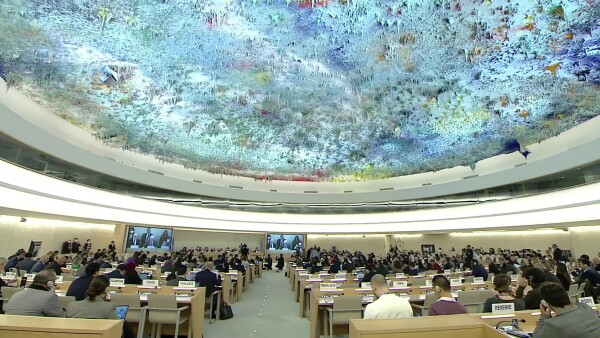
Meeting in special session at the request of Germany in response to ongoing protests in Iran that were sparked by the death in September in police custody of 22-year-old Jina Mahsa Amini, Mr. Türk criticized the “the fortress mentality of those who wield power” in Iran, before insisting that the “unnecessary and disproportionate use of force” must end.
“It pains me to see what is happening in the country,” he told the packed chamber. “The images of children killed. Of women beaten in the streets. Of people sentenced to death.”
The UN High Commissioner highlighted how the security forces, “notably the Islamic Revolutionary Guard Corps and Basij forces have used live ammunition, birdshot and other metal pellets, teargas and batons” against the protest movement as it has spread into a reported 150 cities and 140 universities in all provinces of Iran.
Before calling for an independent probe into all rights violations, the High Commissioner noted that his Office had received “multiple communications” from Iran about the episode, “including domestic investigations”. These efforts “have failed to meet international standards of impartiality, independence and transparency”, Mr. Türk said.
Responding to the High Commissioner’s comments, Iran’s representative, Khadijeh Karimi, Deputy of the Vice President for Women and Family Affairs, insisted that after Ms. Amini’s death, “necessary measures” had been taken to seek justice by the Government. These included the formation of an independent, parliamentary investigation commission as well as a forensic medical team.
“However, before the formal announcement of the probe analysis, the biased and hasty reaction of a number of Western authorities and their interventions in internal affairs of Iran, turned the peaceful assemblies into riots and violence,” she maintained.
Also speaking at the Special Session – the Council’s 35th since it was founded in 2005 - Javaid Rehman, Special Rapporteur on the situation of human rights in Iran insisted that in the past week, efforts to silence the protesters had intensified, including against children.
At least 60 to 70 persons have been killed, he said, including five children, mostly from Kurdish areas. He also described as “alarming” the situation in the Kurdish cities of Piranshahr, Javanrood and Mahabad.
“The Iranian Government has consistently presented unsubstantiated reports and reiterated assertions claiming that Jina Mahsa did not die as a result of any violence or beatings,” he said. “In other reports, the Government refutes the killings of children by security forces, claiming that they committed suicide, fell from a height, were poisoned or killed by anonymous ‘enemy agents’.”
These are three of an estimated 400 who have been killed because they stood up for their right to determine their own life.
Since Ms. Amini’s death following her arrest by Iran’s so-called Morality Police on 13 September, more than 300 people have been killed, including at least 40 children, according to latest UN human rights office information.
At least 15,000 people have been arrested too “and the Iranian regime is now threatening protesters with the death penalty,” said Germany’s Foreign Minister, Annalena Baerbock: “And why? Only because these women, men and children want to enjoy the rights we all want to enjoy: to live in dignity and without discrimination.”
Echoing that message, United States Ambassador (Human Rights) Michèle Taylor told the Council that the people of Iran were “asking for something so simple, something that most of us here take for granted: the opportunity to speak and to be heard. We applaud their courage, especially the women, girls and young people who are bravely demanding respect for their human rights and accountability for abuses.”
ends
STORY: Special Session on Iran – Human Rights Council
TRT: 3 mins 48s
SOURCE: UNTV CH
RESTRICTIONS: NONE
LANGUAGE: ENGLISH / NATS
ASPECT RATIO: 16:9
DATELINE: 24 November 2022 GENEVA, SWITZERLAND
SHOTLIST
- Exterior wide shot, flag alley, Palais des Nations.
- Exterior wide shot, Human Rights Council, UN Geneva.
- SOUNDBITE (English) — Volker Türk, UN High Commissioner for Human Rights: “It pains me to see what is happening in the country. The images of children killed. Of women beaten in the streets. Of people sentenced to death.”
- Medium-wide, delegates including those from Iraq, Iran, Solomon Islands and Ukraine.
- SOUNDBITE (English) — Volker Türk, UN High Commissioner for Human Rights: “The security forces, notably the Islamic Revolutionary Guard Corps and Basij forces have used live ammunition, birdshot and other metal pellets, teargas and batons.”
- Medium-wide, myriad delegates including from Costa Rica, Croatia, Oman and Paraguay.
- SOUNDBITE (English) — Volker Türk, UN High Commissioner for Human Rights: “My Office has received multiple communications from the Government on the events, including domestic investigations into Miss Amini’s death. We remain concerned that the investigations have failed to meet international standards of impartiality, independence and transparency.”
- Medium: delegate from Iran.
- SOUNDBITE (English) — Volker Türk, UN High Commissioner for Human Rights: “I therefore call for independent, impartial and transparent investigative processes into alleged violations of human rights that are consistent with international standards.”
- Wide, panel of speakers including Human Rights Council President Federico Villegas.
- SOUNDBITE (English) — Khadijeh Karimi, Deputy of the Vice President for Women and Family Affairs of the Islamic Republic of Iran: “After the unfortunate decease of Miss Mahsa Amini, necessary measures were undertaken, including (the) planned formation of an independent, parliamentary investigation commission as well as a forensic medical team. However, before the formal announcement of the probe analysis, the biased and hasty reaction of a number of Western authorities and their interventions in internal affairs of Iran, turned the peaceful assemblies into riots and violence.”
- Medium-wide, panel of speakers including Javaid Rehman, Special Rapporteur on the situation of human rights in the Islamic Republic of Iran and on behalf of the Coordination Committee of Special Procedures
- SOUNDBITE (English) Javaid Rehman, Special Rapporteur on the situation of human rights in the Islamic Republic of Iran: “In the past seven days alone, crackdown on protests has intensified with at least 60 to 70 persons killed, including five children, most of them from Kurdish areas. The situation in the Kurdish cities of Piranshahr, Javanrood and Mahabad is alarming.”
- Medium, German delegation.
- SOUNDBITE (English) Javaid Rehman, Special Rapporteur on the situation of human rights in the Islamic Republic of Iran: “The Iranian Government has consistently presented unsubstantiated reports and reiterated assertions claiming that Jina Mahsa did not die as a result of any violence or beatings. In other reports, the Government refutes the killings of children by security forces, claiming that they committed suicide, fell from a height, were poisoned or killed by anonymous ‘enemy agents’.”
- Medium-wide, U.S. delegation in foreground.
- SOUNDBITE (English) — Germany’s Foreign Minister, Annalena Baerbock: “Way more than 15,000 have been arrested and the Iranian regime is now threatening protesters with the death penalty. And why? Only because these women, men and children want to enjoy the rights we all want to enjoy: to live in dignity and without discrimination.”
- Medium-wide, delegates including Belarus, Belgium, Singapore and Slovakia.
- SOUNDBITE (English) — United States Ambassador Michèle Taylor: “The people of Iran are demanding something so simple, something that most of us here take for granted: the opportunity to speak and to be heard. We applaud their courage, especially the women, girls and young people who are bravely demanding respect for their human rights and accountability for abuses.”
- Medium-wide, civil society representatives.
- Medium, U.S. delegation holds up A3 sheets containing names of alleged victims and photos.
- Medium-wide, panning, delegates including Austria, Bahrain, Bangladesh, Eritrea, Malaysia and Saudi Arabia.
Similar Stories

1
1
1
Edited News | OCHA , UNICEF , WFP
Aid agencies warned on Friday of the fast-developing humanitarian emergency inside Taiz City in Yemen, which has been encircled by de facto Houthi forces fighting government troops along the country’s west coast.

2
17
1
2
Edited News , Press Conferences , Images | OCHA , WMO
Two UN agencies teamed up on Wednesday to issue an appeal for immediate assistance to help communities already being impacted by the strongest El Niño on record.

3
16
2
2
Edited News , B-roll , Conferences , Images | UNITED NATIONS , UNOG
Sixth Consultative Meeting on Enhancing Coordination of Peace Initiatives and Efforts for Sudan

1
1
1
Edited News | UNICEF , WHO , UNHCR
Yemen war continues to force families from homes amid hunger and disease
More than 250,000 people have now fled renewed fighting in Yemen, the UN said on Tuesday, citing particular concern for those sheltering in the southwestern city of Taiz and the wider governorate, where access is “essentially blocked”.

1
1
1
Edited News | UNICEF
A little over one year since a ceasefire agreement was announced between Hamas fighters and Israel, more than 340 children have been reported killed and hundreds more injured, the UN Children’s Fund, UNICEF, said on Friday.

1
1
1
Edited News | UNICEF , IFRC
Six weeks after Nepal’s deadly flooding disaster, communities are still struggling to rebuild their lives, but they will need sustained help as global warming increases the risk of another Himalayan catastrophe, the UN Children’s Fund (UNICEF) said on Friday.

1
1
1
Edited News | WHO
In suspected Russia plague death, testing and monitoring underway – WHO
The death of a lab worker in Russia’s Siberia region has sparked concerns about plague being the cause, the UN World Health Organization (WHO) said on Tuesday, adding that it was following the situation closely.

1
1
Edited News | OHCHR , UNOG
UN Human Rights Chief Volker Türk on Friday provided and oral update to the 63rd session of the Human rights Council on Ukraine.

1
1
1
Edited News | OHCHR , UNOG
UN Human Rights Chief Volker Türk on Friday provided and oral update to the 63rd session of the Human rights Council on the human rights situation in Haiti.

1
1
1
Edited News | WHO
Repeated delays in bringing lifesaving medicines, prosthetics and more from Israel into Gaza risk having devastating consequences on Palestinians who urgently need them in the wartorn enclave, the UN World Health Organization (WHO) said on Friday. “A truck full of non-priority supplies or the right supplies arriving too late, doesn't save lives. That's the question that actually matters," said Dr Reinhilde Van De Weerdt, WHO Representative in the OPT.

1
1
1
Edited News | WHO
DRC: Early access to care and oxygen decisive for Ebola patients’ survival – WHO
In the Democratic Republic of the Congo (DRC), health workers fighting the country’s largest-ever Ebola outbreak are struggling to overcome critical challenges to patient care, the UN World Health Organization (WHO) warned on Tuesday.

1
1
1
Edited News | OCHA , UN
Civilians in Iran are continuing to feel the consequences of months of conflict and military escalation, the UN’s top official in the country has said, as loss of life, damage to civilian infrastructure and mounting economic pressures leave many facing continued uncertainty.