

The United Nations Office at Geneva
Multimedia Newsroom
Edited News | OHCHR , UNHCR , UNOG , UNITED NATIONS
UNOG-NEWS Rohingya Joint Response Plan 03MAR2020
Myanamar doing too little to ensure return of displaced Rohingya, says UN refugee agency chief
UN agencies together with the Bangladesh authorities have appealed for $877 million to support hundreds of thousands of Rohingya refugees from Myanmar, where conditions are still not conducive for their safe return, UN refugee agency chief Filippo Grandi said on Tuesday.
Speaking on the sidelines of the 2020 Joint Response Plan (JRP) launch for 855,000 ethnic Rohingya and more than 444,000 vulnerable Bangladeshis in host communities, Mr Grandi urged Myanmar to take quicker action to help the displaced to return home.
“The solution continues to be in Myanmar,” the High Commissioner for Refugees said. “The problem is that things that need to be done there, to create conditions for refugees to return from Bangladesh into Myanmar, are too slow or not happening yet.”
In August 2017, a military operation in Myanmar’s Rakhine state in response to separatist violence prompted hundreds of thousands of ethnic Rohingya to flee.
At the time, then High Commissioner for Human Rights Zeid Ra’ad Al Hussein likened the episode to “textbook example of ethnic cleansing”.
Reporting to the Human Rights Council, he also cited reports of Myanmar authorities laying landmines along the border with Bangladesh and requiring returnees to provide “proof of nationality” - an impossibility, given that successive Myanmar governments have since 1962 progressively stripped the Rohingya population of their political and civil rights, including citizenship rights.
At the current Human Rights Council session in Geneva, Zeid’s successor, Michelle Bachelet, noted that for over half a century, the policies of Myanmar had discriminated against religious and ethnic minorities.
Addressing Member States last week, she also said that the Government of Myanmar now had an historic opportunity to counteract systematic violations “by bringing its people together, as one".
Listing the specific requirements of returning Rohingya refugees, Mr Grandi explained that they needed “freedom of movement, return of internally displaced people that are in camps in Rakhine state, respect of housing, land, property”.
They also needed “clarity on the pathway to citizenship that various commissions have indicated as being the fundamental step that needs to be taken”, the High Commissioner for Refugees insisted, in reference to recommendations by UN-appointed panels of experts.
Standing alongside head of the UN migration agency António Vitorino, Mr Grandi added: “There needs to be clarity in the minds of the refugees of what that means, in order for them not to be discriminated and to get eventually full integration in their own country, in their own society.”
In the months and years that followed the exodus from Rakhine state, Bangladesh has continued to host Rohingya refugees in a series of refugee camps in the south-east of the country, in an area known as Cox’s Bazar, along with host communities.
Highlighting the need for continued international assistance for Bangladesh, Shahriar Alam from the Bangladesh Ministry of Foreign Affairs noted that in the first 17 days alone after the exodus began, almost half a million Rohingya crossed into Bangladesh.
“We expect the UN Member countries to do more and work with me and do everything possible to put pressure on Myanmar to take their citizenship back…repatriation that is safe, voluntary and dignified,” he said.
According to UNHCR, IOM and the Bangladesh authorities, the 2020 appeal places stronger emphasis on supporting host communities that have taken in Rohingya refugees and fostering their well-being.
They need help with public service infrastructure – in particular, to reduce the impact of seasonal monsoon flooding - and access to sustainable livelihoods, along with initiatives to rehabilitate the environment linked to sustainable energy initiatives.
All Rohingya refugee households now use Liquefied Petroleum Gas (LPG) for cooking, which has led to a staggering 80 per cent drop in demand for firewood, the UN agencies said in a statement.
Some 30,000 local Bangladeshi families are also included in the initiative.
The introduction of LPG, together with reforestation measures, has resulted in a remarkable “re-greening” of the areas in Cox’s Bazar District where the Rohingya refugees are living, the appeal organisers maintained.
The appeal’s other objectives include strengthening protection for refugee women, men, girls and boys; delivering life-saving assistance to those in need and working towards sustainable solutions in Myanmar in line with the internationally agreed Sustainable Development Goals agenda.
Latest UN data shows that the 2019 Joint Response Plan was just over 70 per cent funded, meaning that donors provided $650 million against the $921 million requested.
- Wide shot: exterior, flag alley, Palais des Nations, United Nations Geneva.
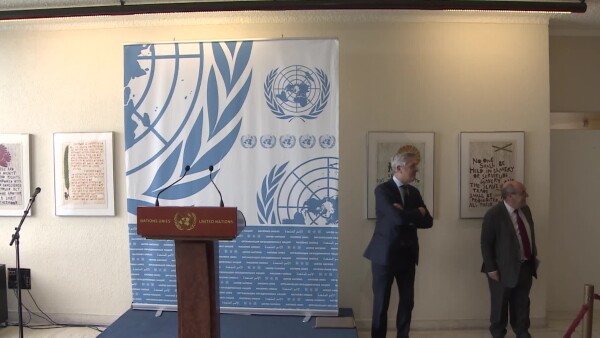
- Wide shot: Filippo Grandi, United Nations High Commissioner for Refugees, followed by António Vitorino, Director General, International Organization for Migration, walking towards podium from right of shot, with lectern and backdrop screen with UN logo.
- SOUNDBITE (EN) — Filippo Grandi, United Nations High Commissioner for Refugees: “The solution continues to be in Myanmar. The problem is that things that need to be done there, to create conditions for refugees to return from Bangladesh into Myanmar, are too slow or not happening yet.”
- Medium shot: reporters taking notes, photographers.
- SOUNDBITE (EN) — Filippo Grandi, United Nations High Commissioner for Refugees: “Freedom of movement, return of internally displaced people that are in camps in Rakhine state, respect of housing, land, property.”
- Medium shot: onlookers, journalists, TV cameras.
- SOUNDBITE (EN) — Filippo Grandi, United Nations High Commissioner for Refugees: “And more important than anything else, is clarity on the pathway to citizenship that various commissions have indicated as being the fundamental step that needs to be taken.”
- Close-up: journalist writing notes on notepad.
- SOUNDBITE (EN) — Filippo Grandi, United Nations High Commissioner for Refugees: “There needs to be clarity in the minds of the refugees of what that means, in order for them not to be discriminated and to get eventually full integration in their own country, in their own society.”
- Medium shot: TV camera monitors showing speaker at podium.
- SOUNDBITE (EN) — Shahriar Alam, Ministry of Foreign Affairs, Government of Bangladesh: “We expect the UN Member countries to do more and work with me and do everything possible to put pressure on Myanmar to take their citizenship back in a manner; repatriation that is safe, voluntary and dignified.”
- Wide shot: stakeout area, journalists, TV cameras, photographers, podium area.
- Medium shot: TV camera monitor showing Bangladesh minister speaking at podium and in rear of shot.
- Close-up: reporter’s hands taking notes on notepad.
- Wide shot: from below, stakeout area, journalists, TV cameras, photographers, podium area.
Similar Stories

1
1
1
Edited News | UNICEF
A little over one year since a ceasefire agreement was announced between Hamas fighters and Israel, more than 340 children have been reported killed and hundreds more injured, the UN Children’s Fund, UNICEF, said on Friday.

1
1
1
Edited News | UNICEF , IFRC
Six weeks after Nepal’s deadly flooding disaster, communities are still struggling to rebuild their lives, but they will need sustained help as global warming increases the risk of another Himalayan catastrophe, the UN Children’s Fund (UNICEF) said on Friday.

1
1
1
Edited News | WHO
In suspected Russia plague death, testing and monitoring underway – WHO
The death of a lab worker in Russia’s Siberia region has sparked concerns about plague being the cause, the UN World Health Organization (WHO) said on Tuesday, adding that it was following the situation closely.

1
1
Edited News | OHCHR , UNOG
UN Human Rights Chief Volker Türk on Friday provided and oral update to the 63rd session of the Human rights Council on Ukraine.

1
1
1
Edited News | OHCHR , UNOG
UN Human Rights Chief Volker Türk on Friday provided and oral update to the 63rd session of the Human rights Council on the human rights situation in Haiti.

1
1
1
Edited News | WHO
Repeated delays in bringing lifesaving medicines, prosthetics and more from Israel into Gaza risk having devastating consequences on Palestinians who urgently need them in the wartorn enclave, the UN World Health Organization (WHO) said on Friday. “A truck full of non-priority supplies or the right supplies arriving too late, doesn't save lives. That's the question that actually matters," said Dr Reinhilde Van De Weerdt, WHO Representative in the OPT.

1
1
1
Edited News | WHO
DRC: Early access to care and oxygen decisive for Ebola patients’ survival – WHO
In the Democratic Republic of the Congo (DRC), health workers fighting the country’s largest-ever Ebola outbreak are struggling to overcome critical challenges to patient care, the UN World Health Organization (WHO) warned on Tuesday.

1
1
1
Edited News | OCHA , UN
Civilians in Iran are continuing to feel the consequences of months of conflict and military escalation, the UN’s top official in the country has said, as loss of life, damage to civilian infrastructure and mounting economic pressures leave many facing continued uncertainty.
1
1
1
Edited News | WHO , UNICEF
Aid agencies in Yemen highlighted the growing hunger emergency sparked by renewed fighting between Houthi opposition forces and Government troops, after mobile health clinics reported that hundreds of children displaced by the violence are suffering from the most deadly form of malnutrition.
1
1
1
Edited News | UNHCR
Displacement on the rise in Yemen as fighting continues - UNHCR
As hostilities worsen in Yemen, more people have been fleeing their homes, further intensifying the humanitarian crisis within the region, the UN Refugee Agency (UNHCR) warned on Tuesday.
1
1
1
Edited News | IOM , OHCHR , UNFPA , UNOG , UNHCR , WHO
Yemen’s humanitarian crisis growing by the hour amid spike in displacement
Yemenis displaced by renewed fighting have described fleeing for their lives amid shelling and gunfire, aid agencies reported on Friday, while highlighting the dramatic increase in humanitarian needs in the country and in Djibouti, where thousands have sought shelter.
1
1
1
Edited News | OHCHR , UNOG
The UN Human Rights Office issued on Friday a report documenting a shocking pattern of sexual violence amid Russia’s full-scale armed attack on Ukraine.