

The United Nations Office at Geneva
Multimedia Newsroom
Press Conferences | FAO , OHCHR , UNECE , UNEP , UNHCR , WHO , WIPO , WMO
Bi-Weekly Press Briefing 27 September 2022
PRESS BRIEFING BY THE UNITED NATIONS INFORMATION SERVICE
27 September 2022
Iran protests
Alessandra Vellucci, for the United Nations Information Service, reminded that the previous day, the UN Deputy Spokesman had called on the Iranian security forces to refrain from using unnecessary or disproportionate force and appealed to all to exercise restraint to avoid further escalation of the protests which had erupted following the death in custody of 22-year-old Mahsa Amini, who had been arrested on 13 September for allegedly not wearing a hijab in full compliance with Iran’s mandatory requirements for how women ought to dress. UN also called on the authorities to respect women's rights and to eliminate all forms of discrimination against women and girls.
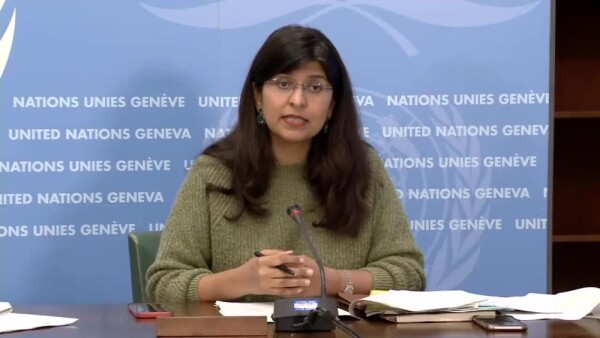
Ravina Shamdasani, for the Office of the High Commissioner for Human Rights (OHCHR), stated that the OHCHR was very concerned by the continued violent response by security forces to protests in Iran, as well as communications restrictions affecting landline and mobile usage, the Internet and social media platforms. Thousands had joined anti-government demonstrations throughout the country over the past 11 days. Security forces had responded at times with live ammunition. Many Iranians had been killed, injured, and detained during the protests.
OHCHR reiterated its call upon the Iranian authorities to fully respect the rights to freedom of opinion, expression, peaceful assembly and association, as a State party to the International Covenant on Civil and Political Rights.
OHCHR statement is available here.
Replying to questions, Ms. Shamdasani said that the OHCHR did not have its own people on the ground but did have reliable sources in the country. One credible NGO had reported that the death toll had already reached 76 individuals in 15 provinces. Over the years, the OHCHR had consistently raised concerns with the Government of Iran regarding freedom of assembly and women’s rights. She reminded that women had been protesting against mandatory hijab for four decades now, many of whom had been harassed, beaten up, or arrested. She could not confirm how many women had been arrested for removing their hijabs in the current protests. OHCHR called on the Government to stop vilifying the protesters.
Russia protests
Ravina Shamdasani, for the Office of the High Commissioner for Human Rights (OHCHR), said that the OHCHR was deeply disturbed by the large number of people who had reportedly been arrested in the Russian Federation for protesting after the authorities announced a partial mobilization of troops in the context of the armed conflict in Ukraine. As of 26 September, according to credible reports, some 2,377 demonstrators had been arrested in various locations across the country. It was unclear how many people remained in detention. She stressed that arresting people solely for exercising their rights of peaceful assembly and freedom of expression constituted an arbitrary deprivation of liberty.
Full OHCHR statement can be accessed here.
Ms. Shamdasani, replying to questions, said that the OHCHR had no access to prisoners of war held in the Russian-occupied territories of Ukraine. OHCHR continued to examine forced deportations of protected persons, which was against the international human rights law. OHCHR continued to ask for access to the Russia-controlled areas of Ukraine. On the mobilization in Russia, Ms. Shamdasani said that conscientious objections to the war ought to be respected by the authorities.
Boris Cheshirkov, for the United Nations Refugee Agency (UNHCR), said that it was a fundamental human right to seek asylum. Official statistics regarding numbers of people leaving Russia was not yet available. People might be leaving for a variety of reasons, and time was needed to collect and analyze any emerging trends.
Political violence in Brazil
Ravina Shamdasani, for the Office of the High Commissioner for Human Rights (OHCHR), responding to a question on the political violence ahead of the 2 October election in Brazil, stressed that the OHCHR was calling on all political parties and their supporters to refrain from violence in the lead-up to the election.
Outbreak of Ebola disease caused by Sudan Virus
Carla Drysdale, for the World Health Organization (WHO), said that on 20 September, the Uganda authorities had announced an outbreak of Ebola disease caused by Sudan Virus. This was the first time in more than a decade that Uganda had declared an outbreak caused by Sudan Virus. The affected areas were located near a busy road in Mubende district, central Uganda. A cumulative number of over 40 cases, some confirmed and some suspected, had been reported so far; 13 confirmed cases were currently hospitalized. WHO experts were already on the ground, and while there was no vaccine to treat Sudan Virus, a number of other measures were possible to help contain the virus and increase the chances of survival for those affected. More information is available here.
Dr. Ana Maria Henao-Restrepo, Co-lead R&D Blueprint for Epidemics with the Health Emergencies Programme of the World Health Organization (WHO), said that two international consultations had been held with all vaccine developers to see which vaccines could be moved forward. Three of those vaccines could be tested in a randomized trial in Uganda, should the Ugandan authorities agree. She stressed that there was no preclinical or clinical evidence to support the claim that the current vaccines, which were already in use, would be able to protect against the Sudan Virus. The best approach to evaluate the candidate vaccines would be to put them to use in the areas where the virus could be currently found. There was no efficacy data against the Sudan Virus as of today, all other control measures ought to be implemented without delay, she stressed.
Responding to questions, Dr. Henao-Restrepo said that the last outbreak of Ebola disease caused by the Sudan Virus had been about one decade earlier. In the past, many Ebola outbreaks, caused by different viruses, had been successfully controlled by a number of public health measures, she said. Surveillance and contact tracing were being prioritized right now so as to grasp the scope of the current outbreak.
6,000 Congolese refugees return home from Zambia
Boris Cheshirkov, for the United Nations Refugee Agency (UNHCR), informed that the UNHCR, with the Governments of Zambia and the Democratic Republic of the Congo, had helped nearly 6,000 Congolese refugees to return home since December 2021. The refugees had fled political and inter-ethnic clashes in the DRC's south-east region in 2017 and had found safety in Zambia. They had expressed excitement and joy at returning home and looked forward to reuniting with family and friends and starting their lives anew.
Mr. Cheshirkov explained that the voluntary repatriation of Congolese refugees was conducted on the basis of the tripartite agreement signed in 2006 by UNHCR and the Governments of Zambia and the DRC. Voluntary repatriation required a full commitment by the country of origin to help reintegrate its own people and the continuing support of the international community.
UNHCR statement can be found here.
Tropical cyclone activity
Clare Nullis, for the World Meteorological Organization (WMO), said that it was the peak of a tropical cyclone season. Over the weekend, hurricane Fiona had left a trail of destruction from the Caribbean to Canada. This week, hurricane Ian had become a category three hurricane today and was currently hitting western Cuba. WMO’s regional specialized centre in Miami was warning of life-threatening conditions, as the eye of the storm went over western Cuba and approached the west coast of Florida. The highest risk was in the heavily populated, low-lying areas from Fort Myers to the Tampa Bay area. Very heavy rainfall was expected, with 12 to 16 inches in central Florida, which could cause flash flooding and mudslides. Both Cuba and Florida were well prepared, which gave hope that casualties would be kept to the minimum.
In other part of the world, typhon Noru in the Philippines had intensified rapidly, hitting the areas of the country which were home to two million people, where a big relief operation was now underway. A positive aspect was that the Philippines had been well prepared. The typhoon was now heading towards Vietnam, where it should make a landfall around 28 September.
International Day of Awareness of Food Loss and Waste
Rosa Rolle, Team Leader, Food Losses and Waste at the Food and Nutrition Division of the Food and Agriculture Organization (FAO), speaking from Rome, said that food losses and waste were a global problem. Over the past two years, agri-food systems had been affected by the pandemic, climate change, and the war in Ukraine. A considerable quantity of food was lost in food chain, prior to retail, she said. Reducing food loss and waste was critical for making agri-food systems more efficient and sustainable, and for securing food around the world. A global virtual event to commemorate this international day would be held on 29 September at 4 pm.
Mark Radka, Chief, Energy and Climate Branch of the United Nations Environment Programme (UNEP), connecting from Paris, said that one of the goals was to raise awareness among consumers on what they could do to cut food waste. About 20 percent of all food available for human consumption was being wasted, warned Mr. Radka. There was evidence that household food waste was generated at similar per capita levels regardless of the country’s income levels. Food waste counted for some 8 to 10 percent of global greenhouse emissions – an issue largely overlooked by country’s national determined contributions under Agenda 2030. UNEP recognized that developing countries needed support in both measuring and limiting the scope of waste.
More details on the International Day of Awareness of Food Loss and Waste are here.
Ninth Environment for Europe Ministerial Conference
Jean Rodriguez, for the United Nations Economic Commission for Europe (UNECE), informed that Ministers from 56 countries of the UNECE Region would gather in Nicosia, Cyprus from 5 to 7 October 2022 for the highest regional UN body meeting on environmental policy. Over the past three decades, this body had adopted a number of important initiatives, which continued to add value to the involved countries. Such cooperation was a good example of what multilateralism could deliver, stressed the UNECE Executive Secretary Olga Algayerova. The three themes of the upcoming Ministerial Conference would be: greening the economy and working towards sustainable infrastructure; applying circular economy to sustainable tourism; and advancing education for sustainable development. Mr. Rodriguez said that this was the first time this Ministerial Conference would take place in the Mediterranean region, and countries outside of Europe from the Mediterranean region were also invited to participate. A ministerial statement was expected to be adopted at the end of the event.
Alejandro Laguna, for the United Nations Environment Programme (UNEP), said that on 5 October, a press release would be issued on pan-European environmental assessment; it would be shared under embargo, along with a fact sheet, on 3 October. It was expected that on the last day of the conference, 7 October, another press release would cover the ministerial statement, informed Mr. Laguna.
Further information is available here.
Human Rights Council
Rolando Gomez, for the Human Rights Council (HRC), said that today, the Council was discussing the future of the right to work in connection with climate change actions. Around noon, the general debate on country situations would continue. On 28 September, HRC would discuss the rights of indigenous peoples, especially in the context of COVID-19. Negative impacts of colonialism on human rights would also be on the agenda on 28 September. Thus far, seven draft resolutions and decisions had been tabled, and the deadline to submit draft texts would be on 28 September; a total of 40 texts were expected. Mr. Gomez confirmed that a draft text on the situation of Uyghurs in China had been tabled; if adopted, this topic would be put on the Council’s agenda at its following session. No draft text on Russia had been submitted yet, said Mr. Gomez in response to questions.
Announcements
Edward Harris, for the World Intellectual Property Organization (WIPO), informed that on 28 September at 10:30 am, WIPO would hold an embargoed virtual press conference to present the 2022 edition of its flagship Global Innovation Index, whose ranking documented the leaders in worldwide innovative activity.
Alessandra Vellucci, for the United Nations Information Service, speaking on behalf of the International Telecommunications Union (ITU), informed that the ITU Plenipotentiary Conference (PP-22) had formally opened in Bucharest on 26 September. Decisions made in Romania would determine the direction and priorities of ITU as it helped shape the future of the information society. Elections of ITU’s leadership team would start on 29 September.
On 28 September 2:30 pm, the International Trade Center would launch its SME Competitiveness Outlook flagship report, focusing on connected services, being transport and logistics, financial services, information and communications technologies, and business and professional services. Speakers would be Pamela Coke-Hamilton, ITC Executive Director, and Barbara Ramos, ITC, Chief, Research and Strategies for Exports.
The Committee on the Protection of the Rights of All Migrant Workers and Members of Their Families would hold this afternoon a general discussion on its future General Comment 6 on the convergence of the Convention and the Global Compact for Migration.
The Committee on Economic, Social and Cultural Rights would begin this morning the review of the report of Mongolia and continue this afternoon consideration of the report of El Salvador.
Ms. Vellucci also informed that today at 3:30 pm, the Committee on Enforced Disappearances would hold a press conference to present findings on Mali, Czechia, and Uruguay.
Finally, Ms. Vellucci informed that today was the World Tourism Day, on which occasion a message by the Secretary-General had been shared.
Similar Stories

1
1
1
Press Conferences | UNHCR
End of UNHCR's 77th Annual Executive Committee (ExCom) meeting week

1
1
1
Press Conferences | UNICEF , IOM , UNHCR
UN Special Assistant to the Personal Envoy Office (SUDAN): Peace Initiatives and Efforts in Sudan; UNICEF: Dire situation of children in Gaza; IOM: Damaged Homes and Energy Attacks Risk Displacing Ukrainians for this winter; UNHCR: update on EXCOM week

1
1
1
Press Conferences | IOM , UNDRR
UN stresses importance of household preparedness for disaster risk reduction.

1
1
1
Statements , Press Conferences | OHCHR

1
1
1
Press Conferences | UNHCR , UNICEF , IFRC , OHCHR , UN WOMEN , IOM , OCHA , WHO
UNHCR – ExCom Meeting, UNICEF – Nepal Recovery, IFRC – Flash Floods, WHO – Mental Health, IOM – South Sudan Floods, OCHA – DRC Humanitarian aid, UNHCR – Sahel Displacement, UNICEF – Yemen Update, IOM – Gaza Shelter, UN Women – Gaza Women, OHCHR – Arrests and detentions of Syrians by Israeli force

2
1
2
Press Conferences | UNCTAD
Presentation of the Trade and Developement Report 2026
Embargoed until 9 October 2026 at 11 a.m. (Geneva Time)
UNCTAD: UNCTAD’s flagship report finds that governments increasingly use industrial, trade, financial and technology policies to pursue economic and national security objectives. Market access and the ability to move into higher-value activities now depend more heavily on technology, finance and geopolitics.

1
1
1
Press Conferences | UPU
Release of the State of the Postal Sector Report 2026
1
1
1
Press Conferences | IOM , ITU , UNECE , UNICEF , WHO , WMO
UNICEF: Ebola, DRC - children orphans or separating them from parents and caregivers; IOM: Humanitarian needs in Djibouti amid arrivals from Yemen and increased migrant movements; WHO: Darfur, scale of health needs far exceeds available resources; WMO co-sponsored Global Heat Forum, Bangkok, monthly Global Seasonal Climate Update; UNECE: UN Forum of Mayors; ITU Plenipotentiary Conference 2026; WHO: child and adolescent obesity guidelines and new global roadmap to tackle pregnancy hypertension, a leading cause of maternal mortality
1
1
1
Press Conferences | OCHA , UN WOMEN , UNHCR , WFP , WHO , WTO , UNEP
OCHA – $160M CERF allocation to 12 underfunded crises; UNHCR – 5.8M refugee children remain out of school amid funding cuts; UN Women – Middle East escalation and food security among women/girls; WHO – Gaza supplies and overall situation; WFP – Yemen food insecurity and impact on global hunger ; UNEP - First International Conference of the Global Framework on Chemicals in Geneva | 16-20 November 2026
1
1
1
Press Conferences | UNHCR , WHO
Yemen's health system nears collapse amid conflict, causing rising casualties and medicine shortages.
1
1
1
Press Conferences | HRC
Update by the Expert Mechanism to Advance Racial Justice and Equality in Law Enforcement
1
1
1
Press Conferences | WIPO , WHO , UNICEF , UNHCR , IOM , WFP , FAO
WIPO Global Innovation Index 2026 launch and press conference, WHO Composition of influenza vaccines for the 2027 Southern Hemisphere flu season, UNICEF Yemen hunger and malnutrition; UNHCR Sudan displacement into Chad; IOM Ebola and population movements in DRC; WFP emergency food assistance in Nepal; and FAO food loss and waste.