

The United Nations Office at Geneva
Multimedia Newsroom
People’s rights to privacy is coming under even greater pressure from the use of modern networked digital technologies whose features make them formidable tools for surveillance, control and oppression, a new UN report has warned.
Speaking to the media today at the United Nations in Geneva, a spokesperson for the UN Human Rights Office (OHCHR), Elizabeth Throssell, said that “the report details how surveillance tools such as the ‘Pegasus’ software, can turn most smartphones into ‘24 hour surveillance devices’, allowing the ‘intruder’ not only access to everything on our phones, but also weaponizing them to spy on our lives.”
This latest report on privacy in the digital age by OHCHR looks at use of intrusive hacking tools (“spyware”) by State authorities, the role of robust encryption methods in protecting human rights online, and the impacts of widespread digital monitoring of public spaces, both offline and online.
“Digital technologies bring enormous benefits to society, but pervasive surveillance comes at a high cost, undermining rights and choking the development of vibrant pluralistic democracies », said Ms. Throssel. «The right to privacy is more at risk than ever before, and this is why action is needed and needed now.”
The report also cautions that government interference with encrypted communications, and indiscriminate surveilling of the public would de facto not meet the standards of proportionality, necessity and effectiveness as required under international human rights law.
“While such spyware tools are purportedly deployed to combat terrorism and crime, they have often been used for illegitimate reasons », reported Ms Throssel. «For example, to clamp down on critical or dissenting views and on those who express them, including journalists, opposition political figures and human rights defenders.”
The report reiterates OHCHR’s call for a moratorium on the sale, transfer and use of hacking tools until a human rights-based safeguards regime is in place.
According to Liz Throssel, “urgent steps are needed to address the spread of spyware ». She added that “the report reiterates the call for a moratorium on the use and sale of hacking tools until adequate safeguards to protect human rights are in place. Authorities should only hack a personal advice as a last resort to, as the report says, ‘prevent or investigate a specific act amounting to a serious threat to national security or a specific serious crime.’ ”
Governments often fail to adequately inform the public about their surveillance activities, and even where surveillance tools are initially rolled out for legitimate goals, they can easily be repurposed, often serving ends for which they were not originally intended.
Ms Throssel added that “the report also raises the alarm about the growing surveillance of public spaces. Now, previous practical limitations on the scope of surveillance have been swept away by large scale automated collection and analysis of data, as well as new digitized identity systems and extensive biometric databases that greatly facilitate the breadth of such surveillance measures.”
Such deep interference with the right to privacy can have a profound negative impact on democracy, free expression and the enjoyment of many other human rights. This is why, the report recalls, any interference with the right to privacy, whether that be hacking, restrictions to access and use of encryption technology or surveillance of the public, must comply with international human rights law.
-ends-
- Medium shot, UN Geneva flag alley.
- Wide shot, press room with panel of speakers.
- SOUNDBITE (ENGLISH) Elizabeth Throssell, spokesperson for OHCHR: “The report details how surveillance tools such as the ‘Pegasus’ software, can turn most smartphones into ‘24 hour surveillance devices’, allowing the ‘intruder’ not only access to everything on our phones, but also weaponizing them to spy on our lives.”
- Close up shot, camera screen showing speaker.
- SOUNDBITE (ENGLISH) Elizabeth Throssell, spokesperson for OHCHR: “Digital technologies bring enormous benefits to society, but pervasive surveillance comes at a high cost, undermining rights and choking the development of vibrant pluralistic democracies. The right to privacy is more at risk than ever before, and this is why action is needed and needed now.”
- Medium shot,
- SOUNDBITE (ENGLISH) Elizabeth Throssell, spokesperson for OHCHR: “While such spyware tools are purportedly deployed to combat terrorism and crime, they have often been used for illegitimate reasons. For example, to clamp down on critical or dissenting views and on those who express them, including journalists, opposition political figures and human rights defenders.”
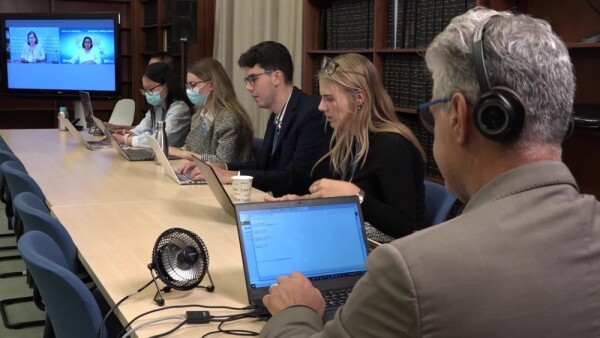
- Medium shot, journalists taking notes.
- SOUNDBITE (ENGLISH) Elizabeth Throssell, spokesperson for OHCHR: “Urgent steps are needed to address the spread of spyware. The report reiterates the call for a moratorium on the use and sale of hacking tools until adequate safeguards to protect human rights are in place. Authorities should only hack a personal advice as a last resort to, as the report says, ‘prevent or investigate a specific act amounting to a serious threat to national security or a specific serious crime.’ ”
- Close up shot, journalists taking notes.
- SOUNDBITE (ENGLISH) Elizabeth Throssell, spokesperson for OHCHR: “The report also raises the alarm about the growing surveillance of public space Now, previous practical limitations on the scope of surveillance have been swept away by large scale automated collection and analysis of data, as well as new digitized identity systems and extensive biometric databases that greatly facilitate the breadth of such surveillance measures.”
- Medium shot, pressroom, journalists taking notes.
- Medium shot, journalist taking notes.
- Medium shot, screen showing speakers.
Similar Stories

1
1
1
Edited News | OCHA , UNICEF , WFP
Aid agencies warned on Friday of the fast-developing humanitarian emergency inside Taiz City in Yemen, which has been encircled by de facto Houthi forces fighting government troops along the country’s west coast.

2
17
1
2
Edited News , Press Conferences , Images | OCHA , WMO
Two UN agencies teamed up on Wednesday to issue an appeal for immediate assistance to help communities already being impacted by the strongest El Niño on record.

3
16
2
2
Edited News , B-roll , Conferences , Images | UNITED NATIONS , UNOG
Sixth Consultative Meeting on Enhancing Coordination of Peace Initiatives and Efforts for Sudan

1
1
1
Edited News | UNICEF , WHO , UNHCR
Yemen war continues to force families from homes amid hunger and disease
More than 250,000 people have now fled renewed fighting in Yemen, the UN said on Tuesday, citing particular concern for those sheltering in the southwestern city of Taiz and the wider governorate, where access is “essentially blocked”.

1
1
1
Edited News | UNICEF
A little over one year since a ceasefire agreement was announced between Hamas fighters and Israel, more than 340 children have been reported killed and hundreds more injured, the UN Children’s Fund, UNICEF, said on Friday.

1
1
1
Edited News | UNICEF , IFRC
Six weeks after Nepal’s deadly flooding disaster, communities are still struggling to rebuild their lives, but they will need sustained help as global warming increases the risk of another Himalayan catastrophe, the UN Children’s Fund (UNICEF) said on Friday.

1
1
1
Edited News | WHO
In suspected Russia plague death, testing and monitoring underway – WHO
The death of a lab worker in Russia’s Siberia region has sparked concerns about plague being the cause, the UN World Health Organization (WHO) said on Tuesday, adding that it was following the situation closely.

1
1
Edited News | OHCHR , UNOG
UN Human Rights Chief Volker Türk on Friday provided and oral update to the 63rd session of the Human rights Council on Ukraine.

1
1
1
Edited News | OHCHR , UNOG
UN Human Rights Chief Volker Türk on Friday provided and oral update to the 63rd session of the Human rights Council on the human rights situation in Haiti.

1
1
1
Edited News | WHO
Repeated delays in bringing lifesaving medicines, prosthetics and more from Israel into Gaza risk having devastating consequences on Palestinians who urgently need them in the wartorn enclave, the UN World Health Organization (WHO) said on Friday. “A truck full of non-priority supplies or the right supplies arriving too late, doesn't save lives. That's the question that actually matters," said Dr Reinhilde Van De Weerdt, WHO Representative in the OPT.

1
1
1
Edited News | WHO
DRC: Early access to care and oxygen decisive for Ebola patients’ survival – WHO
In the Democratic Republic of the Congo (DRC), health workers fighting the country’s largest-ever Ebola outbreak are struggling to overcome critical challenges to patient care, the UN World Health Organization (WHO) warned on Tuesday.

1
1
1
Edited News | OCHA , UN
Civilians in Iran are continuing to feel the consequences of months of conflict and military escalation, the UN’s top official in the country has said, as loss of life, damage to civilian infrastructure and mounting economic pressures leave many facing continued uncertainty.