

The United Nations Office at Geneva
Multimedia Newsroom
Human Rights Committee presents its findings on the political and civil rights in Hong Kong Special Administrative Region (SAR), China.
Speakers:
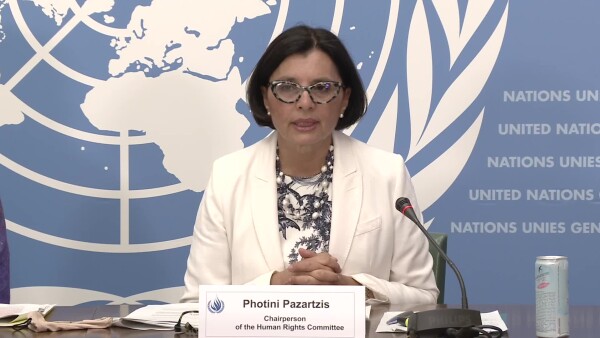
- Photini PAZARTZIS, Chairperson of the Committee
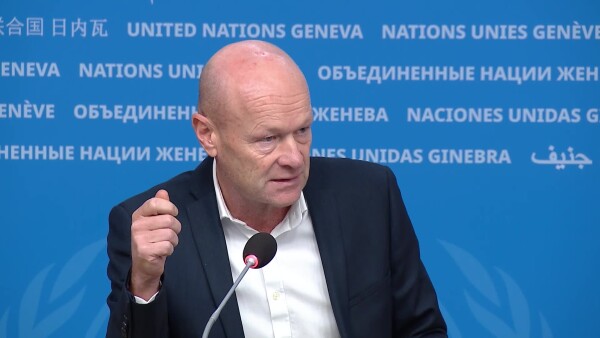
- Christopher Arif BULKAN, Vice-chair of the Committee
- Vasilka SANCIN, Vice-chair of the Committee
Top rights experts urge repeal of Hong Kong’s national security law
Independent UN-appointed human rights experts who have urged China to repeal Hong Kong’s 2020 national security law (NSL) after claiming that its use had led to the arrest of children, said on Wednesday that they welcomed pledges to replace it with a more transparent and consultative process.
Chinese and Hong Kong officials have said the law, imposed “overnight” by Beijing in June 2020, was necessary to restore and safeguard stability after anti-government and anti-China demonstrations erupted in 2019.
The UN Human Rights Committee underscored the shortcomings of the National Security Law (NSL), including its lack of clarity on “national security” and the possibility of transferring cases from Hong Kong to mainland China.
“There was a lot of discussions on recent legislation, including Hong Kong National Security Law. I think there was a constructive discussion on those issues and the committee did raise its concerns,” said Photini Pazartzis, Chairperson of the Human Rights Committee, at a press conference in Geneva.
The panel urged Hong Kong to repeal the national security law and, in the meantime, refrain from applying it.
“The Committee was deeply concerned about the overly broad interpretation of Hong Kong National Security Law, the NSL, which was passed by the National People’s Congress of China without consultation with the Hong Kong’s public,” said vice chair, Christopher Arif Balkan. He added that since it was introduced in 2020, the NSL had reportedly led to the arrests of “over 200 people, including 12 children.”
The Committee monitors the application of the International Covenant on Civil and Political Rights (ICCPR) by State parties. It released its findings on Hong Kong following a scheduled review in Geneva.
The Hong Kong Special Administrative Region is a signatory to the Covenant for investigation, prosecution, trial and execution of penalties, but mainland China is not.
“Once a State party has subscribed to the Covenant, there is an obligation that those rights are paramount. In other words, your local legislation cannot derogate from those rights. There are human rights, after all, universal rights,” explained Mr. Arif Balkan. “China is not a party to the ICCPR. But then China can implement the NSL within Hong Kong. So that creates a lacuna for residents of Hong Kong,” he added.
Hong Kong returned to Chinese rule in 1997 with the guarantee of a high level of autonomy, including freedom of expression. Representatives of the semi-autonomous territory informed the Committee that they were contemplating new national security legislation. The Committee members said they hoped the law could be amended for the better.
“They gave us assurances, that there would be transparency, consultation in enacting a new security law,” said Mr. Arif Balkan.
The UN Human Rights Committee published its findings on Hong Kong, China, among other countries, after the closing of its 135th session on Wednesday in the Swiss city.
The findings contained the Committee's main concerns and recommendations on the implementation of the International Covenant on Civil and Political Rights, as well as positive aspects.
The Human Rights Committee monitors States parties’ compliance with the International Covenant on Civil and Political Rights. It has been ratified by 173 States parties. The Committee is made up of 18 members who are independent human rights experts drawn from around the world, who serve in their personal capacity and not as representatives of States parties.
Ends
STORY: Human Rights Committee on Hong Kong Special Administrative Region (SAR), China
TRT: 02’23”
SOURCE: UNTV CH
RESTRICTIONS: NONE
LANGUAGE: ENGLISH/NATS
ASPECT RATIO: 16:9
DATELINE: Wednesday 27 July 2022, GENEVA, SWITZERLAND
SHOTLIST
-
- Medium shot, UN Geneva flag alley.
- Wide shot, press room with panel of speakers.
- SOUNDBITE (ENGLISH) Photini PAZARTZIS, Chairperson of the Human Rights Committee: “There was a lot of discussions on recent legislation, including Hong Kong National Security Law. I think there was a constructive discussion on those issues and the committee did raise its concerns.”
- Medium shot, lateral, journalists and photographer.
- SOUNDBITE (ENGLISH) Christopher Arif BULKAN, Vice-chair of the Committee: “The committee was deeply concerned about the overly-broad interpretation of Hong Kong’s National Security Law, the NSL, which was passed by the National People’s Congress of China without consultation with the Hong Kong Since its enactment in 2020, the NSL has reportedly led to the arrests of over 200 people, including 12 children.”
- Medium shot, journalist.
- SOUNDBITE (ENGLISH) Christopher Arif BULKAN, Vice-chair of the Committee: “Once a State party has subscribed to it, is party to the Covenant, there is an obligation that those rights are paramount. In other words, your local legislation cannot detract from it, cannot derogate from those rights. They are human rights, after all, universal rights.”
- Medium shot, journalist, laptop in foreground, blurred.
- SOUNDBITE (ENGLISH) Christopher Arif BULKAN, Vice-chair of the Committee: “China is not a party to the ICCPR. So, there is this conundrum, if you will, that China is not a party but then China can implement the NSL within Hong Kong. So that creates a sort of lacuna for residents of Hong Kong in terms of, ‘Where do you get redress?’”
- Medium shot of journalists and UN staff in the press room.
- SOUNDBITE (ENGLISH) Christopher Arif BULKAN, Vice-chair of the Committee: “In light of the fact that they are considering a new national security law and given the fact, the criticisms of the existing one that was imposed overnight in 2020, whether they would have an inclusive, transparent process in doing so; and they gave us assurances which we welcomed, that in enacting a new security law, that there would be transparency, there would be consultation and so on.”
- Various shots of press room, journalists and UN staff listening.
Similar Stories
1
1
1
Edited News | OCHA , UNICEF , WFP
Aid agencies warned on Friday of the fast-developing humanitarian emergency inside Taiz City in Yemen, which has been encircled by de facto Houthi forces fighting government troops along the country’s west coast.

2
17
1
2
Edited News , Press Conferences , Images | OCHA , WMO
Two UN agencies teamed up on Wednesday to issue an appeal for immediate assistance to help communities already being impacted by the strongest El Niño on record.

3
16
2
2
Edited News , B-roll , Conferences , Images | UNITED NATIONS , UNOG
Sixth Consultative Meeting on Enhancing Coordination of Peace Initiatives and Efforts for Sudan

1
1
1
Edited News | UNICEF , WHO , UNHCR
Yemen war continues to force families from homes amid hunger and disease
More than 250,000 people have now fled renewed fighting in Yemen, the UN said on Tuesday, citing particular concern for those sheltering in the southwestern city of Taiz and the wider governorate, where access is “essentially blocked”.

1
1
1
Edited News | UNICEF
A little over one year since a ceasefire agreement was announced between Hamas fighters and Israel, more than 340 children have been reported killed and hundreds more injured, the UN Children’s Fund, UNICEF, said on Friday.

1
1
1
Edited News | UNICEF , IFRC
Six weeks after Nepal’s deadly flooding disaster, communities are still struggling to rebuild their lives, but they will need sustained help as global warming increases the risk of another Himalayan catastrophe, the UN Children’s Fund (UNICEF) said on Friday.

1
1
1
Edited News | WHO
In suspected Russia plague death, testing and monitoring underway – WHO
The death of a lab worker in Russia’s Siberia region has sparked concerns about plague being the cause, the UN World Health Organization (WHO) said on Tuesday, adding that it was following the situation closely.

1
1
Edited News | OHCHR , UNOG
UN Human Rights Chief Volker Türk on Friday provided and oral update to the 63rd session of the Human rights Council on Ukraine.

1
1
1
Edited News | OHCHR , UNOG
UN Human Rights Chief Volker Türk on Friday provided and oral update to the 63rd session of the Human rights Council on the human rights situation in Haiti.

1
1
1
Edited News | WHO
Repeated delays in bringing lifesaving medicines, prosthetics and more from Israel into Gaza risk having devastating consequences on Palestinians who urgently need them in the wartorn enclave, the UN World Health Organization (WHO) said on Friday. “A truck full of non-priority supplies or the right supplies arriving too late, doesn't save lives. That's the question that actually matters," said Dr Reinhilde Van De Weerdt, WHO Representative in the OPT.

1
1
1
Edited News | WHO
DRC: Early access to care and oxygen decisive for Ebola patients’ survival – WHO
In the Democratic Republic of the Congo (DRC), health workers fighting the country’s largest-ever Ebola outbreak are struggling to overcome critical challenges to patient care, the UN World Health Organization (WHO) warned on Tuesday.

1
1
1
Edited News | OCHA , UN
Civilians in Iran are continuing to feel the consequences of months of conflict and military escalation, the UN’s top official in the country has said, as loss of life, damage to civilian infrastructure and mounting economic pressures leave many facing continued uncertainty.