

The United Nations Office at Geneva
Multimedia Newsroom
Edited News | UNESCO , UNHCR
Bi-Weekly Press Briefing: UNHCR Expands Operations in Poland for Ukrainian Refugees 27 May 2022
Amid rising needs of vulnerable Ukrainian refugees arriving to Poland, the UN Refugee Agency (UNHCR) has scaled up its activities in the country to provide aid as Poland continues to be the main country of arrival for Ukrainian refugees. More than 3.5 million have entered the country since the beginning of the war on 24 February.
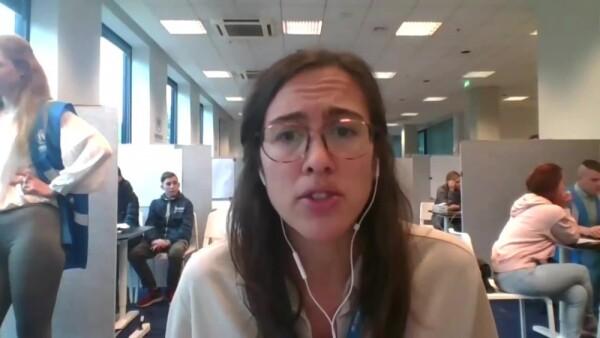
Speaking from Warsaw at a news briefing at the United Nations in Geneva, UNHCR’s spokesperson Olga Sarrado said that “newly arrived refugees often come from areas heavily affected by the fighting, some having spent weeks hiding in bomb shelters and basements”. She added that “they often arrive in a state of distress and anxiety, having left family members behind, without a clear plan for where to go, and with less economic resources and connections than those who fled earlier”.
Noting that “the pace of arrivals has slowed down in comparison to early March, when over 100,000 people were arriving per day, to around 20,000 daily in the course of May”, Olga Sarrado said that “we have also seen more ‘pendular’ movements, where people go back and forth across the border to Ukraine for various reasons, including visiting families, checking their properties or returning to their jobs”.
Health services and medical needs are the main queries UNHCR staff receive from refugees. Other requests concern transportation, financial support, psychosocial needs, accommodation and access to social services, including for people with disabilities and older people.
UNHCR estimates that roughly “about 50 per cent of them would like to stay in Poland”. According to Olga Sarrado “the Polish authorities were mentioning as well that in between 1.5 to 2 million would be staying in their country.”
Given the large internal displacement due to the massive destruction and the ongoing hostilities in Ukraine, Poland expects to continue receiving large numbers of refugees.
Poland has put in place systems to ensure legal stay, access to employment, education, health care and other social welfare schemes for Ukrainian refugees.
“Over 1.1 million have registered with the Polish authorities, meaning they have received a state ID number (called PESEL), which gives them access to the services; 94 per cent of those registered are women and children”, said Ms. Sarrado.
UNHCR rolled out its cash assistance programme in March. As of today, UNHCR has established eight cash enrollment centres in the main refugee hosting areas, including Warsaw, Krakow, Poznan, Wroclaw, Ostroda, Gdynia and Gdansk. Over 100,000 refugees from Ukraine have already received financial support from UNHCR to cover their basic needs, such as paying rent or buying food and medicine.
According to UNHCR’s Ms Sarrado, “almost 20 per cent of those refugees that enrolled for cash assistance have specific needs.” She added that ”aid is provided to serious medical cases, older people, single mothers without family support, women at risk and people with disabilities and half of the children with specific needs are separated or unaccompanied.”
Cash is provided for a three-month period to those most in need until they can better support themselves or be included in government social protection systems.
-ends-
- Exterior medium shot, United Nations flag alley, a sunny day.
- Medium shot, participants typing on laptops in the foreground with TV screen showing speaker delivering the speech in the background.
- SOUNDBITE (English): Olga Sarrado, UNHCR spokesperson (from Poland): “The pace of arrivals has slowed down in comparison to early March, when over 100,000 people were arriving per day, to around 20,000 daily in the course of May.”
- Close-up, TV screen showing the speaker is delivering the speech.
- SOUNDBITE (English): Olga Sarrado, UNHCR spokesperson (from Poland): “We have also seen more ‘pendular’ movements, where people go back and forth across the border to Ukraine for various reasons, including visiting families, checking their properties or returning to their jobs.”
- Close-up, fingers typing on the laptop.
- SOUNDBITE (English): Olga Sarrado, UNHCR spokesperson (from Poland): “Our estimates, because of the interviews that we are doing in border monitoring, roughly say that about 50 per cent of them would like to stay in Poland. And actually, yesterday the Polish authorities were mentioning as well that in between 1.5 to 2 million would be staying in their country.”
- Close-up, fingers typing on the laptop.
- SOUNDBITE (English): Olga Sarrado, UNHCR spokesperson (from Poland): “Newly arrived refugees often come from areas heavily affected by the fighting, some having spent weeks hiding in bomb shelters and basements. They often arrive in a state of distress and anxiety, having left family members behind, without a clear plan on where to go, and with less economic resources and connections than those who fled before.”
- Close-up, participants, blurred, with TV screen showing Olga Sarrado delivering remote message to rear.
- SOUNDBITE (English): Olga Sarrado, UNHCR spokesperson (from Poland): “Over 1.1 million have registered with the Polish authorities, meaning, they have received a state ID number (called PESEL), which gives them access to the services; 94 per cent of those registered are women and children.”
- Medium shot, two participants, seated, following the press conference.
- SOUNDBITE (English): Olga Sarrado, UNHCR spokesperson (from Poland): “Almost 20 per cent of those refugees that enrolled for cash assistance have specific needs. Aid is provided to serious medical cases, older people, single mothers without family support, women at risk and people with disabilities and half of the children with specific needs are separated or unaccompanied.”
- Medium shot, two participants in front of their laptops, with TV screen showing speaker to rear.
- Close-up, participant with TV screen showing speaker delivering the speech to rear.
- Medium shot, participants seated, a journalist is holding a microphone and asking questions.
- Close-up, participants listening.
- Exterior wide shot, United Nations flag flying, a sunny day.
Similar Stories

1
1
1
Edited News | OCHA , UNICEF , WFP
Aid agencies warned on Friday of the fast-developing humanitarian emergency inside Taiz City in Yemen, which has been encircled by de facto Houthi forces fighting government troops along the country’s west coast.

2
17
1
2
Edited News , Press Conferences , Images | OCHA , WMO
Two UN agencies teamed up on Wednesday to issue an appeal for immediate assistance to help communities already being impacted by the strongest El Niño on record.

3
16
2
2
Edited News , B-roll , Conferences , Images | UNITED NATIONS , UNOG
Sixth Consultative Meeting on Enhancing Coordination of Peace Initiatives and Efforts for Sudan

1
1
1
Edited News | UNICEF , WHO , UNHCR
Yemen war continues to force families from homes amid hunger and disease
More than 250,000 people have now fled renewed fighting in Yemen, the UN said on Tuesday, citing particular concern for those sheltering in the southwestern city of Taiz and the wider governorate, where access is “essentially blocked”.

1
1
1
Edited News | UNICEF
A little over one year since a ceasefire agreement was announced between Hamas fighters and Israel, more than 340 children have been reported killed and hundreds more injured, the UN Children’s Fund, UNICEF, said on Friday.

1
1
1
Edited News | UNICEF , IFRC
Six weeks after Nepal’s deadly flooding disaster, communities are still struggling to rebuild their lives, but they will need sustained help as global warming increases the risk of another Himalayan catastrophe, the UN Children’s Fund (UNICEF) said on Friday.

1
1
1
Edited News | WHO
In suspected Russia plague death, testing and monitoring underway – WHO
The death of a lab worker in Russia’s Siberia region has sparked concerns about plague being the cause, the UN World Health Organization (WHO) said on Tuesday, adding that it was following the situation closely.

1
1
Edited News | OHCHR , UNOG
UN Human Rights Chief Volker Türk on Friday provided and oral update to the 63rd session of the Human rights Council on Ukraine.

1
1
1
Edited News | OHCHR , UNOG
UN Human Rights Chief Volker Türk on Friday provided and oral update to the 63rd session of the Human rights Council on the human rights situation in Haiti.

1
1
1
Edited News | WHO
Repeated delays in bringing lifesaving medicines, prosthetics and more from Israel into Gaza risk having devastating consequences on Palestinians who urgently need them in the wartorn enclave, the UN World Health Organization (WHO) said on Friday. “A truck full of non-priority supplies or the right supplies arriving too late, doesn't save lives. That's the question that actually matters," said Dr Reinhilde Van De Weerdt, WHO Representative in the OPT.

1
1
1
Edited News | WHO
DRC: Early access to care and oxygen decisive for Ebola patients’ survival – WHO
In the Democratic Republic of the Congo (DRC), health workers fighting the country’s largest-ever Ebola outbreak are struggling to overcome critical challenges to patient care, the UN World Health Organization (WHO) warned on Tuesday.

1
1
1
Edited News | OCHA , UN
Civilians in Iran are continuing to feel the consequences of months of conflict and military escalation, the UN’s top official in the country has said, as loss of life, damage to civilian infrastructure and mounting economic pressures leave many facing continued uncertainty.