

The United Nations Office at Geneva
Multimedia Newsroom
Edited News | OHCHR , UNITED NATIONS
Ukraine Urgent Debate Human Rights Council 03 March 2022 Afternoon
Date: 03.03.2022
Duration: 3’05”
Ukraine urgent debate – Afternoon
Statements from Poland, the EU, Germany, Venezuela, the US, China and Great Britain.
STORYLINE
Urgent debate on Ukraine continues at the UN Human Rights Council, with statements from Poland, the EU, Germany, Venezuela, the US, China and Great Britain.
The urgent debate was requested by Ukraine to consider a draft resolution on the human rights situation in the country, following Russia’s invasion. The 47 members of the council convened in Geneva to discuss whether to set up a commission to investigate alleged violations of international human rights and international law in Ukraine.
The draft resolution condemns Russia’s invasion, demands the withdrawal of its troops, and calls for the urgent establishment of an independent international commission of inquiry.
In a video message screened at the council this afternoon, Polish foreign minister insisted the aggression conducted by the Russian Federation with the support of Belarus must stop. A strong supporter of the creation of a commission of inquiry, Mr Zbigniew Rau said “it is crucial to ensure that all perpetrators of these violations are brought to justice. Poland strongly underlines the needs to establish international inquiry for all humanitarian violations committed by Russia in Ukraine.”
A position France, speaking on behalf of the European Union as it holds the presidency of its council, shared. Ambassador Jérôme Bonafont underlined Russia was “manipulating facts with no shame, using the word genocide clearly defined by the UN.”
Concerns about manipulation and misinformation were also reiterated by German Ambassador to the UN. “The Human Rights Council must not be misused as a platform for misinformation”, emphasized Ms Katharina Stasch. “This is not only an attack on Ukraine, this is an attack on the freedom and values of all of us. Almost all countries in the world have a big neighbor: stronger than itself. Do we want to live in a world in which the strong and powerful can attack the less powerful? Do we want to live in a world that is then only watching? My answer is no”.
Russia claims its invasion into Ukraine is a “special operation” aiming to “demilitarize” and “de-nazify” Ukraine’s cabinet. Western governments responded imposing sanctions against Moscow. Measures that will only intensify the crisis said the Ambassador of Venezuela who “rejected the coercive and unilateral measures against Russia.”
For the US, the Human Rights Council must send a clear and unmistakable message. With 6’000 anti-war Russian demonstrators detained according to Washington, US Ambassador Sheba Crocker underlined “the Russian people are not our enemy. We applaud those brave Russians who are risking their personal safety by peacefully protesting their government terrible and mistaken war”.
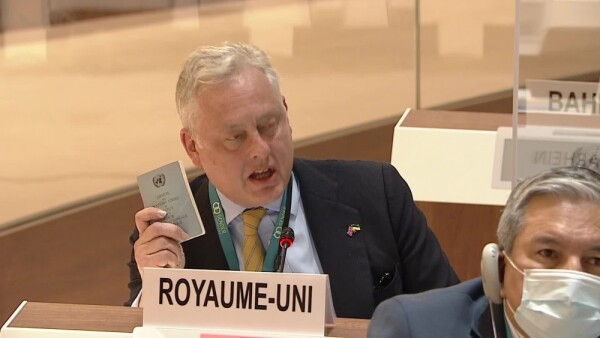
One million refugees have fled Ukraine in just a week. China, who said no to sanctioning Russia, explained it opposes the “politicization of Human Rights issues, using them as a pretext to exert pressure on other countries. “We don’t support any act that may stimulate conflict”, added Mr Chen Xu, Ambassador to the UN, in total disagreement with his British counterpart. “There are multiple allegations of war crimes as a result of the Russian military action. It is unconscionable, to think that a fellow member of this council, a nation that fought so courageously with us to defeat fascism, would commit this egregious violation. President Putin has proved he has no respect for Human Rights, the UN charter or international law,” said Mr Simon Manley.
A commission of inquiry is one of the strongest tools the HRC can use to promote accountability and counter impunity for grave rights violations. Its findings may lead to political sanctions.
Ends
- Flags alley at UN Geneva
- SOUNDBITE (English) Polish Foreign minister Mr Zbigniew Rau “it is crucial to ensure that all perpetrators of these violations are brought to justice. Poland strongly underlines the needs to establish international inquiry for all humanitarian violations committed by Russia in Ukraine.”
- Cutaway
- SOUNDBITE (French) French Ambassador to the UN in Geneva Jérôme Bonafont: “La Russie cherche à réécrire l’histoire, elle manipule les faits de manière éhontée, elle utilise cyniquement la notion de génocide pour justifier son agression. Il s’agit d’un abus dangereux d’un terme clairement défini par les Nations Unies. Aucun des rapports de l’ONU, du conseil de l’Europe ou de l’OSCE ne soutient ces affirmations mensongères et sans fondement.»
- Cutaway
- SOUNDBITE (English) German Ambassador to the UN, Ms Katharina Stasch: “This is not only an attack on Ukraine, this is an attack on the freedom and values of all of us. Almost all countries in the world have a big neighbor: stronger than itself. Do we want to live in a world in which the strong and powerful can attack the less powerful? Do we want to live in a world that is then only watching: my answer is no.
- Cutaway
- SOUNDBITE (Spanish) Ambassador of Venezuela to the UN, Mr Hector Constant Rosales: “Rechazamos las medidas coercitivas unilaterales y de retaliación eco contra RU Ilegales sanciones que intensificaran la crisis.” Translation in English: “We reject coercive measures, economic and financial retaliation against Russia which will intensify the crisis.”
- Cutaway
- SOUNDBITE (English) US Ambassador to the UN, Ms Sheba Crocker: “The Russian people are not our enemy. We applaud those brave Russians who are risking their personal safety by Peacefully protesting their government terrible and mistaken war”.
- Cutaway
- SOUNDBITE (Chinese) Chinese Ambassador to the UN, Mr Chen Xu: “China always opposes the politization of Human Rights issues, opposes using Human Rights issues as a pretext to exert pressure on other countries. Therefore, we oppose establishing Commission of Inquiry on Ukraine. We don’t support any act that may stimulate conflict.”
- Cutaway
- SOUNDBITE (English) Simon Manley, UK Permanent Representative to the UN in Geneva: “There are multiple allegations of war crimes as a result of the Russian military action. It is unconscionable, to think that a fellow member of this council, a nation that fought so courageously with us to defeat fascism, would commit this egregious violation. President Putin has proved he has no respect for Human Rights, the UN charter or international law.”
- Cutaway on Ukraine Ambassador
- Zoom out Human Rights Council room
Similar Stories

1
1
1
Edited News | UNICEF
A little over one year since a ceasefire agreement was announced between Hamas fighters and Israel, more than 340 children have been reported killed and hundreds more injured, the UN Children’s Fund, UNICEF, said on Friday.

1
1
1
Edited News | UNICEF , IFRC
Six weeks after Nepal’s deadly flooding disaster, communities are still struggling to rebuild their lives, but they will need sustained help as global warming increases the risk of another Himalayan catastrophe, the UN Children’s Fund (UNICEF) said on Friday.

1
1
1
Edited News | WHO
In suspected Russia plague death, testing and monitoring underway – WHO
The death of a lab worker in Russia’s Siberia region has sparked concerns about plague being the cause, the UN World Health Organization (WHO) said on Tuesday, adding that it was following the situation closely.

1
1
Edited News | OHCHR , UNOG
UN Human Rights Chief Volker Türk on Friday provided and oral update to the 63rd session of the Human rights Council on Ukraine.

1
1
1
Edited News | OHCHR , UNOG
UN Human Rights Chief Volker Türk on Friday provided and oral update to the 63rd session of the Human rights Council on the human rights situation in Haiti.

1
1
1
Edited News | WHO
Repeated delays in bringing lifesaving medicines, prosthetics and more from Israel into Gaza risk having devastating consequences on Palestinians who urgently need them in the wartorn enclave, the UN World Health Organization (WHO) said on Friday. “A truck full of non-priority supplies or the right supplies arriving too late, doesn't save lives. That's the question that actually matters," said Dr Reinhilde Van De Weerdt, WHO Representative in the OPT.

1
1
1
Edited News | WHO
DRC: Early access to care and oxygen decisive for Ebola patients’ survival – WHO
In the Democratic Republic of the Congo (DRC), health workers fighting the country’s largest-ever Ebola outbreak are struggling to overcome critical challenges to patient care, the UN World Health Organization (WHO) warned on Tuesday.

1
1
1
Edited News | OCHA , UN
Civilians in Iran are continuing to feel the consequences of months of conflict and military escalation, the UN’s top official in the country has said, as loss of life, damage to civilian infrastructure and mounting economic pressures leave many facing continued uncertainty.
1
1
1
Edited News | WHO , UNICEF
Aid agencies in Yemen highlighted the growing hunger emergency sparked by renewed fighting between Houthi opposition forces and Government troops, after mobile health clinics reported that hundreds of children displaced by the violence are suffering from the most deadly form of malnutrition.
1
1
1
Edited News | UNHCR
Displacement on the rise in Yemen as fighting continues - UNHCR
As hostilities worsen in Yemen, more people have been fleeing their homes, further intensifying the humanitarian crisis within the region, the UN Refugee Agency (UNHCR) warned on Tuesday.
1
1
1
Edited News | IOM , OHCHR , UNFPA , UNOG , UNHCR , WHO
Yemen’s humanitarian crisis growing by the hour amid spike in displacement
Yemenis displaced by renewed fighting have described fleeing for their lives amid shelling and gunfire, aid agencies reported on Friday, while highlighting the dramatic increase in humanitarian needs in the country and in Djibouti, where thousands have sought shelter.
1
1
1
Edited News | OHCHR , UNOG
The UN Human Rights Office issued on Friday a report documenting a shocking pattern of sexual violence amid Russia’s full-scale armed attack on Ukraine.